

Meta Title:
Will 3D Artists Be Able to Compete With AI in the Future?
Meta Description:
AI is fast. Taste still wins. See how 3D artists stay in control as AI reshapes animation, cost, quality, and who really wins creative work.
3D Artists vs AI: Who is Going to Win the Creative War in the Future?
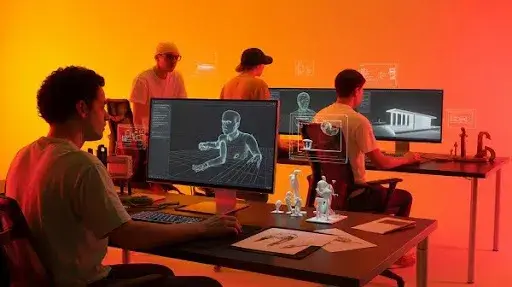
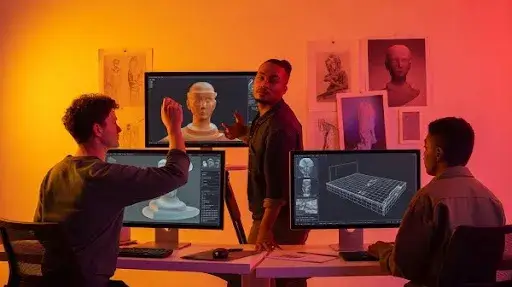
Alt text: 3D artists working on 3D animation projects
A 3D artist does not lose work to “AI.” A 3D artist loses work to speed, cheaper bids, and clients who think “good enough” is good enough.
That’s the real fight.
And it’s already happening in small ways. A brand asks for a product video by Friday. A startup wants ten concept options by tomorrow morning. A marketing team wants “one more version” after you already rendered all night.
So the question is not “AI vs humans.” The question is this: Will the 3D artist stay the person in control of taste, story, and final quality, or become the person who just cleans up machine output?
At Prolific Studio, we sit right in the middle of this shift. We run like a partner-level 3D animation studio, built to support serious brands the way top-tier studios do: clear direction, strong art choices, and production that holds up under pressure. That means we look at AI with open eyes. Not hype. Not panic.
Let’s talk straight about what’s coming, what stays human, and how a 3D artist can still win.
(CTA visual)
Anti-AI art is loud for a reason, and it is not just fear
The anti-AI art pushback is not only about jobs. A lot of it comes from real pain:
- Artists see work scraped without consent
- People see “style cloning” with no credit
- Clients start treating art like a cheap commodity
That anger is valid.
Still, a working studio has to deal with the world as it is. Clients want faster. Studios want cost control. Teams want more content.
So the practical move is to protect what matters:
- Your original characters and designs
- Your client’s brand look and assets
- Your pipeline files and private data
Then use AI in places where it helps without stealing your voice.
Hybrid workflow: the new default for a 3D animation studio
The middle ground is where most serious teams will land. Not a full manual. Not fully automated.
A hybrid workflow looks like this:
- A 3D artist sets the style, mood, and rules
- AI helps create rough options, fast tests, and boring support tasks
- The artist makes final calls and rebuilds parts that need real craft
This is already common in big production. People just call it different things.
And for brands, it’s simple. They want quality and speed. A hybrid pipeline can deliver both if the studio runs it with discipline.
Concept development with AI
The concept stage is where projects either get smooth or become chaotic.
A client brief can be vague. A client might not know what they want until they see it. That’s normal.
AI can help here in a clean way.
Prompting is not “magic,” it is just direction
A 3D artist already gives direction all day:
- “Make it feel premium”
- “More playful”
- “Less glossy”
- “Give it a stronger silhouette”
Prompt writing is the same skill, just typed out.
The advantage is speed. You can produce a range of mood options in hours, not days. Then you pick the best path and move to real production.
Mood boards that match the brief
AI can help generate:
- Mood boards
- Lighting references
- Composition ideas
- Color directions
A 3D artist still needs to curate. If you dump fifty AI images on a client, it creates confusion. If you show twelve strong options and explain why they fit, the project gets clearer fast.
Cleaner feedback loops
When concept alignment is strong, the rest of the pipeline moves faster:
- Fewer late changes
- Fewer “start over” moments
- More trust in the team
That alone can beat AI-only output, because AI-only output tends to change style every time.
3D modeling vs AI model generation
This is where a lot of people get it twisted.
Generating a model is one thing. Delivering a production-ready asset is another thing.
AI tools can generate props, rough environments, and even characters. Great. Then reality hits:
- Bad topology
- Weird edge flow
- Soft details where you need clean forms
- Wrong scale and thickness
- No rig-friendly structure
- Materials that do not match your render style
A 3D artist makes it usable.
AI model generation is best for “support assets”
AI can help generate:
- Background props
- Quick kitbash pieces
- Early blockouts
- Layout testing assets
Then a real artist upgrades it where it counts.
Where traditional 3D modeling stays king
A 3D artist still dominates in areas that need control:
- Hero characters
- Products with exact dimensions
- Mechanical parts
- Medical visuals where accuracy matters
- Branded shapes that must match real packaging
This is also where clients pay more. If a product has to look correct, they don’t want “close enough.”
3ds Max Indie, Blender, Maya, and real production
Tools still matter. Many teams run Blender. Many studios still run Autodesk software. Some freelancers prefer 3ds Max Indie for cost reasons, especially in archviz and product work.
AI does not replace your base software. It sits next to it.
The winning 3D artist learns to:
- Pull rough ideas from AI
- Rebuild inside Blender, Maya, or 3ds Max
- Keep clean scenes, naming, scale, and structure
- Deliver files that another artist can open without crying
That last part is underrated. Clients remember clean production.
3D product visualization needs trust, not random output
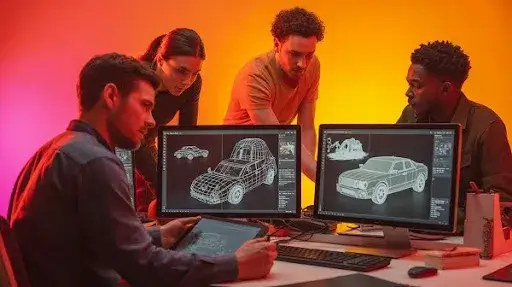
3D product visualization is a perfect example of “AI is helpful, but not the boss.”
Brands need:
- Exact shape
- Correct label placement
- Real material behavior
- Lighting that matches their look
- Consistent angles and camera lenses
- Clean close-ups that sell
AI can help with early ideas, backgrounds, and fast style tests.
The final frames still need a 3D artist who understands:
- Real-world scale
- Surface roughness
- Imitation of studio lighting
- Lens choices
- Product beauty standards
That’s why serious brands still hire a video animation agency or a specialist 3D animation studio for product campaigns.
And when the deliverable is a full launch video, they want 3D product video animation services that hold quality across every shot.
3D graphic design is getting mixed with 3D, and AI will push that trend
Many clients no longer separate “design” and “3D.” They want both in one flow:
- 3D scenes plus typography
- Motion graphics plus product shots
- Social ads plus short loops
That’s 3D graphic design in practice.
AI will push this trend by making rough layout tests faster. The artist still needs to lock the brand rules:
- Type choices
- Spacing
- Hierarchy
- Color discipline
- Motion timing
If you want a clean look, you need a person who cares about details.
Creative bottle art, medical animation, and other niches AI can’t fake well
Some work looks simple until you try to deliver it.
A good example is creative bottle art for beverage brands. The bottle has tiny details. The glass has tricky refraction. The label has rules. The condensation has a specific feel.
Another example is 3D medical animation services. Accuracy matters. You can’t “sort of” show anatomy. Clients are doctors, researchers, and health brands. They want correctness and clarity.
These are areas where a skilled 3D artist stays valuable because the work needs:
- Accuracy
- Repeatable visuals
- Consistent style
- Client-safe production
Rendering upscaling: where AI helps fast, and where it breaks trust
Rendering is the part every 3D artist loves and hates. You want beauty. You also want sleep.
AI upscalers are getting popular because they promise a shortcut:
- Render smaller
- Upscale bigger
- Deliver faster
Used the right way, this can help a lot. Used the wrong way, it can trash the shot.
When upscaling works
Upscaling helps most when the image is already clean:
- Strong lighting
- Clear materials
- No messy noise
- No thin details that get “invented”
A 3D artist can render at a lower resolution for tests and client reviews, then use upscaling for:
- quick previews
- social crops
- early edits
- faster iterations
That alone can shrink the feedback cycle.
When upscaling hurts
Upscaling gets risky when the shot has:
- fine text on labels
- detailed patterns
- hair and fur
- medical details
- product edges that must stay sharp
AI might “guess” missing pixels. That guess can create fake texture, warped type, or weird halos. Clients notice. They just call it “something feels off.”
A good 3D animation studio treats upscaling like a tool, not a replacement for clean renders. You still need proper lighting, proper sampling, and a real eye.
3D animation cost: the part clients ask about, but rarely understand
The phrase 3D animation cost gets searched all the time because buyers are trying to predict the bill before they talk to a studio.
The truth is not complicated. Cost depends on four main things:
- length of the video
- complexity of the assets
- realism level
- number of revisions
AI can reduce costs in some areas, mainly in early concept work and support assets. It does not erase the cost of:
- art direction
- clean modeling
- proper look development
- animation polish
- lighting and compositing
- project management
What AI changes in pricing
AI can cut time in the early stage:
- more concept options for less effort
- faster mood alignment
- quicker drafts for stakeholder reviews
That can reduce the back-and-forth that often inflates budgets.
What AI does not change
AI does not remove the need for:
- correct product accuracy in 3D product visualization
- stable character design for series work
- consistent lighting across many shots
- animation that feels alive, not stiff
- brand-safe output
So the smart way to talk about 3D animation cost in the future is:
AI helps you spend less on wasted cycles. It does not make premium work free.
The skill stack that keeps a 3D artist ahead
If you want to stay valuable, focus on skills AI struggles with.
1) Art direction and decision-making
Clients don’t want ten thousand options. They want the right option.
A 3D artist wins by choosing:
- the right lighting mood
- the right camera angle
- the right pacing
- the right level of detail
AI can generate choices. It can’t own the decision the way a human can.
2) Consistency across a full project
One pretty image is easy. A full campaign is hard.
Consistency means:
- same character proportions every time
- same materials in every shot
- same brand colors under different lighting
- same “feel” across the whole video
This is where weak pipelines fall apart.
3) Clean production habits
Good studios are boring in a good way:
- clean naming
- clean file structure
- proper scale
- organized layers and passes
- controlled versions
That’s how you deliver fast without mistakes.
4) Client communication
A client does not just buy frames. They buy confidence.
The 3D artist who can explain choices in simple terms will keep work flowing:
- “This lighting makes the product feel premium.”
- “This angle shows the label clearly.”
- “This material reads better on mobile.”
That clarity beats raw speed.
Where AI will likely push 3D modeling next
AI will not kill 3D modeling. It will change what you spend time on.
You’ll spend less time on:
- rough blockouts
- background props
- first-pass textures
- fast environment fills
You’ll spend more time on:
- hero assets
- clean topology
- correct materials
- animation-ready structure
- final polish
So the future 3D artist becomes more like a director-builder than a labor grinder.
Frequently Asked Questions
Can AI replace 3D modeling completely?
AI can generate rough assets, but production-ready 3D modeling still needs clean topology, correct scale, and animation-ready structure.
How does AI impact 3D product visualization?
AI can speed up concepts and early looks. Final 3D product visualization still needs accurate materials, lighting, and correct packaging details.
Is anti AI art movement slowing adoption in studios?
Anti-AI art pushes real concerns about consent and credit. Studios still adopt tools where they help production without harming originality.
What affects 3D animation cost the most?
Length, realism level, asset complexity, and revision rounds drive 3D animation cost more than any single tool choice.
Should I hire a video animation agency or use AI tools?
AI tools can help for quick drafts. A video animation agency is better for brand-safe work, consistent style, and reliable delivery.
What are 3D product video animation services used for?
They’re used for product launches, paid ads, ecommerce pages, and demos that show features clearly and make products look premium.
Do studios still use 3ds Max Indie?
Some teams and freelancers use 3ds Max Indie for certain workflows. Many also use Blender or Maya depending on pipeline needs.
What is 3D graphic design in marketing?
It’s a mix of design and 3D visuals, like product renders plus typography, motion graphics, and ad-ready layouts.
What does 3D medical animation services mean?
It means animated visuals for healthcare topics like anatomy, treatments, or devices. Accuracy and clarity matter a lot in this niche.
Final Words
A 3D artist who tries to “out-speed” AI will burn out.
A 3D artist who learns to use AI for support will move faster and keep quality high.
That’s the win.
The future belongs to the artists who keep control of the parts clients can’t get from a button:
- taste
- clarity
- consistency
- trust
If you want animation that looks enterprise-grade, stays on brand, and still moves fast, Prolific Studio can help. We build premium visuals with a studio pipeline that can scale, and we keep the creative choices human.
If you’re planning a launch, a product campaign, a series, or a full brand video, talk to us. We’ll map the scope, the style, and the 3D animation cost upfront so you know exactly what you’re buying.