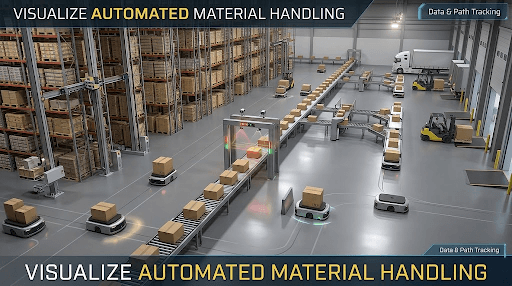
You can use 3d animations to show automated material handling systems that move goods in a warehouse. It can be something as simple as how a box or package is received, sorted, picked, packed and shipped, or simply explain how a complex machine works in a warehouse setting.
For example, you can use 3D animation to show how AGVs and AMRs transport goods in a warehouse. AGVs and AMRs are autonomous mobile robots and automated guide systems responsible for picking and moving cartons or containers between docks and storage areas. You can use 3d animation to show it in practice, how an autonomous guided robot system works, how they follow predesigned routes and move products to desired stations.
You can also use 3D animations to show products moving over a conveyor belt passing through barcode scanners and then directed to sorting lines. Or maybe top down views with close up shots of robots following routes, finding hindrance and rerouting automatically towards their objective. These are just a handful as there are many other examples of how 3d animations can help warehouse managers and logistics to best visualize autonomic handling so they better learn & adapt.
Demonstrate Automated Storage and Retrieval Systems (AS/RS)
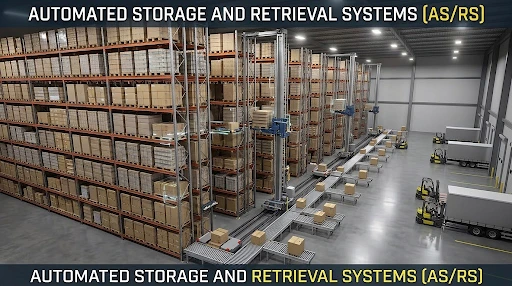
Most warehouses have Automated Storage and Retrieval System commonly referred to as (AS/RS) which are used to store, and retrieve inventory from high-density rackings. These automated systems rely on robotic cranes, shuttles, lifts, and conveyor systems which all work together to load/unload products from racks and beyond. To best explain these systems, warehouse managers often use technical drawings, photographs or complex illustrations to describe their working mechanism to supply chain executives (who often struggle to understand).
A 3D warehouse animation helps in filling that gap by animating entire sequences such as a robotic stacker crane traveling along an aisle between tall storage racks, lifting & lowering its load to designated shelves. Through close-ups and exploded views, it reveals how the crane lifts and handles the load while moving autonomously. Similarly, 3D animators can also animate cutaway view of a shuttle moving along storage racks picking or dropping products. Animators can show the shuttle transferring the load to a lift or conveyor so viewers can better understand how goods move in a warehouse setting. In our opinion, 3D animations are the best tools to explain AS/RS systems, specifically for a warehouse setting.
Explain Warehouse Management System (WMS) Integration
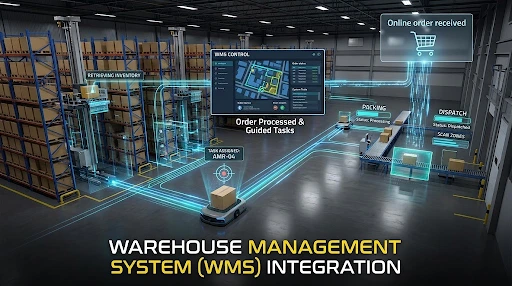
One other way 3D animations benefit your warehouse business is by demonstrating how a Warehouse Management System (WMS) works. By using 3D animation, warehouse managers can explain how a system receives orders, identifies designated products, assigns its picking and coordinates with autonomous systems and personnel how goods are moved through the warehouse, from packing to dispatch. Most WMS operate through software. 3D animations can combine realistic environments with visual representations to show how a software makes a decision and implements it.
You can also use a 3D animation script to animate a sequence showing how a customer places an order through an online store or an ordering platform, and how the order is received and processed in a WMS. You can further show through vector diagrams how the system runs to check the product’s availability & quantity within the inventory. Furthermore, you can combine on-screen graphics to show the order status changing from Received to Processing and continue the sequence further. Another example is where you can animate WMS sending tasks to warehouse control systems showing an autonomous mobile robot transporting cartons onto a moving conveyor belt or a storage system.
Need a Warehouse Automation Animation That Sells?
Show buyers exactly how your robotics, conveyors and AS/RS systems work before they are built. Our 3D animation team delivers clear, investor-ready visuals.
Get a Free Quote
Compare Manual and Automated Warehouse Operations
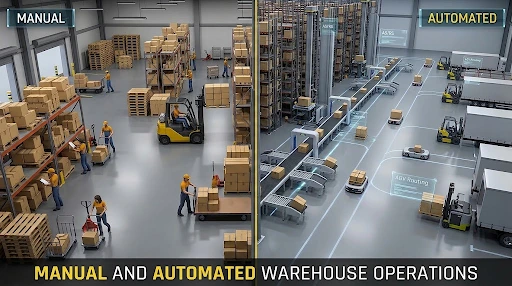
Warehouse managers can use 3D animations to compare a traditional warehouse to a fully automated facility and describe how it handles complex operational tasks. It shows how both environments work side-by-side explaining the differences in how materials are moved, show inventory retrieval, dictate worker involvement and describe storage utilization. It can further show how each facility receives, stores, retrieves, picks, and dispatches products. This makes it overall easier for warehouse operators & logistic managers and business owners to understand where automation can improve operations.
You can also show how goods move through a manual warehouse using forklifts, pallet jacks, and workers, then suddenly shift to an automated facility with conveyors, automated guided vehicles (AGVs), or autonomous mobile robots (AMRs) transporting goods between storage and shipping. You can further show how warehouse employees often work manually by walking between shelves, picking products or moving cartons and then demonstrate how automated robots handle all of these tasks efficiently.
Simulate Warehouse Layouts and Test Automation Scenarios
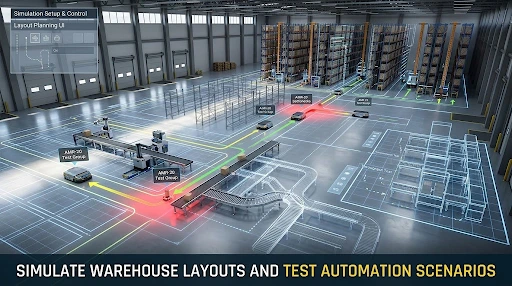
Warehouse managers can also create a virtual model of a warehouse where businesses can test different layouts, equipment configurations and material flow scenarios in a physical facility. This way, they will have a better insight into warehouse planning, identify bottlenecks, and find the best equipment placements which moreover helps them understand how changes can impact the overall operational performance. Imagine a distribution center planning to automate its material handling operations. A 3D warehouse animation could simulate a facility with 20 AMRs, storage racks, conveyors, and picking stations. The warehouse operator could then compare the results and select a configuration for further engineering validation before purchasing equipment or modifying the facility.
Bring Your Warehouse Automation to Life with 3D Animations
Investing in warehouse automation is only half the battle, the remaining half is where you can explain it to your executives, and floor operators. If they are better aware of automation, it’s what drives real ROI for your businesses. By using 3D animation, you can turn robotic workflows, invisible WMS algorithms, and high-density AS/RS grids into clear visual stories. Whether you’re pitching a multimillion-dollar facility upgrade, training staff on new equipment, or testing a layout before purchasing a hardware, 3D visualization can fill the gap between technical complexity and clarity.
Hire a 3D Animation Studio for Your Automation Systems
Book a free consultation with Prolific Studio and get a custom quote for your warehouse automation explainer, product demo or sales animation.
Book a Free Consultation