

In today’s highly competitive digital marketplace, businesses are constantly searching for new ways to capture attention, engage customers, and increase conversions. Traditional product photography and static visuals still play an important role, but modern consumers expect more immersive and interactive experiences when exploring products online.
This shift has fueled the rapid adoption of interactive 3D models on websites. From eCommerce stores and manufacturing companies to technology brands and healthcare organizations, businesses are embracing web-based 3D experiences to showcase products with greater clarity and realism.
At Prolific Studio, we help brands leverage cutting-edge 3D visualization technologies to create engaging digital experiences that go beyond traditional imagery. By combining expert 3D modeling, animation, and web integration, businesses can offer customers a more interactive way to explore products and services online.
The Rise of Interactive 3D Experiences
Consumer expectations have evolved dramatically over the past decade. People no longer want to rely solely on product descriptions and a handful of photos before making purchasing decisions.
Today’s buyers want to:
- Inspect products from every angle
- Understand size, shape, and proportions
- Explore product details closely
- Visualize customization options
- Experience products before purchasing
Interactive 3D models make all of this possible directly within a web browser.
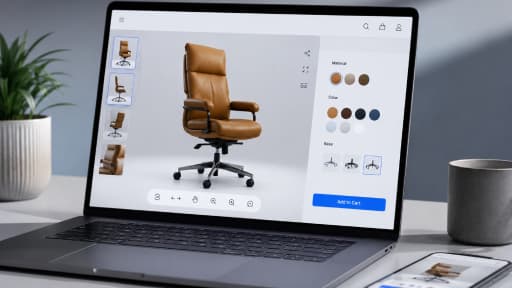
Instead of viewing a static image, users can rotate, zoom, pan, and interact with products in real time. This level of engagement creates a stronger connection between customers and products, leading to improved confidence and purchasing decisions.
What Is an Interactive 3D Model on a Website?
An interactive 3D model is a digital representation of a product or object that users can manipulate directly within a webpage.
Unlike videos or image galleries, these models respond instantly to user input. Visitors can:
- Rotate the object 360 degrees
- Zoom in for detailed inspection
- Change viewing angles
- Explore internal components
- Customize colors and materials
- Interact with product features
These experiences are delivered using modern browser technologies that allow real-time rendering without requiring additional software downloads.
The result is a seamless and immersive experience that works across desktops, tablets, and mobile devices.
Why Businesses Are Investing in Website 3D Models
Enhanced Customer Engagement
Interactive content naturally attracts more attention than static content.
When visitors can actively explore a product, they spend more time engaging with it. Increased interaction often leads to stronger brand recall and improved customer understanding.
Studies consistently show that interactive experiences increase user engagement compared to traditional content formats.
Improved Product Understanding
Many products are difficult to communicate through photography alone.
This is especially true for:
- Industrial equipment
- Consumer electronics
- Medical devices
- Furniture
- Automotive products
- Manufacturing components
Interactive 3D models allow customers to examine every detail, creating a clearer understanding of how products look and function.
Increased Conversion Rates
Purchasing decisions become easier when customers have confidence in what they are buying.
Interactive product visualization reduces uncertainty and helps users make informed decisions.
Businesses that implement advanced product visualization often experience:
- Higher conversion rates
- Increased add-to-cart actions
- Greater customer confidence
- Improved product engagement
Reduced Product Returns
One of the biggest challenges in eCommerce is product returns caused by mismatched expectations.
When customers can thoroughly inspect a product before purchase, they gain a more realistic understanding of its appearance and features.
This improved transparency helps reduce return rates and increases overall customer satisfaction.
The Technology Behind Interactive 3D Models
Modern web-based 3D experiences rely on powerful browser technologies that deliver real-time rendering performance.
WebGL
WebGL serves as the foundation of modern browser-based 3D graphics.
It enables websites to communicate directly with a device’s graphics processing unit (GPU), allowing complex 3D scenes to render smoothly without requiring plugins.
WebGL powers many of today’s advanced digital experiences, including:
- Product configurators
- Interactive visualizations
- Virtual showrooms
- Educational simulations
- Gaming applications
WebGPU
As browser technology continues evolving, WebGPU is emerging as the next generation of graphics rendering.
WebGPU provides:
- Faster rendering performance
- Improved visual quality
- Better resource management
- Enhanced support for complex 3D scenes
This technology will continue expanding the possibilities of interactive web experiences in the coming years.
Building a Website-Ready 3D Model
Creating an effective interactive 3D model requires far more than simply uploading a CAD file to a website.
The process involves several critical stages.
Product Analysis
Every project begins with understanding the product.
Our team evaluates:
- Product complexity
- Materials and finishes
- User interaction goals
- Website requirements
- Performance expectations
This discovery phase helps establish a clear visualization strategy.
3D Modeling
If no digital assets exist, experienced artists create a detailed 3D model from:
- Product photos
- Technical drawings
- CAD references
- Physical prototypes
The goal is to produce a highly accurate digital representation of the product.
Texturing and Material Creation
Materials play a major role in achieving realism.
Artists recreate:
- Metals
- Plastics
- Glass
- Fabrics
- Rubber
- Wood
Advanced physically based rendering (PBR) workflows ensure realistic lighting and material responses.
Optimization
One of the most important steps is optimization.
A model suitable for manufacturing or animation is often too complex for real-time web rendering.
Optimization involves:
- Polygon reduction
- Texture compression
- Geometry cleanup
- Performance testing
- Mobile optimization
This ensures smooth experiences across all devices.
Using Existing CAD Files for Interactive Experiences
Many businesses already possess engineering CAD files.
These files provide an excellent starting point for creating interactive web models.
However, CAD models are typically unsuitable for direct website use because they contain excessive geometric detail designed for manufacturing precision.
Professional optimization transforms CAD assets into web-friendly models through:
Geometry Conversion
Engineering surfaces are converted into polygonal geometry suitable for real-time rendering.
Mesh Simplification
Unnecessary complexity is removed while preserving visual accuracy.
Texture Development
Materials and surface details are created to enhance realism.
Performance Optimization
Assets are refined for fast loading and responsive interaction.
The result is a lightweight model capable of delivering exceptional visual quality online.
Product Configurators: The Next Step in Customer Interaction
Interactive 3D models become even more powerful when combined with product configurators.
A configurator allows users to personalize products directly on the website.
Popular customization options include:
- Colors
- Materials
- Logos
- Accessories
- Components
- Product variations
As customers modify selections, the 3D model updates instantly.
This creates an engaging buying experience that empowers users to build products according to their preferences.
Industries benefiting from configurators include:
- Automotive
- Furniture
- Fashion
- Electronics
- Manufacturing
- Sports equipment
Augmented Reality Integration
Augmented Reality (AR) is rapidly becoming a valuable extension of website-based 3D models.
AR allows users to place digital products within their real-world environments using smartphones or tablets.
Examples include:
- Viewing furniture inside a living room
- Testing machinery placement within facilities
- Visualizing equipment dimensions
- Previewing home improvement products
AR bridges the gap between digital exploration and real-world purchasing decisions.
Virtual Reality and Digital Showrooms
The same 3D assets used for website experiences can support immersive virtual reality environments.
Businesses are increasingly developing:
- Virtual trade shows
- Interactive product demonstrations
- Digital training environments
- Virtual showrooms
- Customer experience centers
This creates additional value from a single investment in 3D content.
Popular Platforms for Web-Based 3D Experiences
Several platforms support interactive 3D deployment.
Three.js
Three.js is one of the most widely used JavaScript libraries for creating web-based 3D experiences.
Benefits include:
- Flexibility
- Large developer community
- Extensive customization
- Strong integration with modern frameworks
Babylon.js
Babylon.js provides a comprehensive framework for advanced interactive experiences.
Advantages include:
- Built-in physics support
- Enterprise scalability
- Advanced rendering tools
- Powerful debugging features
Spline
Spline offers a designer-friendly platform for creating interactive 3D content without extensive coding knowledge.
Sketchfab
Sketchfab provides an easy solution for hosting and embedding interactive 3D models across websites.
PlayCanvas
PlayCanvas is frequently used for high-performance interactive applications and browser-based gaming experiences.
Three.js vs Babylon.js: Which Is Better?
Both frameworks are highly capable, but their strengths differ.
Three.js Is Ideal For:
- Marketing websites
- Creative experiences
- Product showcases
- Interactive landing pages
- React-based projects
Babylon.js Is Ideal For:
- Product configurators
- Enterprise applications
- Web-based simulations
- Browser games
- Complex interactive systems
At Prolific Studio, technology selection depends entirely on project requirements, ensuring each solution delivers optimal performance and functionality.
Mobile Optimization Matters
Today, a significant percentage of website traffic originates from mobile devices.
Therefore, interactive 3D experiences must perform flawlessly on smartphones and tablets.
Optimization strategies include:
- Adaptive rendering
- Responsive interfaces
- Texture compression
- Efficient asset delivery
- Progressive loading systems
These techniques ensure smooth performance regardless of device specifications.
The Future of Interactive Product Visualization
The future of digital commerce is becoming increasingly immersive.
Emerging trends include:
- AI-enhanced personalization
- Real-time customization
- WebXR experiences
- Virtual shopping environments
- Advanced AR integrations
- Digital twins for enterprise products
As technology continues evolving, interactive 3D experiences will become a standard component of successful digital strategies.
Businesses that invest in these technologies today position themselves ahead of competitors while delivering superior customer experiences.
Why Choose Prolific Studio for Interactive 3D Solutions?
At Prolific Studio, we combine creativity, technical expertise, and decades of 3D production experience to help brands unlock the full potential of interactive visualization.
Our services include:
- 3D Product Modeling
- Interactive Web Experiences
- Product Configurators
- 3D Animation Services
- AR and VR Development
- Technical Visualization
- Digital Twin Creation
- Real-Time Rendering Solutions
Whether you need a simple interactive product viewer or a fully customized 3D configurator, our team delivers solutions that enhance engagement, improve customer understanding, and drive measurable business results.
Final Thoughts
Interactive 3D models are transforming how businesses communicate products online. By enabling users to explore, customize, and experience products directly within a website, brands can create stronger connections with customers while improving conversions and reducing uncertainty.
As digital experiences continue evolving, interactive 3D technology is no longer a luxury—it is becoming an essential component of modern product marketing. Companies that embrace these innovations today will be better equipped to meet future customer expectations and stand out in an increasingly competitive digital marketplace.
For businesses looking to boost their online presence, interactive 3D visualization represents one of the most powerful investments available in modern digital marketing.