
Most developers work out when to release a game trailer by counting backwards from launch day. That is the wrong anchor.
The real deadline belongs to Valve. Roughly six weeks before each Steam Next Fest, Valve pulls trailers from store pages to build the official festival trailer. If yours is not finished and live by then, you are not in the running, and that free placement is worth more than anything you can buy.
So the question is not when to publish your trailer. It is what date Valve has already set for you, and whether your production schedule clears it.
Key Takeaways
- Valve pulls trailers about six weeks before Next Fest starts. That is your hard deadline, not the fest date.
- Next Fest 2026 runs February 23, June 15, and October 19. Each game can enter exactly once, ever.
- Announcement trailers belong with your Steam page going live, not before it. A trailer with nowhere to send people wastes its own launch.
- Most indie games need three trailers, not one: announce, demo, launch.
- Start trailer production 16 weeks before Next Fest. Working backwards from Valve’s dates leaves less room than it looks.
- Never drop a trailer into a major Steam sale. The visibility widgets that carry new games disappear during them.
The Deadline That Actually Governs Your Trailer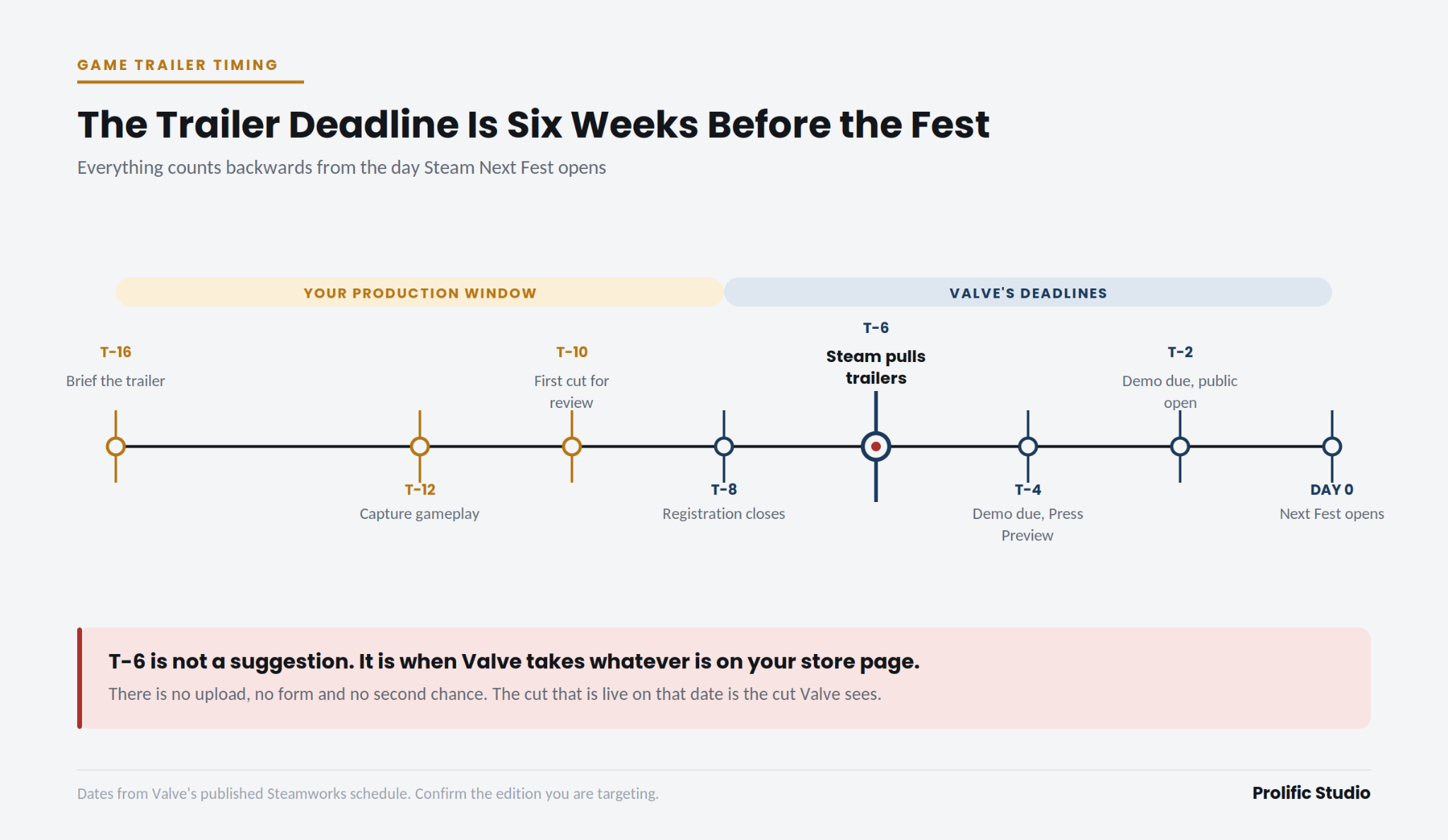
Valve publishes a full schedule for every Next Fest edition, and buried in it is a date most developers read as administrative.
For the February 2026 edition, Valve’s published schedule shows Steam pulling trailers on January 11, with developers notified by January 6 if they were under consideration. The fest itself started February 23. That is a six-week gap, and June followed the same shape: trailers pulled May 4 for a June 15 opening.
Valve is explicit about what this means: this is when they recommend your marketing materials be up to date so you can be considered for the main event trailer and the genre trailers.
Read that as a production deadline, and the game trailer timing problem reorganizes itself. Your trailer does not need to be ready for Next Fest. It needs to be ready six weeks earlier, finished, approved, and live on the store page.
Miss it, and the fest still happens. You just lose the one placement you could not have bought, and compressing a schedule to catch up is the most expensive way to make a trailer.
When to Release Your Announcement Trailer
The same day your Steam page goes live. Not before.
An announcement trailer exists to convert attention into a wishlist. If someone watches it and there is nowhere to click, the attention evaporates, and you have spent your one first impression on a dead end. Game announcement trailer timing is really a question about the store page, not the video.
That pairing sets your earliest sensible date. Most indie teams put the Coming Soon page up somewhere between nine and twelve months before launch, which is when the announcement trailer should land with it.
Later is worse, because wishlists need time to accumulate and the page has nothing to hold a visitor with.
Earlier is not the safe choice; it looks like. A trailer released eighteen months out gets watched by people who will have forgotten the game by launch, and it burns footage you cannot show twice. If you are still deciding what goes in the cut, how to structure a game trailer covers the first-ten-seconds problem that decides whether anyone watches past the logo.
Working Backwards: A Trailer Calendar for Next Fest
Here is the schedule that falls out of Valve’s dates. Everything counts backwards from the day the fest opens.
| Weeks Out | What Happens | Who Sets It |
| T-16 | Brief the trailer, plan what footage you need to capture | You |
| T-12 | Capture gameplay, lock the build you are showing | You |
| T-10 | First cut for review | You |
| T-8 | Registration closes for the edition | Valve |
| T-6 | Steam pulls trailers for the official Next Fest trailer | Valve |
| T-4 | Demo build due if you want Press Preview inclusion | Valve |
| T-2 | Demo build due for the public opening | Valve |
| Day 0 | Next Fest opens | Valve |
Four of those eight rows are not yours to move.
Ask any studio for a lead time, and you will hear four to eight weeks. Overlay that on the table above and the trap becomes obvious.
The trap is the gap between T-16 and T-6. Ten weeks sounds generous until you account for footage capture needing a stable build, two rounds of review, and the fact that your game is still being made while the trailer is being cut. An indie game trailer schedule that starts at T-8 will produce something, but it will be a rush job that Valve sees.
So how far before launch should you release a trailer? For the fest cut, six weeks before the fest, which itself sits two to four months before you ship. For the launch trailer, two weeks out.
Aim for the last Next Fest before your planned launch. Each game gets one entry ever, and wishlists accumulated before the fest are what the fest multiplies. The October 2026 edition is the current reference point for anyone planning now. That single choice does more for your game trailer release strategy than any decision about the edit.
Valve publishes exact deadlines per edition, and they shift by a week or two between fests, so confirm the edition you are targeting before treating any schedule as fixed.
When Should You Submit a Trailer to Steam Next Fest?
Around six weeks before the fest opens, and the submission is passive rather than active.
You do not upload a trailer to Next Fest. Valve takes whatever is live on your store page on the pull date. That distinction catches people out, because there is no form to fill in and no confirmation email. The trailer is either there and finished, or it is not.
Per Steamworks Next Fest documentation, Valve notifies developers under consideration for the official festival trailer only days before pulling, which means the version they see is the version you published weeks earlier. There is no window to swap in a better cut once you know you are in the running.
So the practical answer to when to make a game trailer for a fest is: finish it early enough that the pull date is unremarkable. Teams who treat T-6 as the delivery date are the ones scrambling.
What Valve sees is a finished cut competing against thousands of others for a curation slot, so the edit matters as much as the delivery date.
Do You Need a Trailer Before Your Steam Page Goes Live?
No, and trying to is a common way to waste money.
The trailer and the page should launch together. The page without a trailer converts poorly, since video is the first thing a visitor plays. The trailer without a page has nowhere to send anyone.
The one exception is a teaser cut for a publisher pitch, a festival submission, or a funding conversation. That is a different asset with a different audience, and it is usually thirty seconds of mood rather than a real trailer. Do not confuse it with the thing that goes on your store page.
So should you release a trailer before your Steam page goes live? Only in that narrow pitch scenario. The trailer before or after Steam page question has one more wrinkle worth knowing. Valve reviews store pages before they go public, so build in a week for that. A studio delivering on the day you planned to publish still leaves you a week short.
How Many Trailers Does an Indie Game Actually Need?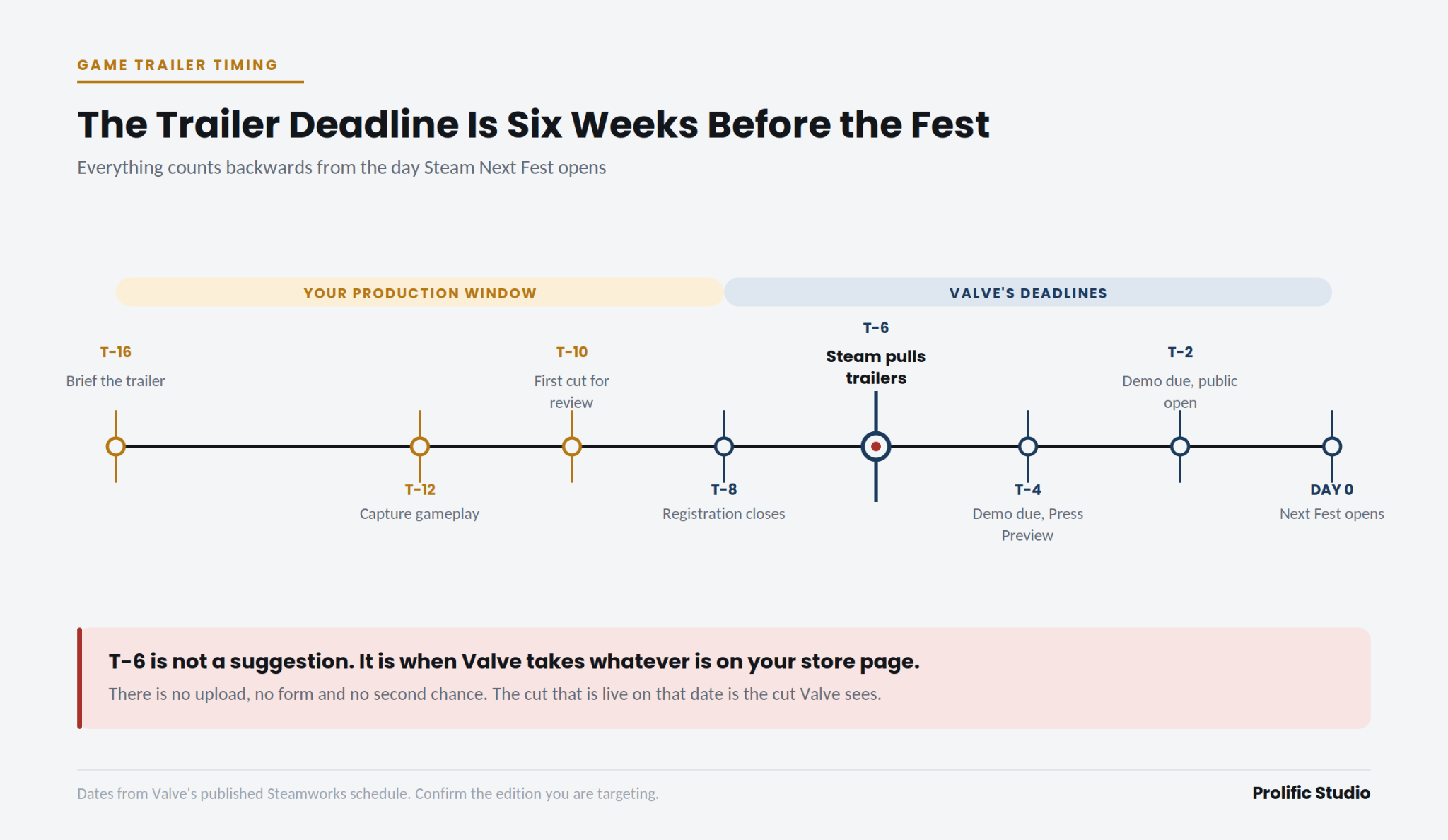
Three, for most projects.
The announcement trailer. Goes live with the Steam page. Its job is a wishlist, not a sale. Sixty to ninety seconds, heavy on hook and identity, light on systems.
The Steam Next Fest trailer. This is the one Valve pulls. It has to show real gameplay, because the audience during a fest is deciding whether to download a demo in the next thirty seconds. This is where the announcement trailer vs gameplay trailer timing distinction bites: they are different cuts for different decisions, and reusing one for both underperforms at both.
The launch trailer. Two weeks before release, not on the day. It needs time to circulate before the buying window opens.
Some teams add a feature trailer or a console announcement. Beyond four, you are usually re-editing rather than adding, and a game animation studio quoting four separate cuts should be able to show you which decision each one serves.
The Worst Times to Drop a Trailer
Some windows are actively bad, and they are avoidable with a calendar.
During a major Steam sale. Seasonal sales pull enormous traffic to Steam, but that traffic arrives with wishlists and recommendations already in hand. The discovery widgets that surface unreleased games are not what shoppers are using.
The week a major AAA title launches. Not every AAA release competes with you, but the ones sharing your audience will take the coverage you were hoping for.
Mid-December through early January. Attention is elsewhere, and press desks are empty.
The same week as your own demo going live. Splitting your announcement across two events halves both, and a demo with no trailer to point at it converts worse than either would alone.
The worst time to release a game trailer, though, is simply before it is finished. A rough cut published to hit a date does more damage than a good cut published two weeks late, because you only get one first watch.
How Trailer Timing Moves Wishlists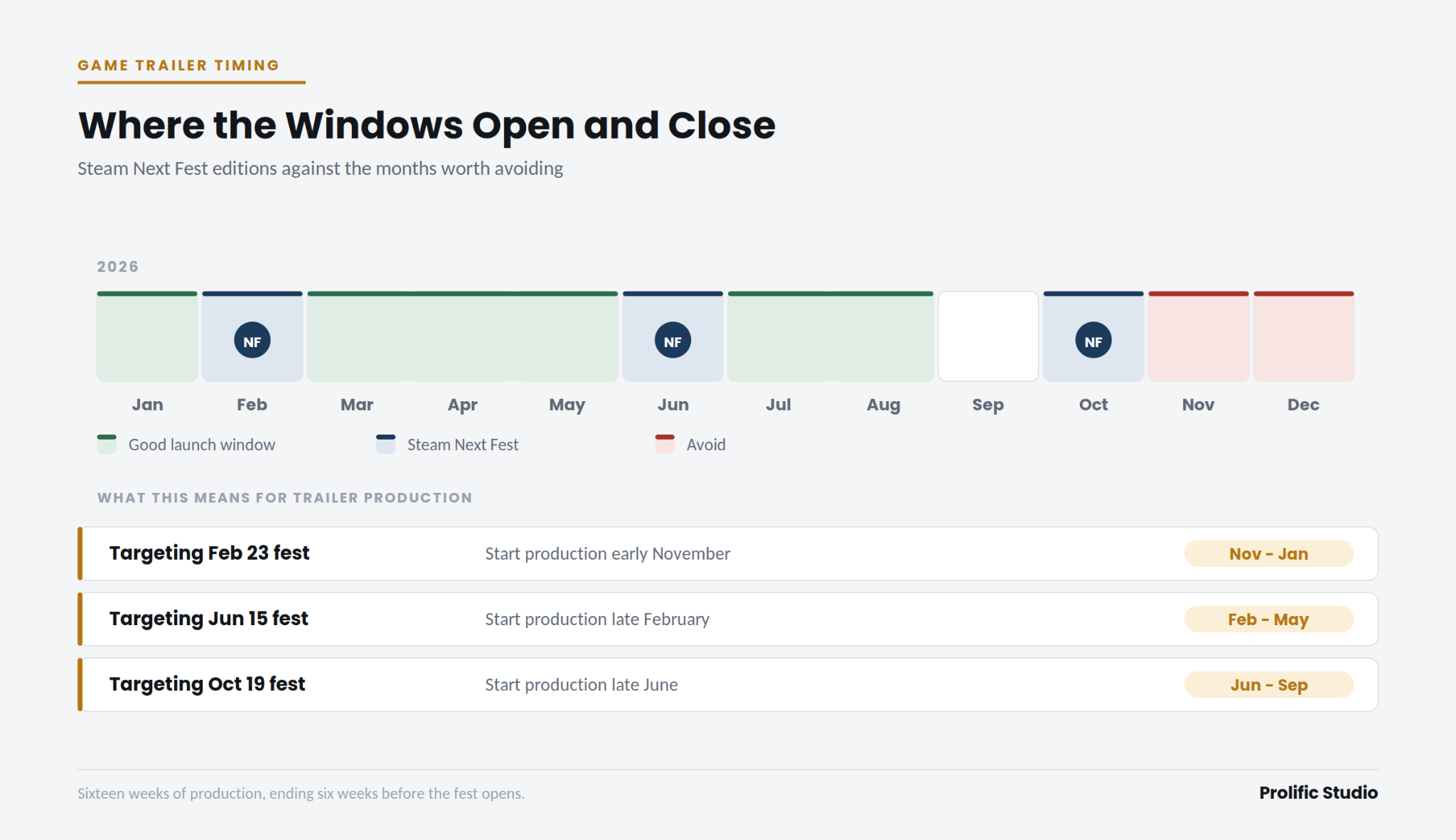
Does trailer timing affect wishlists? Yes, though indirectly, and the mechanism is worth understanding.
A trailer does not generate wishlists on its own. It converts attention that something else created: a fest, a showcase, a creator video, a press piece. Timing determines whether the trailer is ready when that attention arrives.
This is why the question of how long before launch to start marketing an indie game has an unsatisfying answer. Marketing starts when the page goes up, which is when the announcement trailer goes up, which is nine to twelve months out. The trailer is not the campaign. It is the thing the campaign points at.
Next Fest is the clearest case. It is a multiplier on an audience you already have rather than a generator of a new one, so a game arriving with a strong trailer and two thousand existing wishlists gets far more from the week than one arriving with a strong trailer and none.
One clarification worth making here, because teams conflate the two: how trailers differ from cutscenes matters for timing as well as craft, since a cinematic cut for the game itself is on your production schedule while a trailer is on Valve’s.
The practical consequence is that trailer timing and audience building are the same project on different tracks. Publishing the announcement trailer early starts the wishlist clock. Holding the fest trailer until it is genuinely finished protects the multiplier.
Teams that get this wrong usually do one of two things: they announce so late there is nothing to multiply, or they enter a fest with a placeholder cut because the date arrived.
A studio can build you an excellent cut in six weeks. It cannot build you the audience that cut needs to convert.
Final Words
Trailer timing feels like a marketing decision and behaves like a production one. The dates that matter were published by Valve months ago, and your schedule either clears them or it does not.
Work backwards from the trailer pull date rather than from launch. Put the announcement trailer up with the store page. Aim for the last Next Fest before you ship, and treat it as a multiplier on wishlists you already have rather than a substitute for building them.
The three trailers do different jobs at different moments, so budget for three rather than stretching one across all of them. And check Valve’s published deadlines for the specific edition you are targeting, because they shift by a week or two between fests and the whole schedule hangs off that one date.
Everything else is craft. Craft is worth nothing if it arrives on the wrong Tuesday.
One practical habit worth adopting: when a studio quotes you, ask which fest edition the schedule is built around. If the answer is a delivery date rather than an edition, the calendar has not been checked. Sometimes the honest recommendation is to skip an edition entirely, because entering with a weak cut spends your single entry for less than it is worth.
Planning a trailer around a specific fest? Our game trailer animation services are scoped around Valve’s calendar, and we will tell you before you commit whether the dates actually work. Book a call.
Frequently Asked Questions
When should you release your game’s announcement trailer?
The same day your Steam page goes live, typically nine to twelve months before launch. The trailer’s job is converting attention into a wishlist, and without a live page there is nowhere to convert. Publishing earlier burns your first impression on people who will have forgotten the game by release.
How far before launch should a gameplay trailer go out?
If it is your Next Fest trailer, it must be finished and live around six weeks before the fest, because that is when Valve pulls trailers for the official festival video. For a standalone gameplay trailer outside a fest, four to six weeks before launch gives creators and press time to pick it up.
Do you need a trailer before your Steam page goes live?
No. They should go live together. A page without video converts poorly and a trailer without a page has nowhere to send viewers. Build in an extra week for Valve’s store page review so your publish date does not slip.
How many trailers does an indie game actually need?
Three for most projects: an announcement trailer with the store page, a gameplay or demo trailer for Next Fest, and a launch trailer roughly two weeks before release. Each serves a different decision. Reusing one cut across all three underperforms at all three.
Does trailer timing affect wishlist numbers?
Indirectly but significantly. A trailer converts attention rather than creating it, so timing decides whether it is ready when a fest, showcase or press cycle sends people your way. Next Fest in particular multiplies an existing audience rather than generating a new one, which is why arriving with wishlists already banked matters more than the trailer alone.