How Much Does Hybrid Animation Cost? 2D + 3D Pricing Guide
Javeria
Table of Contents
Hybrid animation cost lands between $7,000 and $14,000 per finished minute for most commercial work. Where you fall inside that band comes down to one thing: how much of your runtime is actually 3D.
That is the part most pricing guides skip. Hybrid does not have a rate. It has a blend. A ninety-second video with two 3D hero shots and eighty seconds of 2D is priced nothing like one where the ratio is reversed, though both get called hybrid.
There is also a cost nobody mentions: what it takes to make two layers look like they belong in the same frame. That line item exists in neither pure 2D nor pure 3D, and it is why hybrid is not automatically the cheap option.
Key Takeaways
Hybrid animation cost runs roughly $7,000 to $14,000 per finished minute, driven by your 3D share rather than a fixed rate.
Hybrid is never cheaper than pure 2D. It is 2D plus a premium. Anyone selling it as the budget option is selling you something else.
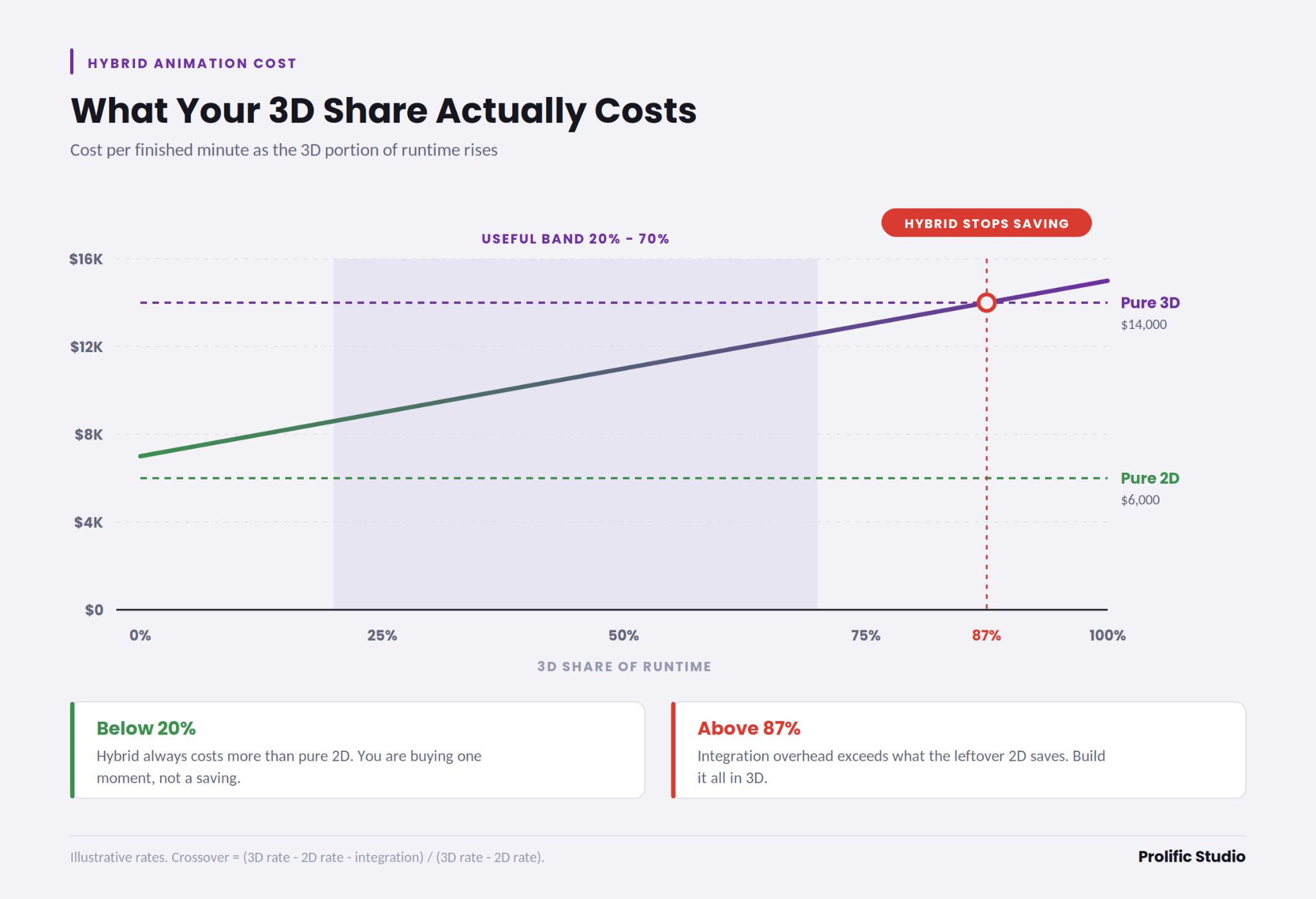
Hybrid stops saving money above about an 85% 3D share. Past that, integration overhead cancels the difference and you should build the whole thing in 3D.
The useful band is a 20% to 70% 3D share. That is where hybrid genuinely beats both alternatives.
Integration and compositing is the hidden line item, and it costs roughly the same whether your 3D share is 10% or 60%.
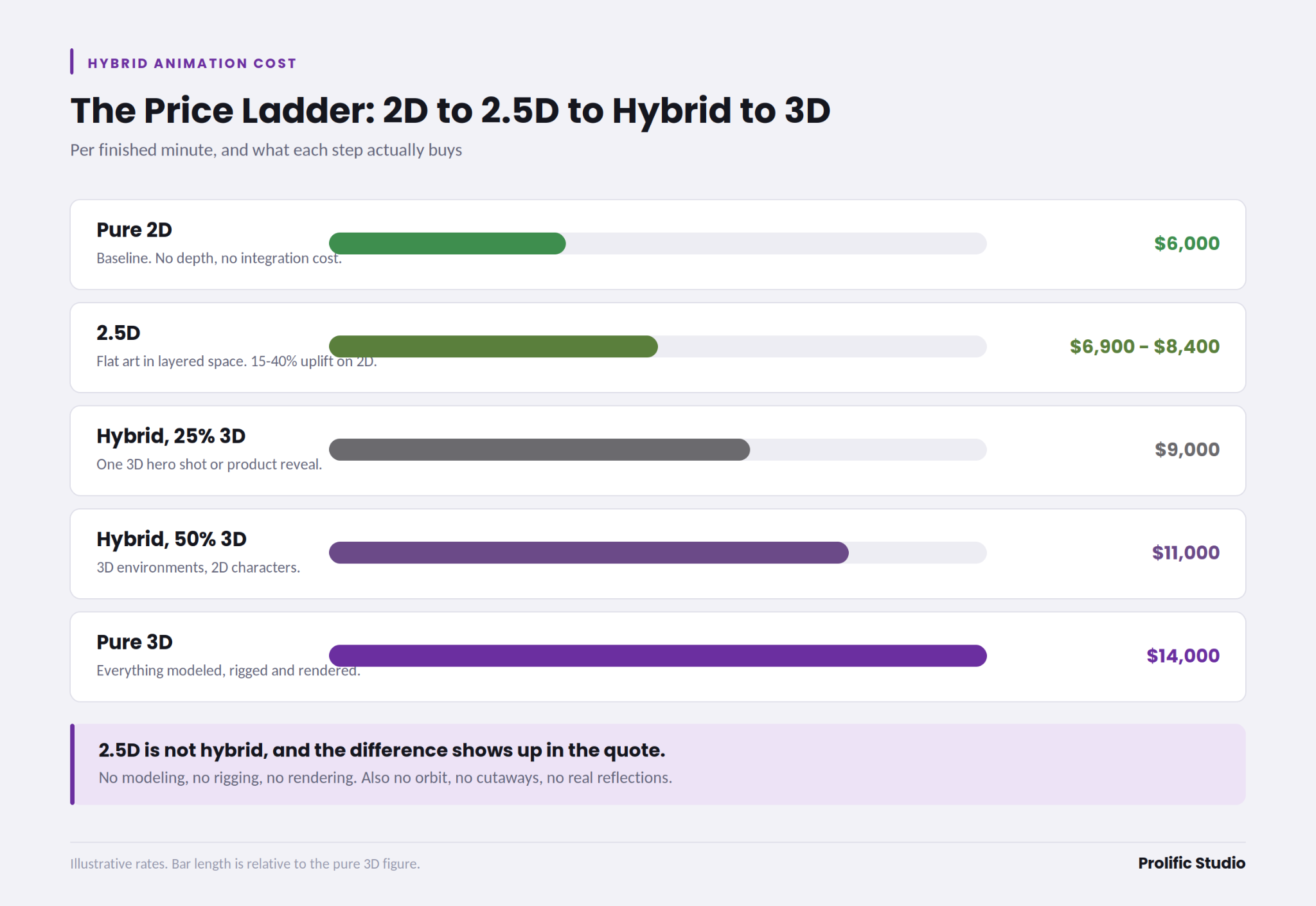
2.5D is not the same thing as hybrid and sits well below it on the price curve.
Why Hybrid Animation Has No Single Per-Minute Rate
Ask five studios for a hybrid rate, and you will get five unrelated numbers, because each is quoting a different blend.
Hybrid is a category, not a technique. It covers 2D characters in 3D environments, cel-shaded 3D that reads as hand-drawn, flat graphics over rendered product, and live-action plates with animated overlays. Those share a label and almost nothing else in production hours.
The only honest way to price it is as a weighted mix of two known rates plus the cost of joining them. Our guide to hybrid animation covers what the techniques are and how they get built. This one covers what they cost.
So if a studio quotes a flat hybrid per-minute figure before asking which shots are 3D, they are guessing. And they have padded the guess.
How Much Does Hybrid Animation Cost Per Minute?
Here is the model. It starts from two baselines.
How much does 2D and 3D animation cost on their own? Custom 2D sits at roughly $4,000 to $8,000 per finished minute for commercial work, and full 3D at roughly $10,000 to $20,000. Published industry benchmarks put 2D explainer work across a wide band, with 3D typically starting near $5,000 and climbing past $25,000 at the high end.
Take the midpoints, $6,000 for 2D and $14,000 for 3D, then add about $1,000 per minute for integration: matching light, shadow, perspective and camera between the two layers.
3D Share of Runtime
Cost Per Finished Minute
What This Looks Like
0% (pure 2D)
$6,000
No 3D, no integration cost
10%
$7,800
One brief 3D moment
25%
$9,000
A 3D hero shot or product reveal
50%
$11,000
3D environments, 2D characters
75%
$13,000
Mostly 3D with 2D effects and type
90%
$14,200
More than pure 3D. Stop here.
100% (pure 3D)
$14,000
No 2D, no integration cost
Two things jump out.
Hybrid never undercuts pure 2D. At a 10% 3D share, you pay 30% more than a 2D-only version. That premium buys one strong moment, often worth it, but mixed media animation cost is a premium and not a saving.
Hybrid stops undercutting pure 3D at about an 87% 3D share. Above that, integration overhead exceeds what the remaining 2D saves. This is the most useful number in the whole comparison, and almost nobody publishes it. Worth asking any 3D animation studio where that line falls on their own rates.
Your 3D Share Is the Number That Sets the Price
Forget style for a moment. Work out what percentage of your finished runtime has to be built in 3D before anyone quotes you.
Not what would look nice in 3D. What has to be. Different questions, and the gap between them is usually 30% of your budget.
Go through the script shot by shot and mark each one. A shot needs 3D if the viewer must see form, volume, mechanism, or the product from an angle flat illustration cannot fake. Everything else, usually most things, is a 2D shot wearing an expensive costume.
Total the seconds. That percentage is your price. What affects hybrid animation pricing has a shorter answer than most studios give. Scene count, character count, and revisions all matter, but the 3D share matters more than all of them combined.
Which Shots Actually Deserve 3D (And Which Never Do)
The triage is unglamorous and saves more than any negotiation.
Build it in 3D when:
The product is on screen and the viewer needs to judge form, scale or finish
A mechanism has to be seen operating, opening, folding or assembling
The camera moves through space in a way that would mean redrawing every frame
Internal structure matters, so a cutaway or exploded view is the whole point
The shot will be reused across videos, spreading the model cost
Keep it in 2D when:
The subject is a concept, a process, a workflow or a data relationship
Characters carry emotion or dialogue rather than demonstrating a physical thing
The shot runs under two seconds, because nobody registers render quality that fast
Text, icons, charts or interface elements are doing the explaining
It is a transition, a background, or anything the eye passes over
Everything in that second list belongs with 2D animation services at a fraction of the rate, and the finished piece still reads as one thing, because the 3D moments land where the viewer was already paying attention. A studio worth its rate will push back on shots you have marked for 3D. That pushback is the service.
What Is 2.5D, and Where Does It Sit on the Price Curve?
2.5D gets used interchangeably with hybrid and should not be. It is a distinct technique at a distinct price.
2.5D takes flat 2D assets and places them in layered space, using camera depth and parallax to simulate volume without building anything in three dimensions. It is a faster, more cost-effective way to get a 3D-like effect without full-scale modeling, and Hollow Knight is the reference everyone reaches for: hand-drawn characters in deep perspective that read as dimensional.
On price, 2.5D animation cost sits just above pure 2D and well below hybrid, since there is no modeling, rigging, texturing or rendering. Call it a 15% to 40% uplift on your 2D rate.
That makes the 2.5D vs 3D animation cost comparison lopsided on paper. The catch is what it cannot do: no real reflections, no genuine camera orbit, no cutaways, nothing requiring the viewer to see an object from a new angle. Need any of those and 2.5D looks like a workaround, because it is one.
What Makes Hybrid Animation Expensive
The cost of combining 2D and 3D animation is not just the sum of the parts. Four things drive it up and only one is obvious.
Integration. Matching light direction, shadow behavior, perspective and camera between layers built in different software. Getting 2D and 3D elements to interact naturally takes deliberate compositing work, and this is the line item unique to hybrid. It is also mostly fixed, which is why a 10% 3D share carries nearly the same integration cost as a 60% one.
Style reconciliation. Deciding how a flat character reads against a rendered environment is an art-direction problem you solve in pre-production or pay for repeatedly in revisions. Skipping it is the most expensive saving available.
Two pipelines, one schedule. A 2D team and a 3D team running against the same deadline. Coordination overhead is real and usually surfaces as project management hours, and a studio outsourcing half the work carries that cost twice.
Revision blast radius. Change a camera move in pure 2D and you redraw frames. Change it in a hybrid shot and you re-render, re-track, re-composite and redraw. Lock your storyboard. Our breakdown of 3D animation cost covers the 3D half of that equation on its own.
When Hybrid Beats Pure 2D, and When It Beats Pure 3D
Two different decisions, and most guides collapse them into one.
Hybrid beats pure 2D when there is a specific thing the viewer has to see in three dimensions and the rest of the story does not need it. A SaaS explainer where the product appears for eight seconds. A medical piece where one mechanism must be accurate and the rest is patient-journey narrative. Hybrid animation cost for explainer videos is usually justified by one or two shots, and if you cannot name them, you probably want 2D.
Hybrid beats pure 3D when most of your runtime is conceptual and only part is physical. Building an entire video in 3D to accommodate two product shots means paying 3D rates for sixty seconds of narration and abstract diagram. That is the most common overspend in this category, and it is where the hybrid animation vs 3D animation cost comparison actually pays off.
So when should you use hybrid animation? When the script genuinely splits into physical and conceptual halves. When it does not split, pick a lane. A muddled 40/60 blend, chosen because nobody would decide costs more than either committed option and looks worse than both.
How to Reduce Hybrid Animation Costs Without Losing the Look
Cut the 3D share before you negotiate the rate. Moving from 50% to 30% saves more than any discount a studio will offer.
Reuse the 3D asset. A model built once can appear in four videos. Amortized across a campaign, modeling cost stops mattering, which is why a 3D product animation agency will often build one product model and deploy it through otherwise-2D pieces.
Use real-time rendering where the shot allows. Engines like Unreal have collapsed render times that used to run overnight, and the savings land in your quote.
Lock style frames before animation starts. Cheap in pre-production, brutal in revision.
Do not spread 3D thinly. Five two-second 3D moments cost more than one ten-second one and land with less impact, because you pay the setup five times.
Final Words
Hybrid pricing confuses people because the word describes an outcome, not a process. Two videos can both be hybrid and differ by 60% in price.
The number that matters is your 3D share. Work it out from the script before you talk to anyone and you can read a quote properly, and challenge it where it deserves challenging.
Below a 20% 3D share, ask whether you need 3D at all. Above 85%, ask why you are not building the whole thing in 3D. Between those, hybrid is usually the right call and occasionally the only sensible one.
Not sure what your 3D share should be? Send us the script. As an animation video production company working across both pipelines, we will mark it up shot by shot and tell you what each option actually costs. Book a call.
Frequently Asked Questions
How much does hybrid animation cost per minute?
Roughly $7,000 to $14,000 for commercial work. The figure moves with your 3D share: about $9,000 at 25%, $11,000 at 50%, $13,000 at 75%. Ask any studio quoting a flat rate which shots they assumed were 3D.
Is hybrid animation cheaper than 3D animation?
Usually, but not always. It stays cheaper until your 3D share reaches about 85% of runtime. Past that, the cost of joining two pipelines exceeds what the remaining 2D saves, and full 3D becomes cheaper and simpler to produce.
What is 2.5D animation, and is it cheaper than full 3D?
2.5D places flat artwork in layered space and uses camera depth and parallax to fake volume. No modeling, rigging, or rendering. So yes, 2.5D animation is cheaper than 3D by a wide margin, and only modestly above pure 2D. The limit: it cannot show an object from a genuinely new angle.
When is hybrid animation worth the extra cost?
When you can name the specific shots needing dimension. A product reveal, a mechanism operating, a cutaway. Point at two or three moments and explain what 3D adds to each, and the premium is earning something. If you cannot, you are buying production value rather than clarity.
Does mixing 2D and 3D make the timeline longer?
Typically two to three weeks longer than a comparable single-format project. Two pipelines run in parallel, integration happens after both finish, and revisions ripple across both. Batch scheduling helps, but do not plan a hybrid piece on a pure 2D timeline.
Javeria is an animation expert at Prolific Studio, with expertise in 2D and 3D animation, motion graphics, VFX, and visual storytelling. With knowledge across industries including healthcare, technology, education, entertainment, finance, and product development, she explores how animation turns complex ideas into engaging visual experiences. Through her insights, Javeria shares practical perspectives on animation, creative trends, production techniques, and digital innovation.