3D animation for real estate helps buyers understand a property before they ever walk through the door. That matters because property decisions now begin online, not at the open house.
The National Association of REALTORS says buyers searched for homes for a steady 10 weeks in its 2025 profile, and sellers placed a high priority on marketing the home to potential buyers, pricing it competitively, and selling within a specific timeframe. Strong visuals are not a nice extra in that kind of market. They are part of how a listing earns serious attention.
Why 3D Animation for Real Estate Matters More Now
Real estate buyers are not short on listings. They are short on certainty.
Photos can show a room. They cannot always explain flow, scale, daylight, finish quality, ceiling height, or how one space connects to another. That is where animation earns its keep. A good property visual does not just show a building. It helps a buyer feel how the space works.
For developers, this matters even more. If the property is still under development, there may be no finished area for filming. If the project is luxury, the buyer wants a flawless presentation before scheduling a private showing. If the listing is investment-led, the buyer may need to understand layouts, amenities, and views before they ever visit the site.
That is where architectural 3D rendering services start doing real sales work.
Buyers Want to Understand the Property Before They Visit
A buyer who arranges a tour typically does not start from scratch. They’ve already looked at photographs, checked the map, compared pricing, and determined if the item is worth their time.
So the visual content has to answer practical questions early.
How big does the living room feel?
Where does the kitchen sit in relation to the dining area?
Does the balcony actually add usable space?
How does the lobby connect to the amenities?
Will the unit feel bright in the afternoon?
Is the layout open, awkward, narrow, or well planned?
A still image can answer some of that. A 3D walkthrough for a property can answer much more because it lets the viewer move mentally through the space rather than jump between isolated photos.
Virtual Tours Are the New Shortlist Tool
A real estate virtual tour is not only for remote buyers. It also helps local buyers decide which properties deserve an in-person visit.
Matterport describes real estate virtual tours as “24/7 open houses” that are immersive, informative, and viewable from any device. That is a useful way to think about it. A property tour no longer has to wait for Sunday afternoon or an agent’s availability. It can be explored at midnight, on a phone, from another city, or during the first serious comparison round.
That is where real estate virtual tour animation becomes more than a visual upgrade. It filters interest. Casual browsers may leave faster, but serious buyers spend more time understanding the property. That is not a bad thing. It means your sales team talks to better-informed prospects.
Architectural Renders Help Sell What Does Not Exist Yet
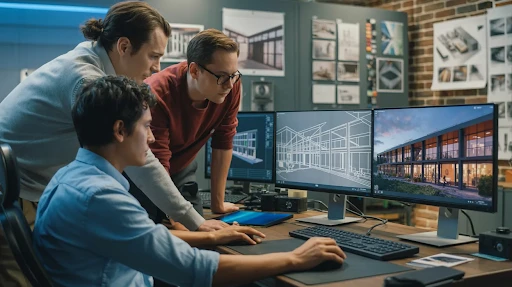
Pre-construction property is one of the clearest use cases for 3D.
A developer cannot wait until the tower is finished to start building interest. Buyers, investors, brokers, and partners need to see the promise before the site looks like much of anything. Renders and animation give them that bridge.
A living room render can show material choices.
A rooftop animation can sell the lifestyle.
A lobby flythrough can make the arrival experience feel premium.
An exterior dusk shot can position the building before the first facade panel is installed.
Architectural 3D rendering services are very valuable for off-plan sales, luxury buildings, commercial spaces, and investor presentations. They transform blueprints and plans into something that people can emotionally comprehend.
Good Real Estate Animation Does Not Just Make Rooms Look Pretty
This is where some property visuals fail.
They show marble, sunlight, soft furniture, slow camera moves, and a skyline. Fine. But after watching, the buyer still does not understand the floor plan or the value of the space.
A strong property animation has to be beautiful and useful. It should guide the viewer through the home in a way that makes sense. Entry first. Then the kitchen. Then, the living space. Then bedrooms. Then the balcony, views, amenities, or neighborhood context.
A good animation studio will not only ask for mood references. It will ask what the buyer needs to believe by the end of the video.
3D Walkthroughs Help Reduce Bad-Fit Showings
Every agent knows the problem. Someone books a showing, walks in, and realizes in two minutes that the layout does not work for them. That wastes time for everyone.
A 3D walkthrough for a property can reduce some of that friction. It will not replace in-person visits, and it should not. But it can help buyers self-qualify earlier. They can understand room flow, basic scale, finishes, and the overall feel before they take the next step.
That matters in a market where both buyers and sellers are cautious. NAR’s 2025 profile notes that buyers continued to report finding the right home as the most difficult task in the buying process. Better visual context helps narrow that search, even if it cannot solve inventory or affordability problems by itself.
The Best Renders Are Specific, Not Generic
A lot of real estate renders have the same problem. They look expensive but interchangeable.
You see the same warm lighting, same pale sofa, same coffee table book, same glass balcony, same vaguely luxurious kitchen. It looks fine. It also looks like every other development.
Better renders feel tied to the property. They show the right neighborhood light. The right material palette. The right view. The right buyer lifestyle. A waterfront condo should not feel like a suburban townhouse. A boutique office lobby should not feel like a hotel lounge unless that is the actual positioning.
This is where a 3D animation studio needs to understand more than modeling and rendering. It needs to understand buyer psychology.
Interactive Animation Lets Buyers Explore Instead of Just Watching
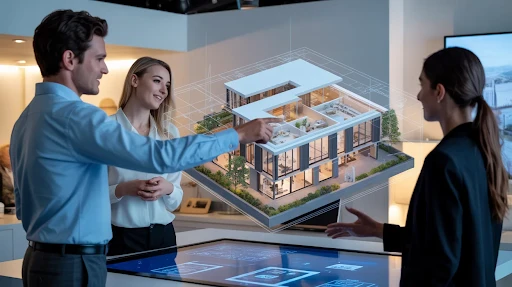
Not every buyer wants to sit through a polished video. Some want control.
That is where interactive animation starts to matter. A buyer may rotate a unit, browse finishes, compare layouts, change from day to night lighting, and explore facilities at their leisure.
NAR defines virtual tours as interactive experiences that allow purchasers to view a home from any place and have a better understanding of how rooms connect before booking an in-person appointment.
This is especially useful for new developments and off-plan sales. A buyer may not be ready to speak to an agent yet. They may still be browsing quietly. Interactive visuals give them enough room to explore without pressure, which can make the first serious inquiry warmer.
VR and AR Are Useful, but Only When They Solve a Real Problem
Some developers get excited about VR and AR because the tech sounds impressive. That alone is not a strategy.
3D animation in VR and AR makes sense when the buyer needs spatial confidence. A luxury villa buyer may want to understand the relationship between indoor and outdoor space. A commercial tenant may need to feel circulation, ceiling height, and reception flow. A buyer from another city may need something closer to an on-site visit before booking travel.
The key is not “use VR because it is modern.” The key is whether the format makes the property easier to trust.
Use 2D When the Message Is About Information, Not Space
There are moments when a 2D animation studio may be the smarter choice.
If you need to explain a payment plan, development timeline, mortgage process, neighborhood growth map, investment return, or buyer journey, 2D can do the job faster and cleaner. Not every real estate visual needs photoreal lighting and camera movement. Sometimes the buyer needs a simple animated map, a timeline, or an icon-led explainer.
This is where real estate brands waste money. They use 3D for everything because 3D feels premium. Then the message gets heavier than it needs to be.
Use 3D when space matters. Use 2D when clarity matters more than realism.
Brand Motion Still Has a Place
Real estate marketing is not only about the property. The developer’s brand matters too, especially in luxury, commercial, and off-plan sales.
That is where logo animation services can help. A clean animated logo can make launch videos, social teasers, broker presentations, event screens, and investor decks feel more consistent. It does not need to be long. In fact, it should not be. A two-second branded close can do more than a dramatic intro that delays the property reveal.
The property should stay in front. The brand should frame it, not crowd it.
A 3D Walkthrough Should Feel Like a Real Visit, Not a Drone Shot
A weak property video floats through rooms without purpose. It looks smooth, but the buyer learns very little.
A better 3D walkthrough for the property follows the logic of a real visit. Arrival. Entry. First impression. Main living area. Kitchen. Private spaces. Outdoor area. Views. Amenities. Then, a clean final image that leaves the buyer with the strongest reason to inquire.
This order matters. Buyers do not experience homes as isolated camera angles. They experience them as movement, rhythm, and discovery. The walkthrough should respect that.
Frequently Asked Questions
Final Words
3D animation for real estate allows developers, agents, and brokers to sell with less guessing. It allows customers to see the layout, movement, scale, finishes, vistas, and lifestyle before making a visit or inquiry. This is especially effective for off-plan projects, luxury listings, commercial spaces, and homes where images cannot fully convey the value.
The best results occur when animation is viewed as a sales tool rather than merely a lovely video. Use architectural 3D rendering services to form desire, real estate virtual tour animation to assist buyers in exploring, and a 3D walkthrough for the property to make the area feel understood before the first showing.