The choice usually gets framed as a budget question, and that framing produces bad videos. A camera and a render farm are good at almost opposite things. Get it wrong and you either spend $40,000 filming something the viewer cannot actually see, or you animate a surgeon who would have been far more convincing on camera. Here is how to work out which situation you are in.
Key Takeaways
- Ask one question before anything else. Can a camera physically and legally see the subject? Everything follows from the answer.
- Live action wins on human credibility. Faces, hands, real clinicians and real rooms carry belief no render earns.
- Animation wins on anything at cellular scale, anything sealed inside a living body, and anything that must look identical every time it plays.
- Per finished minute, the two formats are closer in price than either side admits. Live action carries more variance rather than lower cost.
- Reshoots are the budget risk in live action. Extra revision rounds are the budget risk in animation.
- Hybrid production is the norm for device and pharma launches, usually landing near 60 percent animation to 40 percent filmed.
- Animation ages better. Filmed footage can date within two years through a device revision or a clinician who changes employer.
Which One Should You Actually Choose?
Start with a single test. If a camera can physically reach the subject and you can legally film it, live action belongs on the table. If either condition fails, animation is your only real option.
Almost every format argument reduces to access. A surgeon’s hands positioning a device: filmable. A stent expanding against a vessel wall, seen from inside the vessel: not filmable, not with any camera, not at any budget a company reading this would approve. Sort your content by that criterion and the shortlist tends to write itself.
The complication is that most briefs contain both kinds of content at once. A device launch needs the surgeon, and it needs the mechanism. Which is why the honest answer for a lot of projects is neither format alone, something we come back to further down.
What Live Action Does Better
Trust, mostly. A viewer watching a real clinician in a real hospital extends a kind of belief that no amount of subsurface scattering will buy you.
Four strengths are worth paying for specifically:
- Faces and testimony. KOL interviews, patient stories, investigator commentary. Animation cannot substitute here and should not try.
- Scale and ergonomics. How large a device actually is, how it sits in a hand, whether it looks heavy when somebody lifts it.
- Environment. An operating room, a clinic corridor, a manufacturing floor. These read as real because they are real.
- Speed on simple briefs. A single-location interview can be filmed on Tuesday and delivered Friday. No 3D pipeline moves at that pace.
There is a quieter advantage too. Audiences are less suspicious of footage. Animation invites the question of what has been tidied up or idealized, and a sharp medical reviewer will ask it.
What Only 3D Animation Can Show
Anything smaller than a lens can resolve, anything sealed inside a living body, and anything that has to look identical in take one and take fifty.
Scale comes first. Optical microscopy runs out well before you reach a receptor site, so no camera films a monoclonal antibody binding, or a sodium channel opening, or a compound crossing the blood-brain barrier.
Those events get reconstructed from published structural and kinetic data by people trained to read it, which is the work our guide on what is mechanism of action animation describes in detail.
Access comes second. Even the parts of the body a camera could theoretically reach are usually off limits, and the footage disappoints when you do get it. Endoscopic video is genuinely real. It is also dark, wet, disorienting, and almost impossible to label.
A clean cross-section with a cutaway and a highlighted pathway teaches in eight seconds what raw scope footage fails to teach in sixty.
Animation also permits things filming forbids outright. Slow time down. Strip away tissue layers one at a time. Move through three magnifications in a single continuous camera move. Hold a molecule still and orbit around it. Our piece on how animation explains complex clinical data covers the version of this that applies to trial results rather than anatomy.
One more advantage gets overlooked. Consistency. When your device gets a design revision, an animation gets updated. A filmed sequence needs the surgeon, the suite, and the scheduling office all over again.
Cost, Compared Honestly
Per finished minute, live action medical video runs roughly $3,000 to $25,000 and 3D medical animation runs roughly $5,000 to $25,000. The overlap is much wider than the sales pitch on either side suggests.
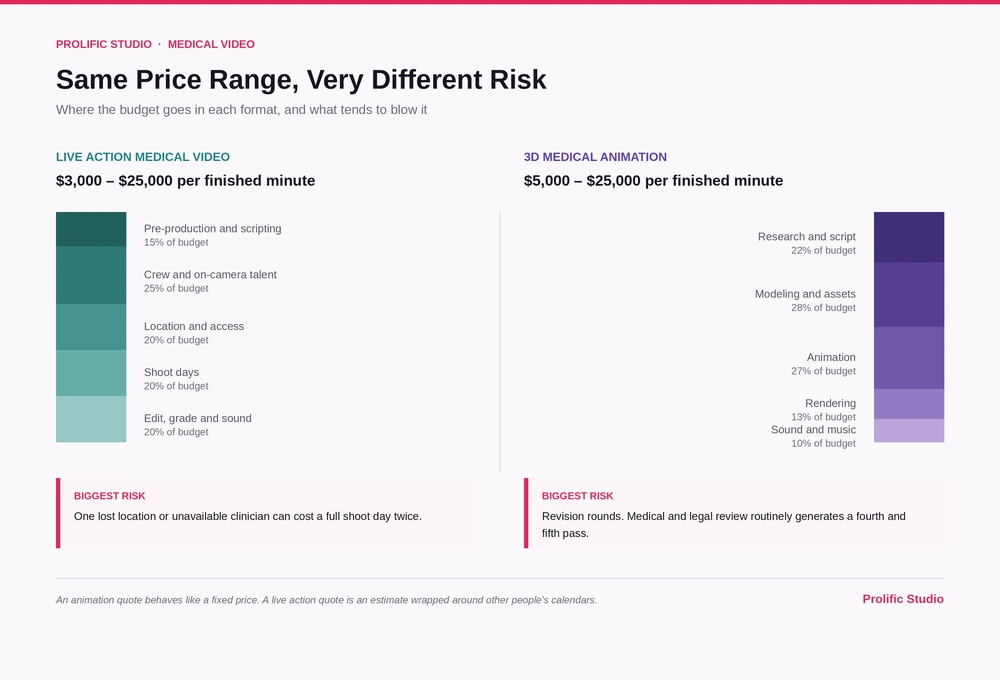
Averages hide the thing that actually decides projects, which is variance. An animation quote behaves almost like a fixed price because the studio controls every variable inside its own building.
A live action quote is an estimate wrapped around a weather forecast, a hospital scheduling office, and a surgeon who might get pulled into a real case an hour before your call time. We broke down the animation half of this in our medical animation cost guide, including the line items most quotes leave off.
Something buyers routinely miss on the filmed side: operating room access is rarely a line item you can simply purchase. It arrives with a compliance process, a sterile field nobody crosses, and a shooting window measured in hours.
How Do Timelines and Logistics Compare?
Live action is quicker to shoot and slower to schedule. Animation is slower to build and almost entirely within your control.
An interview-led medical video can move from brief to delivery in three to five weeks, and most of that is calendar rather than work. A 90-second 3D piece takes six to twelve weeks. On paper, animation looks like the slow option. In practice, an animation timeline rarely moves, while a live action one depends on people whose day jobs involve emergencies.
Then there is consent, which derails more medical shoots than budget does. Filming a patient, or filming anywhere a patient might drift into frame, pulls you into the privacy obligations set out in the HHS guidance on HIPAA. Release forms, de-identification, and a plan for what you do if someone withdraws consent after the video is cut. None of it is insurmountable, and all of it takes weeks.
Ask any producer who works in hospitals what actually goes wrong, and you will hear the same short list. The suite gets reassigned to an emergency case. The consultant who agreed to appear is called away.
Building services runs a fire alarm test during your only clean audio window. A device arrives with a serial number that legal will not clear for camera. Each of these is survivable on the day, and each one costs a shoot day you have already paid for.
Regulated promotional content adds a layer on top, whichever format you pick. The FDA’s oversight of prescription drug promotion applies to a filmed sequence exactly as it applies to an animated one. What differs is the cost of complying late. An animator reopens a scene file. A production company reopens a location booking.
Which Format Performs Better With Your Audience?
That depends on who is watching, and the pattern is fairly consistent across categories.
|
Audience |
Leans toward |
Why |
| Patients and caregivers | Animation, with a human frame | Simplified visuals lower anxiety; a real face up front builds trust |
| Prescribers and HCPs | Animation | Mechanism detail and data are the entire point |
| Surgeons and proceduralists | Hybrid | They want the real hands and the internal view |
| Procurement and hospital committees | Live action | Ergonomics, footprint, workflow fit |
| Investors and boards | Animation | Platform mechanism, differentiation, pipeline |
| Congress and booth traffic | Animation | Silent, loopable, readable from ten feet away |
Patient audiences are the interesting case. Filmed patient stories carry real emotional weight, while animation explains a procedure without the flinch factor, so the strongest patient education work usually draws on both.
Booth video deserves its own note. Congress floors are loud, so your video plays silent whether you planned for that or not. Animation is built for it. A filmed interview with the sound off is a person moving their mouth.
The Hybrid Option Most Brands Overlook
Most launch videos should be both formats, and the split usually lands near 60 percent animation to 40 percent filmed.
The logic gets clearer once you stop treating this as an either-or purchase. Film whatever earns trust. Animate whatever cannot be filmed. Then cut them so the viewer travels from a surgeon’s hands into the vessel those hands are working inside, a transition neither format achieves alone and one that audiences actually remember.

Hybrid does introduce coordination cost. You are running a production company alongside an animation studio, or a single medical animation agency that handles both, and the animated sections have to match the filmed lighting and color. Budget a few thousand for the grade that makes two halves look like one video.
Studios that do this often will build animated camera moves to match the lens choices used on the shoot, and you can tell immediately when nobody bothered. Our roundup of best medical animation examples for healthcare brands includes several hybrid pieces worth studying before you write a brief.
What Happens After the Video Is Delivered
Animation keeps earning after delivery. Live action largely stops.
Assets are the reason. A finished animation leaves you holding models, rigs, and scene files, so year three costs a re-render rather than a reshoot: a device revision, a label change, a new indication, a second market: all edits. Negotiate reuse rights in the original contract; this is one of the largest hidden savings available in the medium.
Filmed footage has the opposite profile. It is fixed. The clinician on screen may join a competitor. The device may become last generation. Even the scrubs can date a video in a way nobody notices until a prospect does.
Localization tilts the same direction. On-screen text in an animation is a layer somebody swaps out. In footage, it is frequently burned into the shot, and lip sync makes dubbing awkward in a way animation sidesteps completely. A pharmaceutical animation company running a launch across twelve markets will usually build the core asset animated for that reason alone.
Final Words
Strip out the budget conversation, and one question settles this. What does the viewer need to see to believe you, or to understand you?
If they need to believe a person, put a person on camera. If they need to understand a mechanism, build the mechanism. Most briefs need both, so the real decision is rarely which format but what proportion, and that is a conversation about your audience rather than your budget.
Send us the brief and tell us who watches it. Prolific Studio scopes filmed, animated and hybrid work across device, pharma and provider marketing, and our wider animation services run from single patient explainers to full launch campaigns. We will tell you plainly which parts of your video want a camera and which parts do not.