
3D explainer animation for SaaS is not about making a software brand look expensive for the sake of it. SaaS teams are using it because acquisition is getting harder, buyers are doing more research before talking to sales, and product pages have to explain value faster than ever.
McKinsey’s B2B Pulse research found that B2B buyers now expect more channels, more convenience, and more personalized experiences, with many willing to switch suppliers if those expectations are not met. That is the real pressure behind better SaaS visuals.
Why 3D Explainer Animation for SaaS Is Becoming a CAC Tool
Customer acquisition cost goes up when people need too much convincing.
That sounds blunt, but it is true. If your product is hard to understand, every channel gets heavier. Paid ads need more clicks. Landing pages need more copy. Sales calls take longer. Demo requests bring in poor-fit leads. Customer success has to explain the basics that should have been clear before signing up.
This is where SaaS marketing animation starts earning its place. A clear animated explanation can remove the first layer of confusion before a buyer talks to sales. It can show what the product does, who it is for, what problem it fixes, and why it is different from the tools the buyer already has.
That does not magically cut CAC by itself. But it can make the funnel less wasteful.
SaaS Buyers Do Not Want to Wait for a Sales Call to Understand the Product
B2B buying has changed in a very obvious way. Buyers still want human contact at the right time, but they also expect digital self-service, remote interaction, and useful content before they commit to a conversation.
McKinsey’s B2B research says customers want to engage across traditional, remote, and self-service channels in roughly equal measure throughout the buying journey. It also notes that B2B companies are now operating in a “ten-channel” world, not a four-or-five-channel one.
For SaaS, that means your product has to sell itself earlier.
A static homepage hero is not always enough. A list of features is not always enough. A screenshot can show an interface, but it rarely explains what happens before, during, and after a workflow.
An animated explainer video for software can do that job better. It can walk the buyer through the problem, the workflow, the outcome, and the “why now” without making them read a wall of copy.
Why 3D Works Better for Complex SaaS Than Flat Screenshots
Screenshots are useful, but they can also flatten the product.
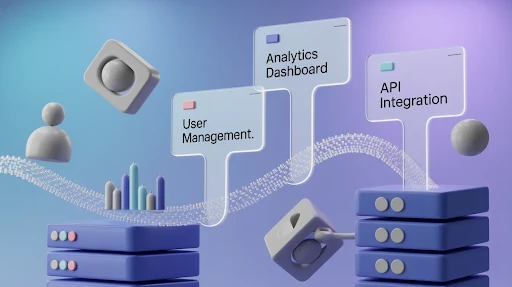
Most SaaS platforms are not just screens. They are systems. Data moves from one place to another. Users trigger actions. Automations run in the background. Reports update. Alerts route to teams. Integrations talk to each other. The value is often in the movement between steps, not in one dashboard image.
That is where a 3D animation studio can help SaaS brands show the invisible structure behind the product. The animation can turn data flow, automation, cloud architecture, security layers, or multi-user workflows into something a buyer can follow.
A 3D visual does not need to be overly technical either. The best versions are clean. They show the system without drowning the viewer in product jargon.
When 2D Is Better, and When 3D Is Worth It
This is where teams need to be honest.
Not every SaaS product needs 3D. Some products are better explained with 2D animation services, especially if the idea is simple, process-based, or more about people than systems. A scheduling tool, onboarding app, billing workflow, or lightweight productivity platform may not need a full 3D visual language.
3D becomes more useful when the product is hard to picture.
For example:
- A cybersecurity SaaS showing threat detection across systems.
- A logistics platform showing shipment visibility across regions.
- A cloud infrastructure tool showing how data moves between services.
- An AI product showing how inputs become outputs inside a workflow.
- A fintech platform showing risk scoring, approvals, and reporting layers.
That is the key difference. 2D can explain an idea. 3D can make a system feel tangible.
The Video Has to Match the Funnel Stage
A common mistake: using one explainer everywhere.
The homepage version should be short and clear. It should help a cold visitor understand the category, pain point, and product promise quickly.
The sales deck version can go deeper. It can show workflow logic, integrations, and business outcomes.
The onboarding version should not sell at all. It should help users reach the first useful action.
A paid ad cutdown should be sharper. It may only need one pain point and one visual payoff.
This is where a good explainer video guide is useful internally. Not because every SaaS team needs more documentation, but because the team needs to stop treating one video like it can solve every part of the funnel.
3D Product Explainer Video Cost Should Be Judged Against Waste
The question “What is the 3D product explainer video cost?” matters. No SaaS team should spend blindly.
But the better question is: where are we wasting money now?
Are demo calls too long?
Are paid leads confused?
Do prospects misunderstand the product category?
Do buyers compare you to the wrong competitors?
Do trial users fail before activation?
Do sales keep building custom explanations for every account?
If those problems are real, the cost of a clear explainer may be easier to justify. You are not buying animation as decoration. You are buying a reusable explanation asset that can support ads, landing pages, sales calls, onboarding, webinars, investor decks, and product launches.
SaaS Animation Should Sound Like Product Strategy, Not Agency Poetry
This is where a lot of videos lose people.
They open with vague pain. Then they show floating icons. Then a voice says something about teams working smarter. Then the product appears for eight seconds. Then the logo lands.
Nobody remembers it.
Good types of explainer videos for SaaS are more direct. They show the problem clearly. They show the product doing something specific. They name the buyer’s friction. They make the before-and-after obvious.
A founder should be able to watch the first draft and say, “Yes, that is exactly what we keep explaining on calls.”
If not, the video is probably too generic.
Paid Ads Need One Sharp Idea
Most SaaS ads try to say too much.
They mention the product category, the pain point, three features, a customer type, and a vague outcome. That is a lot to ask from someone scrolling between emails, reports, and random videos.
For paid ads, one idea is usually enough.
Show the manual process.
Show where the team gets stuck.
Show the automated fix.
Show the result.
That is where 3D explainer animation for SaaS can work well. It can show the system behind the software without needing a messy live-action setup or a screen recording that looks like every other SaaS ad.
Landing Pages Need Clarity Before Proof
A landing page has to answer the first question quickly.
“What does this actually do?”
Until that question is answered, testimonials, badges, pricing, and feature tables do not carry as much weight. A visitor cannot trust proof for a product they still do not understand.
An animated explainer video for software can handle that first layer. It should show the pain, the product flow, and the result in plain terms. Not every feature. Not every dashboard. Just the core reason the product exists.
Once that is clear, the rest of the page can do its job.
Match the Style to the Product
Some SaaS products need clean UI motion. Others need system diagrams. Some need characters. Some need abstract 3D shapes to show invisible processes like data, automation, routing, scoring, or security.
That is why understanding the types of 3D animation matters. A SaaS brand may need product visualization, motion graphics, 3D system diagrams, abstract data animation, character-led storytelling, or a hybrid of several styles.
Pick the style based on the buyer’s confusion.
If the buyer does not understand the workflow, show the workflow.
If they do not understand the architecture, show the system.
If they do not understand the outcome, show the before and after.
Do not pick a style just because it looks premium.
Keep the Product Close to the Story
Some SaaS videos look good but barely show the product.
That is risky.
The viewer should not finish the video thinking, “Nice animation, but what does the software actually do?” The product does not need to appear every second, but it should feel present. Show the dashboard when it matters. Show a simplified UI when the real screen is too complex. Show the result the user gets after the software does its job.
A skilled animation studio in the USA should know when to simplify the interface and when to show real product behavior. Too much detail becomes noise. Too little detail feels fake.
Logo Motion Should Be a Finishing Touch
Brand polish matters, but the logo should not steal time from the explanation.
For SaaS, logo animation services are useful for product launch videos, YouTube intros, webinar clips, sales decks, and social cutdowns. A clean logo motion system makes the brand feel consistent across touchpoints.
Just keep it short.
A buyer watching a SaaS explainer wants the problem solved quickly. A long logo reveal at the start can make the video feel slow before the message even begins. Use the logo like a signature, not a curtain that takes too long to open.
Where Explainer Video Company Fits In
For brands that want a focused partner for explainer work, Explainer Video Company is our newly founded child company, launched in 2026. It specializes in explainer videos for brands that need clearer product communication, stronger sales assets, and sharper animated content without turning the project into a bloated production.
Frequently Asked Questions
Final Words
3D explainer animation for SaaS helps reduce customer acquisition costs when it makes the product easier to understand before sales have to step in. It can support paid ads, landing pages, demos, onboarding, product launches, and retention content.
The key is focus. Do not make a pretty video that says nothing. Build an explanation asset that answers the buyer’s real question, filters poor-fit leads, and helps the right users move faster. That is how animation starts, cutting waste from the SaaS funnel instead of just decorating it.
Related Articles: