3D medical animation vs live action video is not really a fight between two formats. It is a choice between what needs to be seen and what needs to be felt.
Live action is good when the viewer needs a human face. A doctor speaking calmly. A patient sharing an experience. A clinic team showing real care. A lab, hospital, or device team proving there are real people behind the work.
3D medical animation does a different job. It shows the part nobody can film properly. A drug action inside the body. A stent opening in an artery. A surgical tool moving through tissue. A device sitting in anatomy. A disease pathway changing over time.
So the better question is not, “Which format looks better?”
The better question is, “What is the viewer struggling to understand?”
3D Medical Animation vs Live Action Video: What Changes on Screen?
The biggest difference is control.
Live action records what is in front of the camera. That can be powerful. Real faces, real rooms, real hands, real emotion. But the camera has limits, especially in healthcare.
It cannot move through a blood vessel on command. It cannot show a molecular interaction clearly. It cannot remove blood, glare, background clutter, or awkward angles from a surgical scene. It cannot slow down a biological process and show it from three clean views.
Animation can.
A good animation production company should not push 3D just because it looks impressive. That is the wrong reason. The format should match the problem. If the audience needs trust, use people. If the audience needs internal detail, use animation.
That one rule saves a lot of wasted production time.
Where Live Action Medical Video Still Wins
Live action medical video works best when the story needs warmth.
A hospital introduction usually needs real clinicians. A patient testimonial needs a real person. A founder story needs a real voice. A doctor explaining a treatment can feel more reassuring than a fully animated piece, especially when the patient is nervous.
There are times when a healthcare brand should show the room, the team, the tools, the environment, and the people doing the work.
Live action also helps when the product or process can be shown clearly. A nurse demonstrating an at-home device. A physician explaining pre-surgery instructions. A researcher walking through lab work. These moments feel more believable when they are filmed.
But live action starts to struggle when the important part is hidden.
That is where the video can become vague. The doctor explains what happens inside the body, but the viewer is still imagining it. The device is held in someone’s hand, but the buyer still does not see how it behaves once placed. The treatment is discussed, but the mechanism stays abstract.
For those cases, live footage alone is not enough.
Where 3D Medical Animation Makes More Sense
3D medical animation is usually the stronger choice when the viewer needs to see inside, under, through, or beyond the surface.
A device deployment.
A surgical pathway.
A drug mechanism.
An anatomy sequence.
A diagnostic process.
A cellular response.
A product feature that cannot be filmed cleanly.
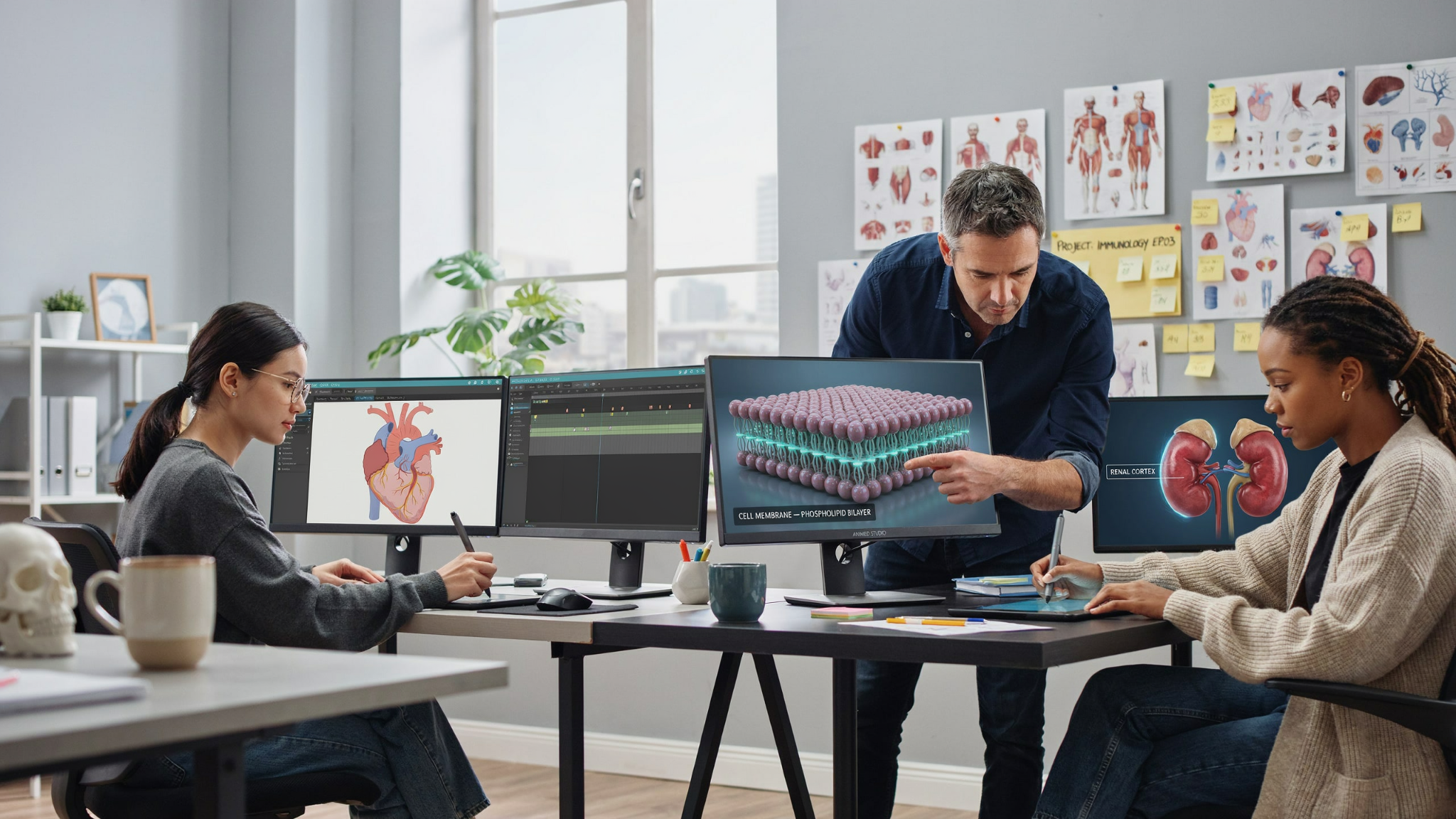
These are the areas where medical animation studios tend to give healthcare teams more control. The scene can be simplified without becoming inaccurate. The camera can move exactly where the explanation needs it. The animation can highlight one structure and hide everything else for a few seconds.
That matters because medical content gets confusing fast.
A cluttered live procedure may be technically real, but still difficult for patients or buyers to understand. A clean animated medical video can guide the eye and make the same idea easier to follow.
The goal is not to make healthcare look more dramatic.
The goal is to make the important part visible.
Patient Education Often Needs Both Formats
A patient education video can work beautifully when live action and animation are used together.
Start with a doctor speaking directly to the patient. Keep it calm. Keep it human. Let the viewer feel that a real person understands the concern.
Then use animation to show the part the doctor cannot point to easily.
For example, a knee replacement video may use live action for the surgeon’s explanation, then 3D to show the joint damage and implant placement. A heart procedure video may show the doctor first, then animation of the catheter path. A cancer care video may use live action for reassurance, then animation for the treatment concept.
This is why the “medical animation vs live action” decision is not always either-or.
Sometimes the best healthcare video production uses both formats in the same piece. Live action handles trust. Animation handles clarity.
That combination works because patients do not only need facts. They need to feel less lost.
Medical Explainer Video Services Should Start With the Confusion

A medical explainer video should not begin with the format.
It should begin with the viewer’s problem.
What are they not understanding? What do they keep asking? Where does the sales conversation slow down? Which part of the procedure makes patients nervous? Which product feature sounds good in words but does not click until people see it?
That is where medical explainer video services can make a real difference.
If the topic is a clinic service, doctor-led message, care program, or patient welcome video, live action may be enough. If the topic involves anatomy, device function, pathology, diagnostics, surgery, or pharma science, animation may explain it faster.
The format should not be chosen because one looks more polished.
It should be chosen because it answers the viewer’s question with less effort.
Pharma and MOA Videos Usually Need Animation
Pharmaceutical content is rarely easy to show with live action.
A treatment may interact with receptors, enzymes, immune cells, proteins, inflammatory signals, or disease pathways. That does not show up clearly in a filmed scene. A scientist can explain it, yes, but the viewer still has to build the picture in their head.
That is hard work.
This is where mechanism of action animation services are often the better fit. A mechanism of action video can show the disease process first, then the target, then the treatment interaction, then the intended response.
That order helps the viewer stay with the science.
The mistake is trying to include every possible pathway, label, and downstream effect. Then the video becomes a moving textbook. Nobody wants that, especially during a sales meeting, investor presentation, or HCP education session.
A good pharmaceutical animation video gives the viewer a clear route.
Problem. Target. Action. Result.
That is usually enough for the first pass.
Live Action Makes the Brand Feel Real
Healthcare brands should not abandon live action just because 3D can show more.
People still want to see people.
A medical device company can use 3D to show how the device works inside anatomy, then live action to show the engineers, clinicians, or trainers behind it. A biotech company can use animation for the science, then a founder interview for the mission. A hospital can use 3D for procedure education, then live action for patient reassurance.
That mix feels more complete.
Animation explains the hidden part. Live action reminds the viewer that real professionals are involved.
For healthcare, that balance matters.
Cost Depends on What You Need to Show
A live action medical video can be simple or expensive.
A doctor interview in one clinic room is not the same as a full hospital shoot with lighting, crew, patient stories, multiple locations, makeup, sound, approvals, and retakes. The budget moves fast once real people, rooms, schedules, and compliance reviews are involved.
3D has a different cost shape.
The expensive part is usually the build: anatomy models, device models, textures, rigging, medical review, storyboards, and revisions. Once those assets exist, they can often be reused. A device model can support a sales video, trade show loop, training clip, and website visual. A body system model can support more than one healthcare animation video.
So the cheaper option depends on the job.
If the project needs real people and one simple message, live action may be leaner. If the project needs internal anatomy, product function, or a mechanism of action video, animation may save time and confusion later.
Timelines Are Different Too
Live action has a lot of moving parts.
You need locations, schedules, permissions, clinicians, patients or actors, crew, equipment, wardrobe, lighting, sound, and backup plans. A small shoot can move quickly. A healthcare shoot with approvals can drag if one person is unavailable or one location is not ready.
3D production does not need a clinic room or operating theater, but it does need careful planning.
The script has to be right. The storyboard has to be approved. The medical details have to be checked before the team gets too deep into animation. Once rendering begins, late changes can become painful.
That is why medical video production should never rush the planning stage. Whether it is filmed or animated, the early decisions save the project later.
Review Can Be Harder Than Production
Healthcare videos rarely get approved by one person.
Medical, legal, brand, product, clinical, sales, and sometimes regulatory teams may all have opinions. That is normal. It is also where projects get stuck.
Live action has one annoying problem: if something was filmed wrong, fixing it may mean a reshoot. Wrong wording. Bad room choice. Missing shot. Product shown from the wrong angle. A doctor who said the line differently than approved. These are not always easy fixes.
Animation has more room for revision, but only up to a point. Changing a label is easy. Rebuilding a device movement after final animation is not.
For any healthcare marketing video, review the script and storyboard carefully before production gets expensive. It sounds basic. It saves budgets.
Device Demos Usually Favor 3D

Medical device teams often need to show more than the product’s outer shape.
They need to show how it enters the body, where it sits, how it expands, how it reads data, how it locks, how it releases, or how it avoids surrounding anatomy.
That is hard to do with live footage alone.
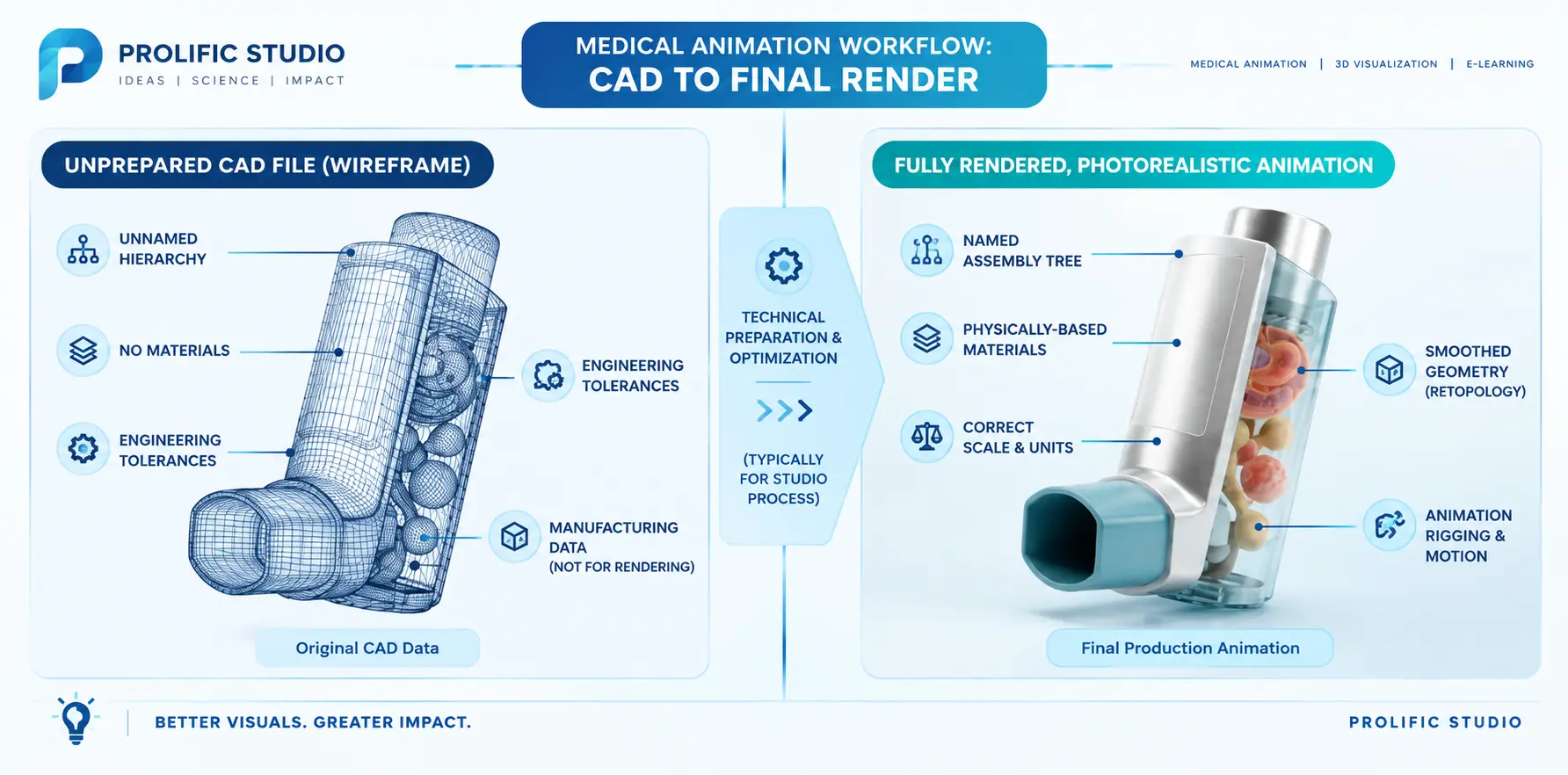
A medical device animation can remove clutter and show the exact function. It can open the device, isolate parts, show scale, and compare old versus new movement. This is useful for product launches, sales training, investor decks, HCP education, and conference booths.
Live action can still help. Show the device in a clinician’s hand. Show the packaging. Show the team. Show training use.
But when the buyer needs to understand function, 3D usually carries the heavier explanation.
Final Words
3D medical animation vs live action video comes down to one question: what does the viewer need to understand or feel?
Live action is stronger for trust, emotion, real teams, real places, and human reassurance. 3D is stronger for anatomy, device function, surgery, pharma mechanisms, microscopic science, and anything that cannot be filmed clearly. The smartest medical video production often uses both formats, with each one doing the job it is actually good at.
Frequently Asked Questions
When Should Healthcare Brands Use Live Action?
Use live action when the viewer needs to see real doctors, patients, teams, facilities, product handling, or a human explanation that builds confidence.
When Should Healthcare Brands Use 3D Animation?
Use 3D when the topic involves anatomy, device function, cellular activity, drug mechanisms, surgery, diagnostics, or anything that cannot be filmed clearly.
Can Medical Videos Use Both 3D and Live Action?
Yes. Many strong healthcare videos use live action for trust and animation for explanation. This works well for patient education, device demos, pharma content, and biotech storytelling.
Which Format Costs More?
It depends on the project. Live action costs rise with locations, crew, talent, and reshoots. 3D costs rise with model detail, scientific accuracy, rendering, animation complexity, and review needs.
Related Articles: