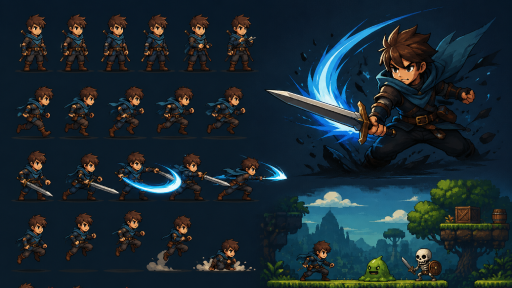
The success of a 2D game rarely depends on graphics alone. While beautiful environments and memorable character designs attract players, it’s animation that truly brings a game to life. Every movement, attack, jump, and reaction tells a story, making characters feel responsive and believable.
Whether you’re building a fast-paced platformer, a role-playing adventure, a fighting game, or a mobile puzzle game with animated mascots, the quality of your character animations directly affects the player’s experience. Smooth, responsive animation improves gameplay, enhances immersion, and gives players confidence in every action they perform.
At Prolific Studio, we understand that game animation is much more than moving a character from one frame to another. Our team creates animations that balance artistic creativity with technical precision, ensuring every movement feels natural while maintaining optimal performance across platforms. Through our professional 2D Animation Services, we help game developers create engaging worlds filled with expressive characters and fluid gameplay.
In this guide, we’ll explore the most important animation types used in modern 2D games, explain why each one matters, and share best practices that professional studios use to create memorable gaming experiences.
Why Animation Is Critical in 2D Games
Unlike animated films, where viewers simply watch the action unfold, video games are interactive. Every movement depends on player input.
Players expect immediate responses whenever they press a button. If a character reacts slowly or the animations feel stiff, the gameplay quickly becomes frustrating.
Good game animation helps players:
- Understand what their character is doing
- React to enemies and obstacles
- Feel emotionally connected to the game
- Enjoy smoother gameplay
- Recognize attacks, abilities, and movement patterns
Professional game animation combines visual appeal with functionality. Every frame has a purpose beyond simply looking attractive.
Understanding Animation States
Before creating animations, developers typically organize characters into animation states.
Each state represents a specific action that can transition into another action depending on player input.
Common animation states include:
- Idle
- Walking
- Running
- Jumping
- Falling
- Landing
- Attacking
- Taking Damage
- Death
- Victory
Modern game engines like Unity and Unreal Engine use animation state machines that smoothly transition between these movements.
1. Idle Animation
Idle animation may seem simple, but it’s one of the most important animations in any game.
Whenever the player stops moving, the character shouldn’t freeze like a statue. Small movements make the character appear alive and ready for action.
Typical idle animations include:
- Breathing
- Looking around
- Blinking
- Adjusting clothing
- Holding weapons differently
- Tail movement
- Hair movement
- Floating effects
These subtle details add personality without distracting the player.
For example:
- A knight may tighten their grip on a sword.
- A wizard’s cloak might sway slightly.
- A robot may emit blinking lights.
- A dragon may gently flap its wings.
The goal is to communicate life, even when the player isn’t actively moving.
2. Walk Animation
Walking is the foundation of character movement.
A believable walk cycle communicates:
- Weight
- Personality
- Mood
- Character type
Different characters should never share identical walking styles.
Consider these examples:
A soldier
- Confident posture
- Firm steps
- Controlled movement
A zombie
- Uneven stride
- Slow movement
- Dragging feet
A child
- Light steps
- Energetic motion
- Slight bounce
Professional animators carefully balance body mechanics so loops feel seamless without obvious repetition.
3. Run Animation
Running animations communicate speed and urgency.
Compared to walking:
- Longer strides
- Faster arm movement
- More exaggerated body lean
- Greater vertical motion
Run cycles are essential in:
- Platformers
- Action RPGs
- Endless runners
- Adventure games
- Fighting games
Since players spend significant time running, these animations must remain visually appealing even after hundreds of repetitions.
4. Jump Animation
Jumping appears in nearly every 2D game genre.
However, a convincing jump involves several stages rather than a single animation.
Professional jump animations include:
Anticipation
The character bends knees before launching.
Takeoff
The body pushes upward.
Airborne
The character reaches maximum height.
Falling
Gravity begins pulling the character downward.
Landing
Impact is absorbed naturally.
Using principles like Squash and Stretch makes jumps feel energetic and satisfying.
5. Landing Animation
Landing deserves its own animation.
Heavy characters should hit the ground differently than lightweight characters.
Landing can communicate:
- Weight
- Fall distance
- Surface material
- Damage
Small jumps may require only a brief landing.
Long falls often include:
- Dust effects
- Camera shake
- Larger body compression
6. Attack Animation
Combat defines many modern games.
Attack animations must clearly communicate:
- Attack direction
- Timing
- Reach
- Damage window
Poor attack animation leads to confusing gameplay.
Common attack types include:
- Sword swings
- Punches
- Kicks
- Magic casting
- Bow shooting
- Spear thrusts
- Gun firing
Each attack requires anticipation, impact, and recovery phases.
7. Combo Animation
Many action games allow players to chain attacks together.
Instead of isolated movements, combo systems smoothly transition between multiple attacks.
Examples include:
- Punch → Kick
- Slash → Spin Attack
- Fireball → Dash Strike
Well-designed combos improve gameplay while making combat more visually exciting.
8. Damage Animation
Characters shouldn’t ignore enemy attacks.
Damage reactions provide essential gameplay feedback.
Common reactions include:
- Small flinch
- Knockback
- Stagger
- Shield block
- Falling backward
Different enemy attacks may trigger different reactions depending on damage strength.
9. Death Animation
Every game eventually requires characters to die.
Death animations should match both gameplay and story tone.
Examples include:
- Falling forward
- Exploding
- Turning into dust
- Melting
- Collapsing dramatically
- Disappearing into magic
Boss characters often receive elaborate multi-stage death animations that reward players after difficult battles.
10. Victory Animation
Celebrating success gives players emotional satisfaction.
Victory animations may include:
- Sword raised
- Dancing
- Cheering
- Magic effects
- Character posing
- Saluting
These animations frequently appear after completing levels or defeating bosses.
11. Special Ability Animation
Many modern games feature unique abilities.
Examples include:
- Teleportation
- Super attacks
- Healing
- Flying
- Shape shifting
- Summoning creatures
These animations often combine hand-drawn artwork with particle effects for dramatic visuals.
12. Environmental Interaction Animation
Interactive worlds feel more immersive.
Characters may:
- Open doors
- Push crates
- Pull levers
- Climb ladders
- Swim
- Sit
- Pick up objects
These animations strengthen the connection between players and the game world.
13. Climbing Animation
Platform games often include climbing mechanics.
Animations vary depending on:
- Rope climbing
- Ladder climbing
- Wall climbing
- Vine climbing
- Mountain climbing
Smooth transitions between climbing and walking maintain gameplay flow.
14. Swimming Animation
Water changes movement dynamics.
Swimming animations usually include:
- Floating
- Diving
- Surface swimming
- Underwater movement
Additional ripple and splash effects improve realism.
15. Flying Animation
Flying creatures require completely different movement systems.
Examples include:
- Birds
- Dragons
- Fairies
- Spacecraft
- Magical characters
Wing speed, body tilt, and hovering all contribute to believable aerial motion.
Principles Behind Great 2D Game Animation
Professional animators rely on classic animation principles while adapting them for interactive gameplay.
Key principles include:
Timing
Movement speed affects gameplay responsiveness.
Spacing
Frame spacing controls acceleration and deceleration.
Anticipation
Preparing players before major actions.
Squash and Stretch
Adds flexibility and impact.
Follow Through
Secondary motion improves realism.
Arcs
Natural movement rarely occurs in straight lines.
Exaggeration
Stylized games often exaggerate actions for better readability.
Optimizing Animations for Performance
Beautiful animation should never reduce game performance.
Studios optimize by:
- Using sprite atlases
- Reusing animation cycles
- Compressing sprite sheets
- Reducing unnecessary frames
- Sharing skeleton rigs
- Optimizing texture sizes
Efficient animation keeps games smooth across mobile devices, PCs, and consoles.
How Prolific Studio Creates Engaging 2D Game Animation
At Prolific Studio, we combine creativity with technical expertise to deliver animations that elevate gameplay. Our artists collaborate closely with developers, designers, and storytellers to ensure every movement supports both the game’s mechanics and its visual identity.
Our 2D Animation Services are designed for game studios, indie developers, startups, and entertainment brands seeking expressive, performance-optimized animation. From concept development and character design to animation production and implementation-ready assets, we focus on creating animations that are visually compelling and technically efficient.
Whether your project requires charming frame-by-frame animation, cutscenes, combat sequences, or polished character movement, our team tailors every animation to your game’s style and platform requirements.
If you’re looking to learn more about our capabilities, explore our 2D Animation page to see how we help transform creative ideas into immersive gaming experiences.
Common Mistakes to Avoid
Even experienced developers can run into animation challenges. Some of the most common issues include:
- Overly long animations that delay player input
- Lack of anticipation before attacks
- Identical movement for every character
- Abrupt transitions between animation states
- Ignoring character weight and momentum
- Poor frame timing that makes motion appear unnatural
- Excessive animation detail that impacts performance
Avoiding these pitfalls leads to smoother gameplay and a more enjoyable player experience.
The Future of 2D Game Animation
Although 3D gaming continues to evolve, 2D games remain incredibly popular thanks to their artistic flexibility and timeless appeal. Advances in animation tools now allow developers to blend traditional frame-by-frame animation with skeletal rigs, procedural motion, and dynamic effects, creating richer experiences than ever before.
As indie games, mobile titles, and cross-platform releases continue to grow, high-quality animation will remain a defining factor in player engagement. Studios that invest in polished, expressive character animation will stand out in an increasingly competitive market.
Final Thoughts
Animation is the heartbeat of every successful 2D game. From a character’s first idle pose to their final victory celebration, every movement shapes how players experience your game.
Creating responsive, expressive animations requires artistic skill, technical understanding, and a deep appreciation for gameplay mechanics. When done well, animation not only enhances visuals but also strengthens storytelling, improves user experience, and makes every interaction feel rewarding.
Whether you’re developing a side-scrolling platformer, an action RPG, a fighting game, or a casual mobile experience, investing in professional 2D animation is one of the smartest decisions you can make. At Prolific Studio, we’re passionate about helping developers create memorable gaming experiences through expertly crafted animation that captivates players and brings digital worlds to life.