Blue Eye Samurai did not arrive as a small experiment that slowly found its crowd. It landed on Netflix on November 3, 2023, with a very clear identity, a heavy visual signature, and a lead character who was never going to disappear into the streaming pile.
Netflix’s official page still frames it in the bluntest possible terms: Mizu is a young warrior in Edo-period Japan, driven by revenge against those who made her an outcast. Since then, the show has not only been renewed for Season 2 but has also won the Creative Arts Emmy for Outstanding Animated Program.
Why Blue Eye Samurai Never Felt Like “Just Another Netflix Adult Animation Show”
That sounds obvious now, but it was not obvious on paper. A revenge story set in 17th-century Japan could have gone in a lot of predictable directions. It could have leaned on empty cool. It could have drowned in stylized violence and called that depth. It could have borrowed the surface of samurai cinema without building a real emotional center.
What helped the series right away was that the pitch had tension inside it. Tudum’s official series write-up describes Mizu as a mixed-race master of the sword living in disguise while hunting the four white men who remained illegally in Japan during the closing of its borders.
That already gives the show a harder emotional edge than a lot of prestige-looking genre animation. The revenge is not random. It is tied to shame, identity, inheritance, and self-hatred.
The Premise Is Clean, but the Show Is Not Simple
That is one of the better things about it. The setup is easy to explain. The actual series is not.
If someone asks what is Blue Eye Samurai about, you can answer in one line and still miss most of the weight. Yes, Mizu is hunting men tied to her origin. Yes, it is an Edo-period revenge drama. But the show is also about gender performance, social exclusion, status, humiliation, restraint, and the ugly logic of deciding that vengeance is the only shape your life can take.
That is why the character does not feel like a stock action lead. She feels like somebody who has been bent around a wound for a long time.
The Voice Casting Was More Deliberate Than It First Looked
The Blue Eye Samurai cast helps a lot here. Netflix’s cast guide says Amber Noizumi and Michael Green wanted to prioritize performers of Asian heritage when casting the series, and that gives the voice bench a different feeling from the usual “who can we get on the poster” approach.
Maya Erskine voices Mizu, with George Takei, Masi Oka, Cary-Hiroyuki Tagawa, Brenda Song, Darren Barnet, and Randall Park all in the main mix. Kenneth Branagh is there too, but the center of gravity is pretty clear.
That matters because Mizu cannot be played like a cool symbol. She has to sound like somebody who has suffered a lot of damage. Erskine gives her enough control that the character never turns melodramatic, but she also lets the strain show.
That is a hard balance. It is probably why so many people looking up who voices Mizu in Blue Eye Samurai end up remembering the performance long after the plot beats blur together.
Why Blue Eye Samurai Looks Handmade Even When It Clearly Isn’t
This is where the show really separates itself. A lot of people try to describe it quickly and end up calling it anime-adjacent or cinematic or painterly and then stop there. None of those descriptions is completely wrong, but they are still too blunt.
Netflix’s behind-the-scenes material describes the show as vivid adult animation with a live-action edge. Blue Spirit’s own project page is even more revealing.
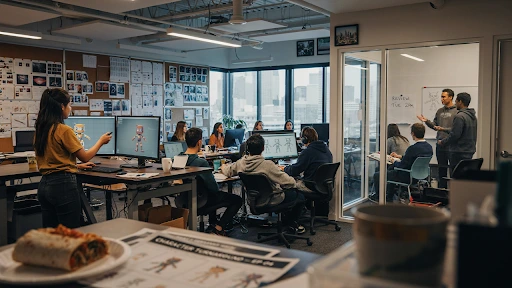
The studio lists the production as CGI animation with HD 2D backgrounds, and then breaks out the actual pipeline pieces: 2D background work, CG assets fabrication, CGI layout, CGI animation, FX, rendering, and compositing. In other words, the series looks hand-touched because the team built it to feel that way, not because it was avoiding CG altogether.
That is why the series is useful when people start flattening everything into a fake 2D vs 3D animation argument. Blue Eye Samurai is a good reminder that the real question is not which camp wins. The real question is what combination gives the material its own skin.
The Hybrid Style Feels Like a Choice, Not a Compromise
That difference matters more than people think. Some hybrid projects look like they ended up between techniques by accident. This one does not.
The Blue Spirit breakdown makes it clear that the team used a mix of 2D backgrounds and CG-heavy production stages, but the final result does not read as a pipeline compromise.
It reads like intent. The series keeps the edge of something drawn while still getting the camera control, depth, lighting, and fight staging that a pure flat-TV approach might have struggled to hold at the same scale.
That is why the show becomes a much better example of types of 3D animation than the term usually gets credit for. Not everything in 3D has to advertise itself as shiny, rounded, or “fully digital-looking.”
It also explains why this thing feels more tactile than a lot of work from a modern animation studio pipeline, which is technically cleaner but emotionally thinner. The texture here is part of the storytelling.
This Is Also Why the Show Keeps Getting Talked About Like a Prestige Drama
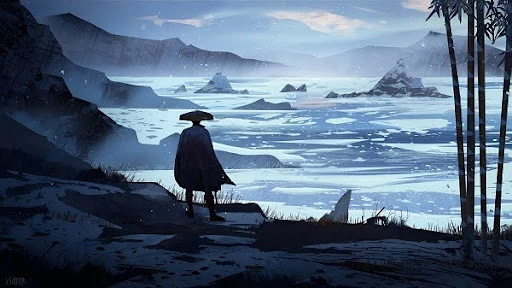
Not because it looks expensive. Plenty of shows look expensive now. Because it feels authored.
That is the thing people are usually reaching for when they say a series “stands out.” It is not only about polish. It is about whether the world feels interpreted by somebody instead of merely assembled. Blue Eye Samurai has that.
Netflix now openly brands it as an Emmy-winning series, and that tracks. It does not feel like it was engineered to match a genre slot. It feels like a show that knew its own shape from the start.
You could even say it has more in common with carefully staged 2D video animation services work than with a lot of noisy action animation. The image is always doing narrative work, not just mood work.
Season 2 Matters Because the First Season Actually Set a High Bar
A lot of streamers renew visually impressive shows because they look like they should matter. That is not quite the same thing as earning a second season. In this case, Netflix renewed the show back in December 2023, and Tudum now says Blue Eye Samurai season 2 is officially in production with a sneak peek already released.
That means the show has moved past launch hype and into the harder phase where it has to prove the first season was not just a great-looking strike.
And that is the right pressure for it to be under.
The Hybrid Look Works Because It Never Turns Into a Tech Demo
A lot of hybrid shows run into the same problem. They want the prestige of saying they blend 2D and 3D, but the final image just ends up looking like two pipelines politely tolerating each other.
This series avoids that. Blue Spirit’s own project page lays the process out pretty plainly: HD 2D backgrounds, CG asset fabrication, CGI layout, CGI animation, FX, rendering, and compositing. That is a lot of digital machinery, but the finished image does not feel like it is showing off the machinery. It still feels worked by hand.
That distinction matters. There is a version of this show that could have leaned much harder into slickness and lost half its atmosphere.
If it had started chasing the kind of glossy finish people associate with 3D video animation services, the world might have looked richer for a second and less haunted after that. Here, the slight roughness and the controlled flatness do more emotional work than a shinier surface would have.
The Show’s Violence Feels Drawn, Not Processed
That is part of why the action sticks with people. The blood, the blade contact, the impact frames, the pauses before a strike, none of it feels like the show is trying to imitate a game cinematic or a blockbuster trailer beat for beat. It feels illustrated, then pushed into motion.
Blue Spirit’s CEO told the CNC that the production pursued a 2D aesthetic inspired in part by Japanese animation in both character design and acting, even though the studio handled the animation pipeline from layout through final shots. That explains a lot. The team was not only building movement. It was guarding a very particular visual attitude.
That is why the series feels farther away from 3D game trailer services than people might expect, even though it can be just as controlled in action staging. Those trailers are built to sell instant spectacle. Blue Eye Samurai is doing something harsher. It wants the impact to feel personal, not merely impressive. That is a different use of precision.
Blue Eye Samurai Is a Good Reminder That Pipeline Talk Is Usually Too Shallow
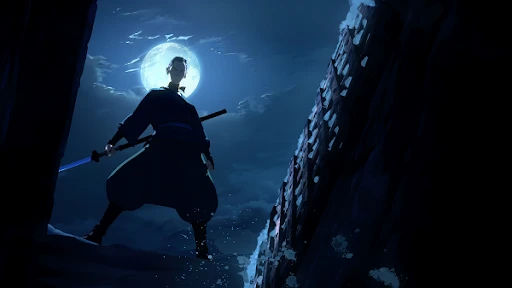
People love reducing animation conversations to labels. 2D. 3D. anime. prestige. cinematic. premium. Those words are not always useless, but they get lazy fast. This show is a pretty strong argument for looking past them. If you only describe it as a hybrid, you miss the point. If you only describe it as Netflix adult animation, you miss the point.
The interesting part is how the pipeline choices support mood, not how easy they are to summarize. Blue Spirit’s official breakdown makes it clear there were multiple production stages working together, but the result reads as one coherent image system rather than a pile of departments stitched together at the end.
That is also why the usual arguments around 2D animation software feel a bit beside the point here. Software matters, obviously. Tools matter. But this show is a good case study in how tool choice only becomes meaningful when the creative target is unusually clear.
The series did not stand out because somebody picked a magical pipeline. It stood out because the team knew what it wanted the image to feel like before the tool conversation ended. That is an inference, but it is the one the finished work keeps pointing back to.
Frequently Asked Questions
Final Words
Blue Eye Samurai works because every major choice seems to be pulling in the same direction. The writing, the voice work, the violence, the stillness, and the hybrid image all serve the same mood instead of fighting for attention.
That is why the show feels more complete than a lot of “prestige” animation that only has surface confidence. It is also why Season 2 matters. The first season did not just look different. It proved that adult animation can feel handmade, controlled, and emotionally severe without giving up scale.
Related Articles: