

Start with what the product lets someone do, not what it is. That single reordering fixes most technical explanations before you change a word of the vocabulary.
Engineers describe products from the inside out: architecture, then components, then capability, then benefit. Buyers need the reverse. They need the outcome first, and they will only ask how it works once they care that it does.
The gap is not intelligence. Your buyer is smart. They are just not fluent, and fluency is what your team forgot they had.
What follows is the working method: how to explain technical products to non-technical buyers without stripping out a single accurate claim.
Key Takeaways
- Learning how to explain technical products starts with reordering, not rewording. Outcome first, mechanism second, proof third.
- Lead with what it does for them, then how it works, then why you can be believed.
- The problem is the curse of knowledge, not your buyer’s ability. Once you know something, you cannot remember not knowing it.
- Simplifying is not dumbing down. You are removing jargon, not accuracy. Those are different edits.
- Every industry loses buyers at a different point. Medical devices lose them on mechanism, construction on tolerance, electronics on spec inflation, office furniture on invisible engineering.
- Some things cannot be explained in words at all. Anything spatial, sequential, or internal needs to be shown.
- Test your explanation on someone outside the company. If they cannot repeat it back, it does not work yet.
Why Smart Technical Teams Keep Losing Non-Technical Buyers
There is a well-documented cognitive trap behind this. The curse of knowledge describes what happens when you know something so well you can no longer imagine not knowing it.
The classic demonstration: one person taps a famous song on a table while another tries to name it. Tappers predict the listener will get it about half the time. Listeners manage around three percent. The tapper hears the melody. The listener hears knocking.
Your product page is knocking.
This is why technical to non-technical communication fails in a specific pattern. The writing is not bad. The writer just cannot hear how it lands. They read “adaptive thermal regulation across the substrate layer” and hear a clear, useful sentence. The buyer hears nothing.
Worse, the failure is invisible. Nobody emails to say your explanation confused them. They just leave, and your analytics record it as a bounce rather than a translation error.
This is the central problem with explaining complex technology in marketing. The people best qualified to describe the product are the least able to hear how it sounds.
The One Question That Reframes Any Technical Explanation
Before writing anything, answer this: what does this let someone do that they could not do before?
Not what it has. What it enables. The distinction sounds small and changes everything.
“Sixteen-channel simultaneous sampling” is a feature. “You can test every sensor on the line at once instead of one at a time” is what it lets someone do. Same fact. One of them a buyer can act on.
It also protects you from what technical teams fear most about explaining complex products simply: losing precision. You are not making the claim vaguer; you are stating it in terms of consequence. The sixteen channels are still there. You stopped leading with them.
How Do You Sell a Technical Product to a General Audience?
You sell to the least technical person in the room, then give the most technical person somewhere to go. That is not a compromise; it is arithmetic. B2B purchases now involve a buying group of roughly six to ten people, and only one or two of them evaluate your architecture.
The rest are assessing risk, cost, and whether this makes their job easier. If your material only speaks to the engineer, you have persuaded one vote out of eight.
So the goal when you simplify technical product marketing is not to write down to anyone. It is to write a first layer everyone can act on and hold the depth in reserve. Nobody is insulted by a clear opening sentence. Plenty are lost by a dense one.
Explainer video services tend to work well here for exactly that reason: one asset the whole committee can watch together, rather than a document only one of them finishes.
Five Rewrites: Spec Sheet Language vs Buyer Language
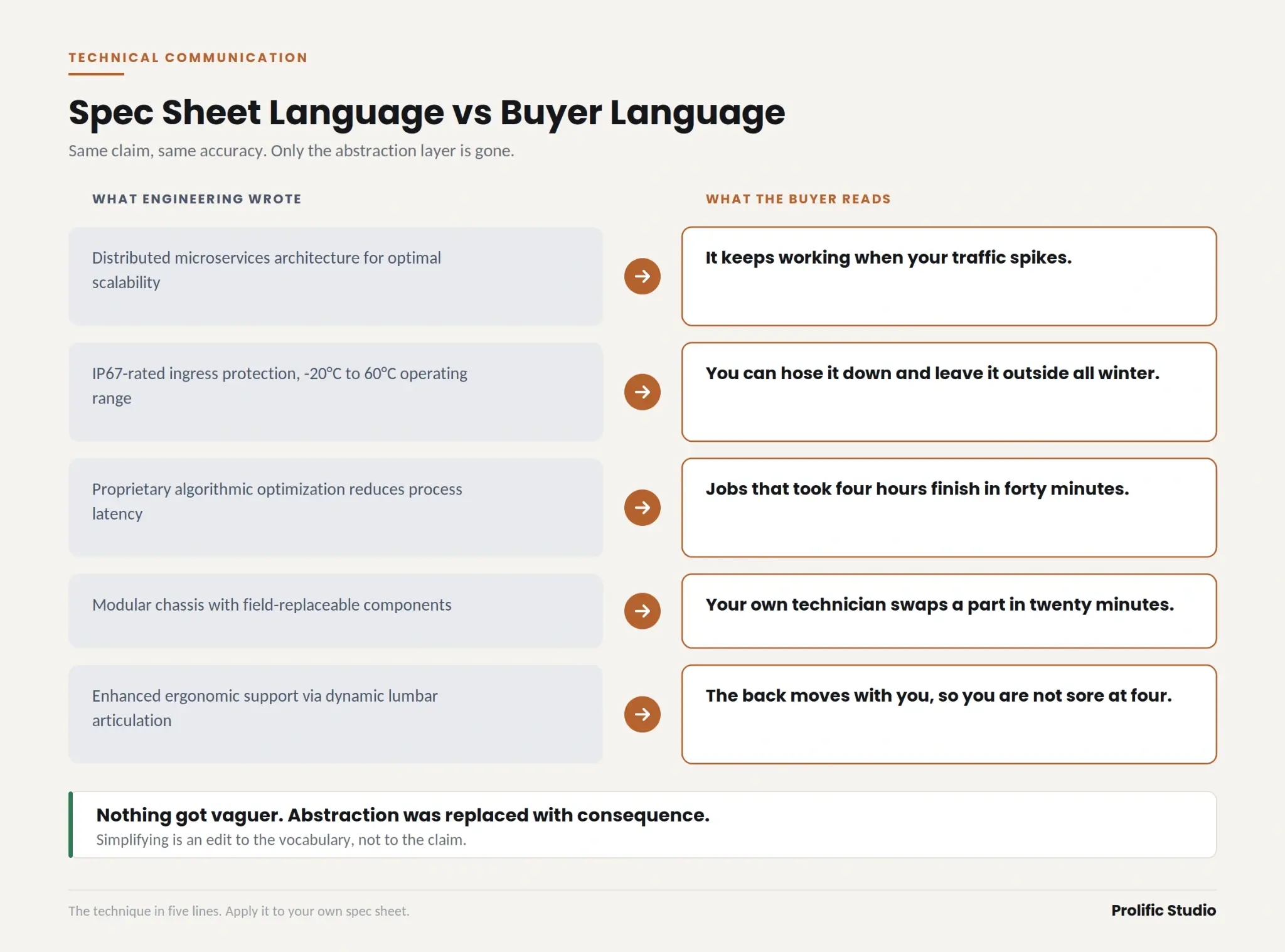
Abstract advice about clarity is useless. Here is the edit itself.
Before: Our platform leverages a distributed microservices architecture for optimal scalability. After: It keeps working when your traffic spikes, because each part scales on its own.
Before: The unit features IP67-rated ingress protection and an operating range of -20°C to 60°C. After: You can hose it down and leave it outside all winter.
Before: Utilizes proprietary algorithmic optimization to reduce process latency. After: Jobs that used to take four hours finish in about forty minutes.
Before: Engineered with a modular chassis supporting field-replaceable components. After: When a part fails, your own technician swaps it in twenty minutes. No service call.
Before: Delivers enhanced ergonomic support through dynamic lumbar articulation. After: The back moves with you, so you are not sore at four o’clock.
Look at what actually changed. No claim got softer. Every “after” is still true and still specific. What disappeared was the abstraction layer, and what replaced it was a consequence the reader can picture. That is the whole technique for how to simplify a complex product for customers.
The same edit works in any medium, which matters when you are picking one: our breakdown of the types of explainer videos maps which format suits which kind of message, since how to explain complex technology simply depends partly on what you are explaining it with.
The Three-Layer Model: Outcome, Mechanism, Proof
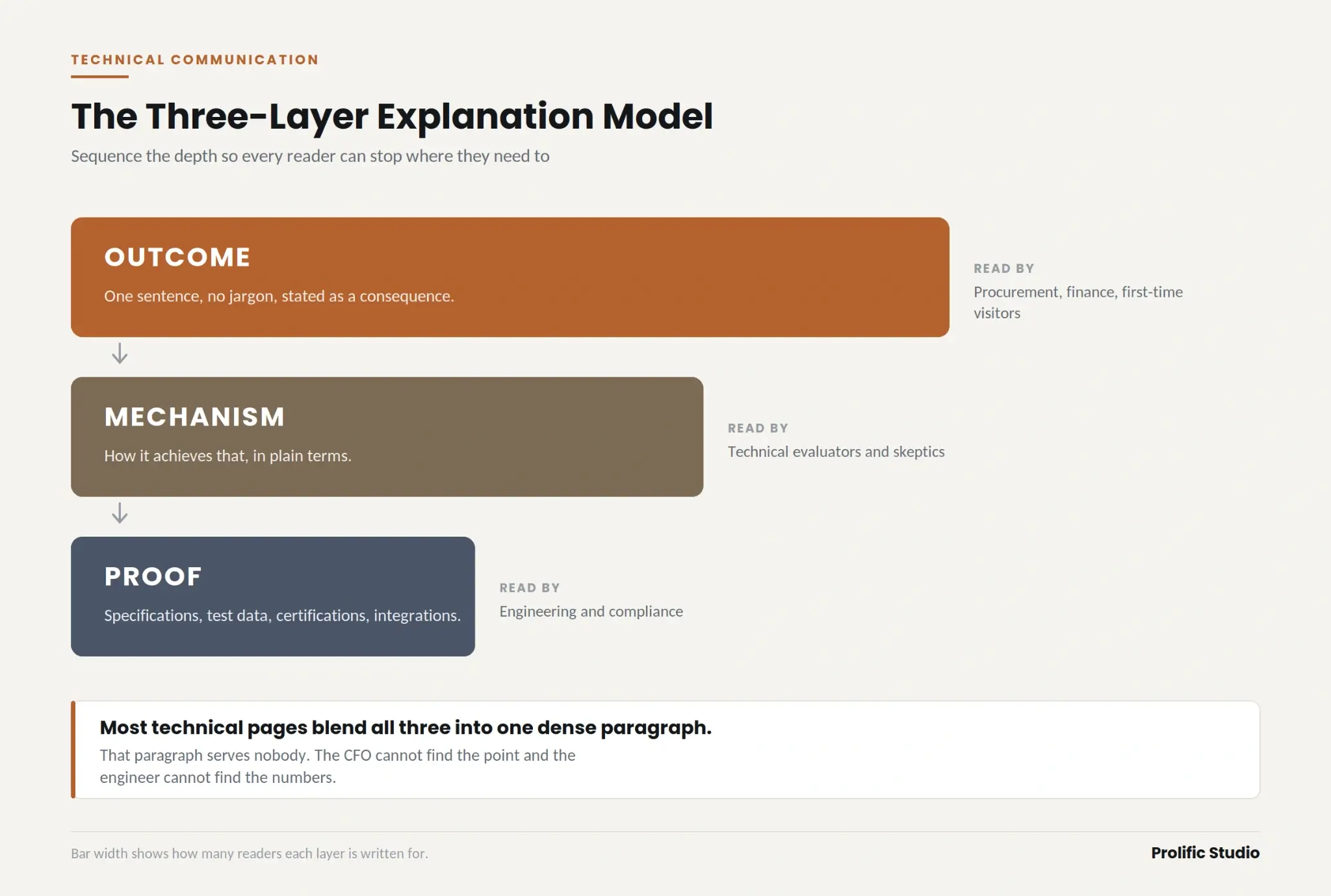
Different readers need different depths, and they arrive together. A page serving only one of them loses the rest.
Layer one is the outcome. One sentence, no jargon, stated as a consequence. This is what a procurement lead, a CFO, or a first-time visitor reads. Most will read nothing else, so it has to stand alone.
Layer two is the mechanism. How it achieves that, in plain terms. This is where a technical evaluator starts paying attention and where the skeptic checks whether you are bluffing.
Layer three is the proof. Specifications, test data, certifications, integrations. The detail your engineering audience wants, and everyone else scrolls past.
Stack them in that order, and nobody has to dig. The CFO reads two lines and leaves satisfied. The engineer scrolls to layer three and finds the numbers. Neither is annoyed by the other’s content, because it is sequenced rather than blended.
Most technical pages blend all three into one dense paragraph. That paragraph serves nobody.
Where Words Stop Working, and You Have to Show It
There is a point past which better writing cannot help you, and recognizing it saves a lot of wasted effort.
Words handle claims, comparisons, and consequences well. They handle four things badly: anything spatial, anything sequential, anything hidden inside a housing, and anything where the value only appears in motion.
Try explaining in a sentence how a surgical stapler forms a staple line, or how a curtain wall bracket absorbs building movement, or the airflow path through a sealed enclosure. You can do it. It will take four hundred words, and the reader will still not see it. Thirty seconds of visual demonstration will.
This is the actual reason video keeps outperforming other formats in B2B marketing, and it has little to do with attention spans. It is that a moving picture can carry spatial and sequential information that prose physically cannot encode.
A client of ours once had eleven paragraphs describing a filtration cartridge. The replacement was a nine-second cutaway. Nobody read the eleven paragraphs. Everyone watched the nine seconds.
So the best way to demonstrate a complex product is usually to stop describing it. 3D animated video services earn their cost when the product has geometry that matters: internal structure, mechanism, assembly, or scale. Where the subject is a process, a workflow, or a data relationship rather than a physical object, flat motion design does the job for considerably less.
Four Industries, Four Different Explanation Problems
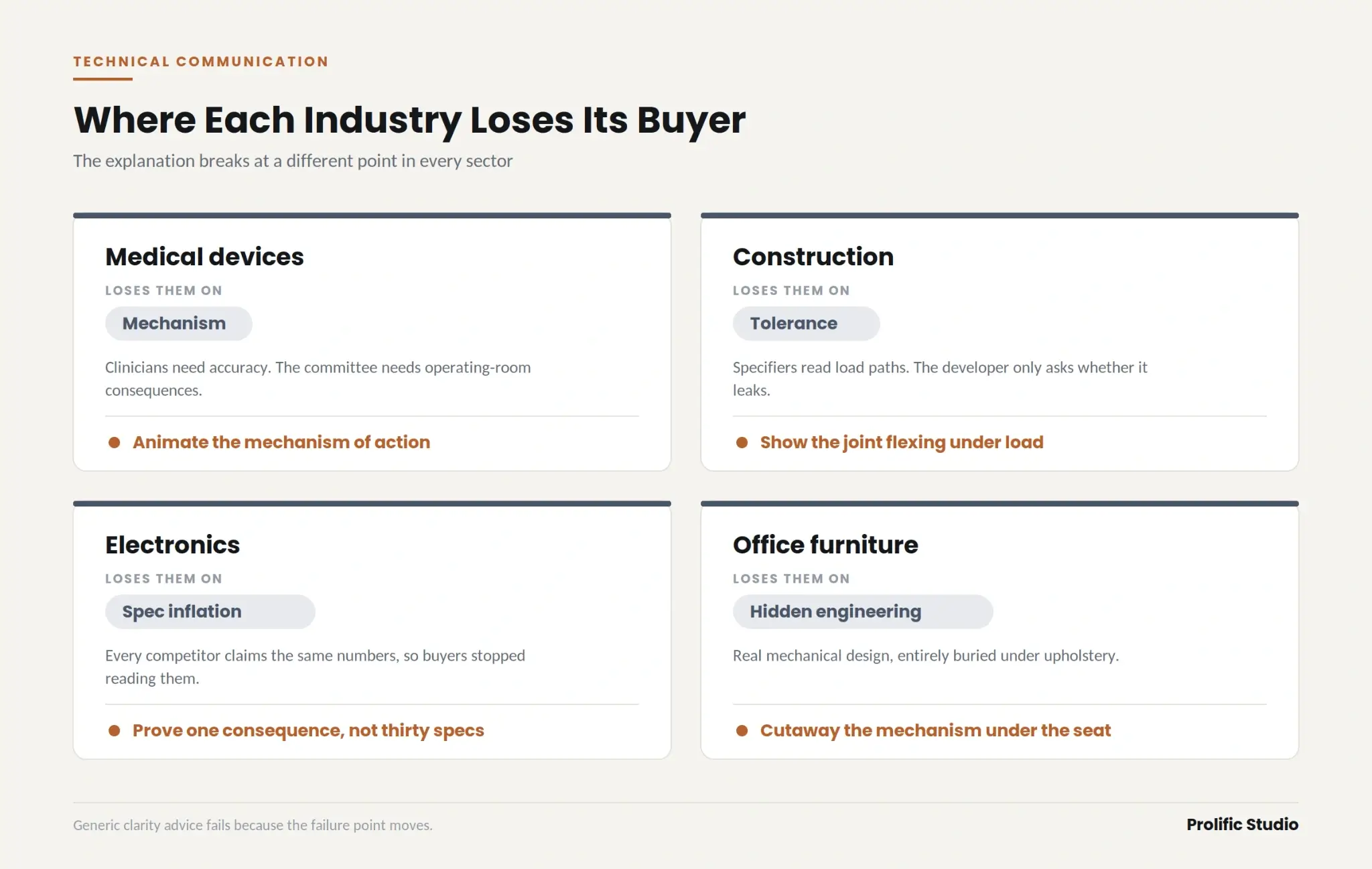
Generic advice on marketing technical products fails because each sector loses its audience at a different moment.
Medical Devices: The Mechanism Is the Sale
Clinicians want the mechanism, and they want it accurate. The purchasing committee includes administrators and finance leads who need it in operational terms: shorter procedure, fewer complications, less recovery time.
The mistake is writing one document for both. Layer it instead, and animate the mechanism of action, since no photograph shows what happens inside tissue.
Construction: Tolerance Is Invisible Until It Fails
Specifiers care about load paths and thermal movement. The developer signing the check cares whether the facade leaks in ten years. Same fact, opposite ends. Show the movement joint flexing under load, and both audiences get it at once, one technically and one intuitively.
Electronics: Everyone Is Shouting Specifications
The whole category has inflated its spec sheets, so numbers no longer differentiate anything. Buyers stopped reading them.
What still cuts through is demonstrated consequence. Not “40% lower thermal output” but the fan that never audibly spins up. Making engineering products easy to understand here means picking one consequence and proving it, rather than listing thirty specs nobody compares.
Office Furniture: The Engineering Is Hidden
A task chair contains real mechanical engineering, all of it buried under upholstery. Buyers see a chair and compare on price and color, because that is all there is to see.
Cutaway visuals do the entire job here. Show the mechanism under the seat, and a $1,400 chair suddenly reads differently against a $400 one. This is also the one category on this list where 2D animated video services often outperform 3D, because the argument is about comparison and posture over time rather than physical detail.
How Do You Know If Your Explanation Actually Works?
You cannot judge your own explanation, because you already know the answer. Use other people.
The stranger test. Give it to someone outside your company and outside your industry. Ask them to explain the product back to you. If they cannot, the explanation failed, and no amount of confidence about how clear it is changes that.
The so-what test. Read each sentence and ask “so what?” If you cannot answer, that sentence is a feature pretending to be a benefit. Cut it or finish it.
The sales call test. Listen to your best salesperson explain it out loud. Spoken explanations are almost always clearer, because a live face gives instant feedback. Steal their words.
The jargon audit. Highlight every term a new hire would need explained. That is your list. Some terms are load-bearing and stay. Most are habit.
How Prolific Studio Handles This
Half of our work on a technical project happens before anyone opens a 3D application.
We start by finding where the explanation actually breaks. Sometimes it is the script. Sometimes the product genuinely cannot be shown from the outside, and the whole job becomes a cutaway. Sometimes a client needs three short pieces for three different audiences rather than one video trying to serve everyone.
That scoping conversation is why we start with the message rather than the medium. A beautifully animated video built on a confusing script is still a confusing video, just an expensive one.
Final Words
Most technical products are not hard to explain. They are explained by people standing too close to them. Which means learning how to explain technical products is less about writing talent than about deliberately stepping back.
The fix is mechanical, not creative. Lead with what it lets someone do. Layer the depth so different readers can stop where they need to. Replace abstraction with consequence, keeping every claim exactly as accurate as it was. And when the thing you are describing is spatial, sequential, or hidden, stop writing and show it.
Then hand it to a stranger and see if it survives contact.
Sitting on a product nobody outside your team understands? As an animation studio that works mostly with technical clients, we can tell you whether you have a script problem or a format problem. Book a call.
Frequently Asked Questions
How do you explain a technical product simply?
Lead with the outcome, then the mechanism, then the proof. Say what the product lets someone do before saying what it contains, and swap abstract descriptions for concrete consequences. “IP67-rated” becomes “you can hose it down.” The claim stays just as accurate. The reader can now picture it, which is the difference between a specification and an explanation.
How do you sell a complex product to a general audience?
Stop selling the complexity and start selling the result of it. A general audience does not evaluate architecture; they evaluate consequence, so give them one clear outcome they can repeat to a colleague. Keep the technical depth on the page, just further down, because your buying committee usually contains one person who will want it and several who will not.
How do you communicate technical information to non-technical people?
Assume missing fluency, not missing intelligence. They can follow the logic; they just do not know your vocabulary. Define every term on first use, draw analogies from things they handle daily, and show anything spatial or sequential rather than describing it. Then ask them to explain it back, because nodding is not understanding.
How do you explain a complex idea in simple terms?
Find the one thing that changes because of it. Complex ideas carry many true statements, and the instinct is to include them all, which is what makes the explanation collapse. Pick the single consequence that matters most to this listener and build around it. Let the rest sit in supporting detail.
Do explainer videos work for technical products?
They work best for technical products, which is the opposite of what people assume. Simple products barely need explaining. Video earns its cost when a product has internal structure, a sequence of operation, or spatial relationships that prose handles badly. If your team keeps reaching for a whiteboard on sales calls, that is a fairly reliable sign that the explanation wants to be visual.