


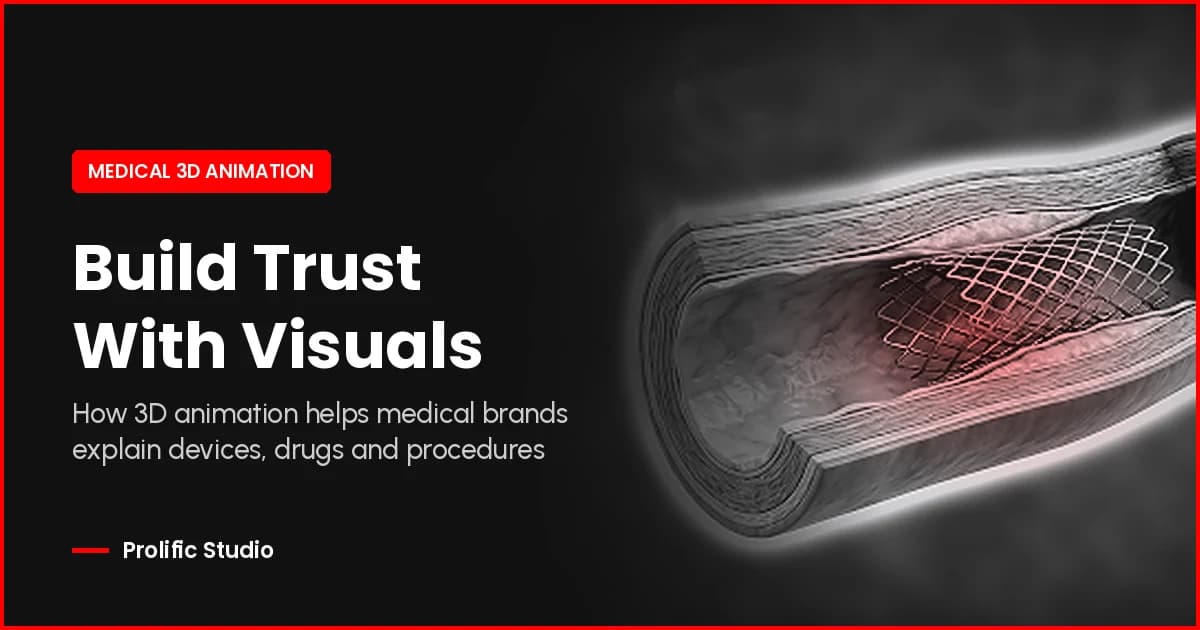
The patient can’t imagine how the stent functions in the constricted artery. Similarly, the investor can’t imagine how the biologic binds to the receptor. The purchasing officer of the hospital can’t see the fit of the equipment just from looking at the product pictures that the sales representative gives.
That’s the gap medical 3D animation services fill. Well-made animation ceases stop being a decorative element and becomes something that can serve as evidence. In a way that is not usually done by slides and brochures.
This guide will describe how healthcare brands are using visual storytelling in their business today, how much it costs to use 3D in this case, when 3D is unnecessary, and how expensive-looking animation differs from an effective one. We will also touch upon the issues a good animation company should consider before giving a quote for the work.
Struggling to explain how your product works?
Our medical 3D animations make it clear in one watch.
- Show what happens inside the body, step by step
- Give sales teams a demo that works in any meeting
- Help patients understand their treatment before it starts
Why Clear Visuals Build Trust in Healthcare
Healthcare audiences don’t always show up mentally relaxed. Clinicians are skeptical of marketing claims, and for good reason. Procurement professionals evaluate products that are nearly identical according to the specification sheets. Regulators examine every sentence for anything they can’t back up. Investors are wondering whether the science is real or just well-packaged.
Clarity is the fastest way through all that doubt. And clarity is more difficult than marketers think. In the 2003 National Assessment of Adult Literacy, only 12% of US adults scored at the proficient level for health literacy.
Read that as a marketer. If most adults have trouble understanding material that medical experts consider clear, a brochure on nerve compression isn’t going to help. But a diagram showing the nerve, the pressure point, and the treatment path often does. Trust doesn’t come from big words; it comes from being understood.
How Healthcare Brands Use Visual Storytelling
Healthcare animation covers more ground than most people expect. Five uses come up again and again.
Visualizing Mechanisms of Action and Disease Progression
3D animation helps demonstrate how a medication acts inside the body at the cellular or molecular level and how a particular disease evolves. These are the two most popular briefs: mechanism of action and mechanism of disease.
The written brief asks you to imagine the picture yourself, while the animation creates one. The camera starts with a full-body view, zooming in on the organ, then the tissue, and finally a single cell where a molecule interacts with its receptor. Each zoom brings the viewer closer, and no one will feel lost making a leap from anatomy to biochemistry.
Here is when one should use restraint. Show target, interaction, and effect. Skip the rest. Our biotech animation projects stick to this rule closely because complex mechanism animations confuse rather than inform.
Demystifying Surgical and Medical Procedures
Animations can be produced by hospitals and makers of medical devices to demonstrate the internal mechanism of a device or the procedure. It all depends on the audiences involved.
The intention for the patient is to reassure. People always have a tendency to expect the worst in any situation, and explaining to them the entire process will help them to develop real expectations of surgery.
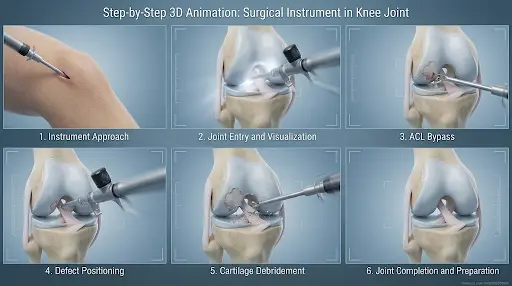
For surgeons and buyers of the medical facility, the objective of the animation is to provide evidence. Photos can show you what a device looks like, but cannot show how it is opened, locked, expanded, or manipulated inside a body. That’s where animation comes in.
There are three main criteria in the standard for an animation. The movement has to be correct, the anatomy has to make sense, and the sequence has to match how the device is used in practice.
Improving Retention and Health Literacy
Retention becomes the silent victory of visual storytelling. There is a claim that visual learners remember up to 65% more information when it is conveyed visually rather than text alone.
However, the direction of the conclusion can’t be challenged. Complicated medical terminology becomes a brief story that starts somewhere, ends with a problem, and offers a solution. A patient who can explain the course of the treatment to relatives understands the concept.
This is the real benefit to the healthcare system. Good understanding means good adherence, and better follow-up conversations lead to clear expectations.
Supporting Clinical Staff Training
Institutions use interactive 3D models and training videos to teach clinical personnel, from nurses to specialized doctors, the latest therapy techniques and equipment. The example makes sense. New technologies and techniques become available across multiple facilities simultaneously, and each facility requires the same training. Written instructions allow interpretation. Visual reference doesn’t.
The interactive model gives an edge to the video because the doctor can manipulate the anatomy, isolate a structure, and conduct the procedure at their own pace. This is important for specialized doctors who need to understand the rationale behind a specific procedure rather than just the steps. If your organization develops in-house training, you should read our guide to 3D medical visualization.
Regulatory and Investor Presentations
Corporations utilize precise animation technology to communicate clinical data and information regarding the mechanics of the device to government organizations such as the FDA or EMA, and to explain the timeline to institutional investors. Though the audience may be different, the problem remains the same. They have limited time and must understand a complex product.
Precision plays an important role here more than anywhere else. Just a single mistake in labeling the structures or one unsupported claim will ruin the whole presentation. Investors will see through it when a video is more polished than the science behind it.
Have a complex procedure to explain? Get a free storyboard before you spend a dollar on production.
Why Sequence Is Where 3D Earns Its Cost
Not all concepts in medicine are usually visual. Sometimes they’re sequential. First, the disease appears, then the body reacts, and finally the drug takes effect.
A still image captures a moment. A 3D animation will show a sequence of events that viewers will need to figure out the cause and effect. This is why 3D often wins over static graphics in explaining how drugs work, new instruments, implants, diagnostics, and biologics. When viewers have to figure out movement, timing, positioning, and interactions, a static graphic will leave blanks for them to fill.
There’s a cost to that. Creating 3D visuals is much more expensive and time-consuming than creating static images. But the issue is not whether 3D looks more visually appealing than still graphics. Most often it does. The question is whether your viewer needs the additional dimension to understand the message.
When 2D Animation is a Smarter Choice
Not every healthcare communication video requires 3D visualization. Service explanations, hospital orientation, insurance advice, wellness promotions, application tutorials, and behavior change videos will do better with 2D animation. It will be easier to modify, localize, and less demanding for the viewer.
If the purpose is to explain how an appointment or patient portals work, or the need for prevention, understanding anatomy is not required. With flat illustration, you’ll get the job done faster and have enough money for additional localization or editing. Our review of the types of medical animation highlights the unique features of mechanism videos, surgical animations, device explanations, and other content types.
Accuracy Comes Before Beauty
A pharma video may be appealing but ineffective if the science is loose. This is where pharmaceutical animation requires structure right from the beginning. Script, storyboard, visual claims, labels, voice-over, and final sequence need to align with the brand’s approved claims.
The medical, legal, and regulatory experts shouldn’t show up as surprise guests at the final review phase. Correcting a claim in the script takes minutes. Correcting it after full animation would require days and a significant portion of the budget. It seems slow at the beginning. But it is almost always faster overall.
Here are some practices that make things easier. Agree on the approved claims before the storyboard starts. Attach a source for each of the scientific statements used. Keep a single copy of the script signed off by all. Track changes across review rounds so reviewers can understand what changed.
And don’t forget who makes the final decision. A studio can build accurately and flag risks, but approval sits with your regulatory team.
Built for MedTech, pharma and healthcare teams
- Mechanism of action
- Medical device demos
- Surgical procedures
- Patient education
- Regulatory presentations
Sales demos for hospital buyers, investor decks or patient content, we script, storyboard and animate it in one place.
Calm Beats Overproduced
Here is where many medical brands fail in their approach to video creation. Like a launch trailer for any product or brand features dramatic music, sweeping camera angles, and effects throughout the video. In the healthcare industry, such a storytelling style will only undermine credibility.
A more appropriate style would be subtle. Proper anatomy. Proper movements. Proper labels. Proper pacing. Appropriate amount of details without going too much into depth.
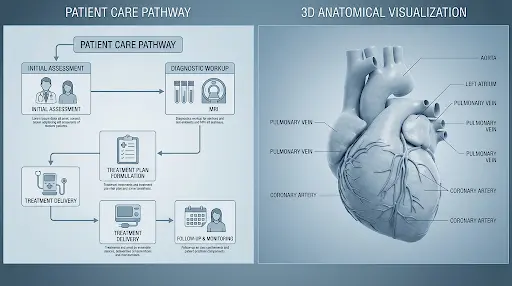
The same principle applies to anatomical visuals. A better visual story doesn’t show everything that exists in our body. If a video focuses on knee pain, we don’t need all the ligaments and layers of tissues. When creating a video about a vascular device, we will use the vessel walls, their location, and blood flow, but not an anatomy lesson.
What to Look for in a Medical Animation Studio
Experience in healthcare is more important than having an impressive reel. Find out if they have previous experience working on clinical content and what their approach to accuracy would be. The medical content studio would ask you to provide your references, sources, and reviewers’ names.
They also need answers to several questions before they can quote. Who would be viewing this video? What would they do after watching it? What claims would be approved? Where would this video be screened and for how long? A studio that jumps straight to visual styles hasn’t understood the brief.
Also, pay attention to the production process. It includes script creation, storyboarding, style frame creation, animation creation, and the final video review. In our medical animation productions, we go through all these stages, and your subject matter experts can participate in the decision-making process at each stage.
Make Your Next Healthcare Video Easier to Trust
The most effective medical 3D animation services are those that begin by asking yourself a single, straight-up question about your viewer: what do they need to know before they will trust us? Design your visuals accordingly, and make sure that they are both simple and true.
If you are looking to plan a drug rollout, a device demonstration, clinical training, or even a patient education series, reach out to Prolific Studio, and we will take you through our script and storyboarding process.
Struggling to explain how your product works?
Our medical 3D animations make it clear in one watch.
- Show what happens inside the body, step by step
- Give sales teams a demo that works in any meeting
- Help patients understand their treatment before it starts
Frequently Asked Questions
Related Articles: