

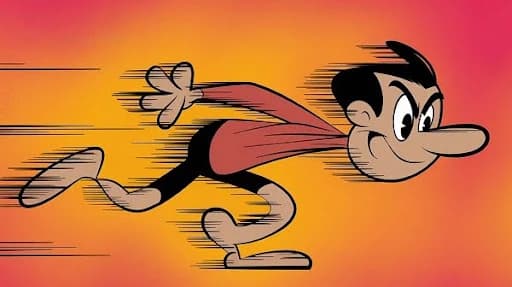
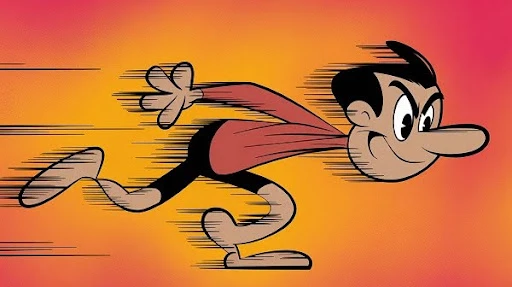
Smear frames are the blink-and-you-miss-it drawings that make a punch feel like it snaps, a head turn feel like it whips, and a character exit feel like it breaks the laws of physics in the funniest possible way.
In simple terms, a smear frame is an in-between frame that simulates motion blur by stretching, duplicating, or simplifying a form so the jump from Pose A to Pose B reads as speed instead of teleportation.
If you’ve ever paused an old cartoon and thought, “Why does this character look like melted taffy,” congratulations. You found the trick.
What Smear Frames Actually Do
Smears solve a very specific problem: your eyes expect blur when something moves fast, but animation is built from crisp drawings. Smears bridge that gap.
They also do something else that matters just as much: they let you keep strong key poses without filling the gap with a bunch of mushy in-betweens. One bold smear can preserve the pose-to-pose clarity while still selling speed.
This is why smears show up everywhere from classic shorts to modern TV. A good 2D animation studio uses them like punctuation, not like decoration.
The Three Smear Types You’ll Actually Use
There are endless variations, but most smears fall into three buckets. Once you can name them, you can choose faster.
1) Elongated In-Between
This is the “stretch the form along the path of action” smear. Great for:
- Fast turns
- Quick reach and grabs
- Snap head darts
- Whip exits
It’s also the smear people overdo. If the silhouette stops reading as the character, it becomes a visual gag by accident.
2) Multiples
Instead of stretching, you duplicate parts of the body along the motion path. Think of it as animation “echoes.”
- Great for fast hands
- Great for repeated actions like a flurry
- Often cleaner than elongation when you want readability
3) Drybrush and Motion Marks
This is the older-school “painted blur” approach, less literal distortion, more directional energy. It’s still useful when you want speed without breaking the design too much, especially on effects passes and fast props.
When a Smear Helps and When It Hurts
Smears are a power tool. Use them where the audience’s brain is already expecting blur.
Use smears when…
- The action is too fast to read on twos or threes
- The pose jump is huge and the in-between looks like a broken rig
- The action is meant to feel snappy, comedic, or explosive
- You need impact without extra frames (budget and schedule love this)
Don’t use smears when…
- The shot is subtle acting and the audience needs micro expression
- The camera is close and the face needs to stay readable
- The design is super graphic and distortion breaks the model rules
- The smear pulls attention to itself and becomes the “joke” unintentionally
A good test: if you can describe the smear as its own moment, it might be too loud. The best smears feel like speed, not like an extra drawing asking for applause.
A Short History: From “Cheats” to a Signature Look
Before smear frames became a recognizable technique, animation used other blur cheats: action lines, smoke clouds, and painterly streaks to suggest travel and speed.
Smears started showing up sparingly in the 1930s, but one of the most widely cited “big” milestones is Chuck Jones’ The Dover Boys at Pimento University (1942), which made extensive use of limited animation techniques and smear-like motion shortcuts.
That short matters because it wasn’t just “look, a new trick.” It showed how stylized motion blur could become part of the film’s personality. The smear wasn’t hiding. It was performing.
If you work at an animation studio in the USA, you still see the same lesson play out today: audiences forgive wild distortion when it’s consistent with the tone and timing.
How Smears Translate Outside Classic 2D
Smears were developed as a 2D solution, but the idea travels. You see versions of it in modern CG and even in stop-motion, where it becomes a physical problem instead of a drawing problem.
We’ll get into those later, including why smears in clay animation are a completely different kind of headache, and how studios handle them when the “one-frame cheat” requires extra physical assets.
You’ll also see smears used in marketing cuts. A punchy smear moment can make a shot feel faster in sizzle reels, because the audience reads energy first and mechanics second.
And yes, games use smear logic too, especially in fast attacks where clarity matters more than realistic blur. That crossover is one reason game trailer services teams care about smear language, even when the footage is real-time.
Smear Frames in TV Animation: Why They Get Wilder
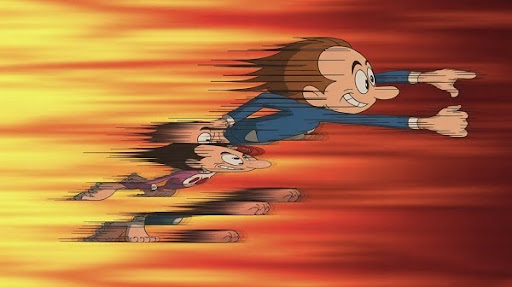
TV animation is where smears stop being “subtle blur” and start becoming comedy. The reason is practical: when you’re animating on tighter schedules, you want speed and readability without drawing a lot more in-betweens. Smears are a clean shortcut because they let you jump between strong keys without the motion feeling choppy.
How to keep TV smears from looking like mistakes:
- Tie the smear to a clear arc. If the smear doesn’t follow the path of motion, it reads like a glitch.
- Protect the silhouette. You can distort inside shapes, but the outside contour should still say “that character.”
- Keep the smear frame count low. One frame usually does the job. Two frames can work, but only when the action is truly violent.
Feature Animation: Smears That You Feel More Than You See
Feature films tend to use smears with more restraint. Not because features hate exaggeration, but because the camera is often closer and the audience has more time to study faces and performance.
The most useful way to think about feature smears: they’re often used to support acting, not replace it. A fast eye dart, a snap to camera, a sudden recoil, a quick hand flick. The smear is a seasoning, not the meal.
A good feature smear should pass this test:
- Pause on the smear and it still looks like “a choice,” not a broken drawing.
Smear Frames in CG: How They’re Actually Made
Smears in CG used to be rare because rigs and deformation systems weren’t built to push forms that far. That’s why Hotel Transylvania (2012) is often cited as a notable turning point for bringing stylized smear thinking into modern CG feature work.
How CG smears typically get done today:
- Shape keys or blendshapes: Artists sculpt a “smeared” version of the pose and blend into it for a single frame.
- Pose-space deformation: A rig can trigger a smear deformation only at specific angles or speeds.
- Animated mesh swaps: For extreme smears, you swap to a special smear mesh for one frame, then swap back.
- Comp help: Sometimes the “smear” is a combo of small deformation plus stylized motion blur.
If you’re working with a 3D animation studio, this is where pipeline discipline matters. CG smears are fast on screen, but they can be slow in production unless the rigging and shot workflow already expects them.
Stop-Motion Smears: When the “One-Frame Cheat” Costs Days
In stop-motion, you don’t draw a smear. You build it, swap it, and shoot it. That’s why smears are rarer in physical animation. The technique can require extra replacement parts and careful planning, especially if multiple pieces smear at once.
ParaNorman is often referenced in smear discussions because LAIKA’s pipeline made replacement parts viable at scale, including huge volumes of replacement face parts produced through rapid prototyping for nuanced expressions.
What makes smears hard in puppet animation:
- You need physical “in-between” parts. Not just one face, but sometimes multiple facial and body components.
- Continuity gets brutal. If the smear replacement doesn’t match lighting and texture, it pops.
- Rig removal can get messy. Fast motion already stresses clean-up. Add a smear swap and you’ve got more to hide.
When stop-motion smears work, they feel magical because your brain knows it shouldn’t be possible. That’s the payoff.
Smear Frames in Video Games: Why They Still Matter at 60 Frames Per Second
Games already have motion blur options, so why do smears show up at all?
Because gameplay clarity often beats realism. A stylized smear can make an attack read cleaner, especially in fast combat where silhouettes overlap and the camera is moving. Academic work on smearframes in games points out that smears are held for only one or two frames, basically a lightning-fast morph that communicates speed and direction.
Where smears show up most in games:
- Melee swings: Swords, claws, staff attacks.
- Dash moves: Fast travel bursts where the character needs to feel snappy.
- Impact moments: A quick smear into a hit pose makes the strike feel sharp, even if the hit is only a few frames.
A simple rule for games: if the player needs to understand the move instantly, a stylized smear can help more than realistic blur.
Frequently Asked Questions
How do you draw smear frames for fast punches and sword swings?
Use a single in-between that follows the arc of action, simplify the silhouette so it stays readable, and place it between two strong keys, not on the impact pose.
Are smear frames used in 3D animation, and how are they created?
Yes. In 3D animation they’re typically created with blendshapes, pose-space deformations, or one-frame mesh swaps, with Hotel Transylvania often cited as an early notable modern CG example.
What’s the difference between smear frames and motion blur?
Smear frames are a stylized, hand-made abstraction of blur that can exaggerate shape and timing, while motion blur is usually a camera or render effect that blends movement more realistically.
Why do video games use smear frames even at 60 frames per second?
Because smears improve readability and impact in fast combat. They communicate direction and speed in one or two frames, even when realistic blur is available.
Final Words
Smear frames are a tiny tool with a huge footprint. TV uses them to keep motion punchy on tight schedules. Feature films use them to add snap without stealing focus. CG uses them when rigs and pipelines are built to allow controlled distortion. Stop-motion uses them sparingly because they can require real-world replacements. Games use them because readability and style win fights that realism can’t.
If you want smears to look intentional, treat them like timing. One clear arc, one clear frame, and a strong pose on both sides.
Related Articles: