

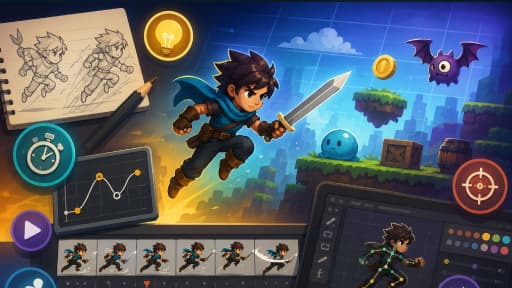
The gaming industry has evolved tremendously over the past decade, but one thing has remained constant: great animation creates memorable gaming experiences. Whether you’re developing a fast-paced platformer, a story-driven RPG, or a casual mobile game, animation is what transforms static artwork into living, breathing characters that players connect with.
A beautifully illustrated character can certainly catch attention, but without fluid movement, expressive emotions, and believable actions, even the best designs can feel lifeless. This is why successful game studios invest heavily in animation quality it directly impacts gameplay, storytelling, immersion, and player retention.
At Prolific Studio, we’ve seen firsthand how professionally crafted animations elevate games from visually appealing to emotionally engaging. Every movement, jump, attack, idle pose, and facial expression contributes to the player’s experience. That’s why our 2D animation services focus not only on artistic quality but also on gameplay functionality, ensuring every animation feels responsive and purposeful.
Creating exceptional 2D game animation isn’t simply about drawing more frames. It’s about understanding motion, timing, anticipation, squash and stretch, player psychology, and visual storytelling.
In this guide, we’ll explore seven professional techniques that help developers and artists create smoother, more engaging animations for modern 2D games.
Why Animation Matters in 2D Games
Many people assume graphics are the most important visual aspect of a game. While art style certainly matters, animation often has a greater influence on how polished a game feels.
Great animation helps players:
- Understand gameplay mechanics
- React quickly during combat
- Connect emotionally with characters
- Feel immersed in the game world
- Enjoy smoother gameplay
Poor animation, on the other hand, creates confusion. Delayed attacks, stiff movement, unnatural transitions, and awkward poses make even visually impressive games feel unfinished.
The difference between an indie game that players remember and one they quickly forget often comes down to animation quality.
Tip 1: Plan Every Animation Before Drawing a Single Frame
One of the biggest mistakes beginner animators make is jumping directly into animation software.
Professional animators rarely start by creating frames immediately.
Instead, they spend significant time planning.
Proper planning reduces revisions, improves consistency, and speeds up production later in the project.
Before animating, define:
- The purpose of the animation
- Player interaction
- Character personality
- Camera angle
- Game mechanics
- Transition points
- Animation length
For example, a sword attack animation isn’t just about swinging a weapon.
Ask questions like:
- Is the attack heavy or quick?
- Does it interrupt movement?
- Can players cancel it?
- Does the enemy react?
- What emotion should the player feel?
Answering these questions early prevents unnecessary redesign later.
Create Animation Thumbnails
Professional game artists often sketch rough thumbnails showing key poses.
These don’t need to be beautiful.
They’re simply visual notes showing:
- Starting pose
- Anticipation
- Action
- Recovery
- Idle return
These sketches make the production process significantly faster.
Build an Animation List
Large projects often contain hundreds of animations.
Create a checklist such as:
- Idle
- Walk
- Run
- Jump
- Fall
- Attack
- Block
- Hit
- Death
- Victory
- Interaction
This helps maintain consistency across the entire project.
Tip 2: Focus on Strong Key Poses First
One common misconception is that smooth animation comes from drawing hundreds of frames.
In reality, excellent animation begins with excellent key poses.
Key poses communicate the most important moments of an action.
Imagine a character throwing a punch.
The audience should instantly recognize:
- Preparation
- Impact
- Follow-through
If these three poses look powerful, the animation already feels convincing.
Everything between them simply supports the movement.
Think Like a Photographer
Imagine freezing your animation at any frame.
Would that frame still communicate action?
Professional animators create poses with:
- Clear silhouettes
- Strong balance
- Dynamic angles
- Readable limbs
Avoid flat poses where arms overlap the torso or legs become difficult to distinguish.
Players often see animations for fractions of a second.
Every frame must remain readable.
Exaggeration Improves Readability
Games usually benefit from slightly exaggerated movement.
Instead of realistic motion:
- Lean characters further
- Stretch jumps higher
- Squash landings more
- Rotate shoulders further
- Extend arms completely
Players understand exaggerated movement much faster than realistic movement.
This principle has been used successfully in everything from classic arcade games to modern AAA titles.
Tip 3: Add Secondary Motion to Make Characters Feel Alive
One of the easiest ways to improve animation quality is adding subtle secondary movement.
Secondary motion refers to everything that moves after the main action.
Examples include:
- Hair swaying
- Clothing fluttering
- Capes flowing
- Weapon straps swinging
- Ponytails bouncing
- Accessories moving naturally
These details create realism without requiring complex animation.
Never Let Characters Feel Frozen
Even idle animations should contain movement.
A character standing perfectly still immediately appears lifeless.
Instead, animate subtle actions such as:
- Gentle breathing
- Eye blinking
- Weight shifting
- Finger movement
- Shoulder motion
- Hair movement
These small additions make characters feel like they’re constantly thinking and reacting.
Add Personality Through Idle Animations
Idle animations are an excellent opportunity to communicate personality.
Consider these examples:
A confident knight may stand tall with crossed arms.
A nervous mage might constantly adjust their robe.
A mischievous thief could spin a dagger while waiting.
A tired traveler may stretch occasionally.
Without dialogue, players immediately understand who these characters are.
Use Physics Wisely
Secondary motion should complement the main animation.
When a character suddenly stops running:
- Hair continues moving
- Clothing settles naturally
- Equipment swings forward
- Capes slowly come to rest
These small physics-inspired movements dramatically improve perceived quality.
Professional Insight from Prolific Studio
Creating memorable game animation requires more than artistic talent. It demands a deep understanding of gameplay, timing, responsiveness, and player expectations.
At Prolific Studio, our dedicated 2D Animation Services combine creative storytelling with production-ready workflows to help game developers build expressive characters, smooth gameplay animations, cinematic cutscenes, and visually engaging game experiences. Whether you’re developing an indie title or a large-scale commercial game, investing in high-quality animation ensures players remain immersed from the first frame to the final boss battle.
Tip 4: Master Timing and Spacing to Create Natural Movement
Great animation isn’t defined by how many drawings you create it’s defined by how those drawings are timed. Timing and spacing are two of the most important principles in 2D animation, especially in games where movement directly affects player experience.
Timing determines how long an action takes, while spacing determines how far an object moves between frames. Together, they control the speed, weight, and personality of every action.
For example:
- A ninja should accelerate and stop quickly.
- A giant monster should move slower with noticeable momentum.
- A magical creature may float with smooth, graceful motion.
- A robot might move with mechanical precision and deliberate pauses.
Each movement tells players something about the character before a single line of dialogue appears.
Use Ease-In and Ease-Out
Real-world objects rarely start or stop instantly. They gradually accelerate and decelerate.
Instead of moving your character at the same speed throughout the animation:
- Begin slowly.
- Increase speed during the action.
- Slow down before stopping.
This creates smoother and more believable movement.
For example, when a character jumps:
- They crouch slightly.
- They push off the ground.
- They accelerate upward.
- They slow near the peak.
- Gravity pulls them down.
- They land with impact.
- They recover before returning to idle.
Each stage has its own timing, making the animation feel responsive and satisfying.
Different Genres Need Different Timing
Not every game follows the same animation rules.
Platformers
- Quick jumps
- Fast direction changes
- Responsive attacks
Fighting Games
- Sharp anticipation
- Powerful impact frames
- Precise recovery timing
Adventure Games
- Smooth exploration
- Natural walking cycles
- Cinematic interactions
Puzzle Games
- Relaxed pacing
- Soft transitions
- Minimal distractions
Understanding your game’s genre helps determine the right animation style.
Tip 5: Make Facial Expressions Tell the Story
Players connect with characters through emotion. While body language is important, facial animation often delivers the strongest emotional impact.
Even in pixel art or stylized 2D games, expressive faces can make characters feel memorable and relatable.
Focus on the Eyes
Eyes communicate attention, emotion, and intent.
Small adjustments can dramatically change how a character is perceived.
Examples include:
- Wide eyes for surprise
- Narrow eyes for determination
- Looking away for uncertainty
- Rapid blinking for nervousness
- Slow blinking for confidence
These subtle details help players understand a character’s emotions without relying on dialogue.
Animate the Mouth Naturally
The mouth plays a major role in expressing emotion.
Rather than using a single smile or frown, animate changes that match the situation.
A happy character might:
- Smile gradually
- Raise their cheeks
- Open their mouth while laughing
An angry character might:
- Tighten their lips
- Bare their teeth
- Clench their jaw
These combinations create believable emotional performances.
Match the Face with the Body
Facial animation should always support body movement.
Imagine a victorious warrior celebrating after defeating a boss.
If the body jumps with excitement but the face remains expressionless, the animation feels disconnected.
Instead:
- Raise the eyebrows.
- Open the mouth.
- Add confident eye movement.
- Tilt the head slightly.
These coordinated actions create stronger emotional storytelling.
Tip 6: Keep Animations Efficient Without Losing Quality
Many beginner animators believe that adding more frames automatically creates better animation. In reality, excessive frames can make gameplay feel sluggish and increase production time.
Professional game animation focuses on clarity and efficiency, ensuring every frame serves a purpose.
Prioritize Readability
Ask yourself:
- Does this frame communicate something new?
- Does it improve the movement?
- Does it help the player understand the action?
If not, consider removing it.
Players often react within fractions of a second. Clean, readable animation is usually more effective than overly detailed motion.
Optimize for Performance
Efficient animation also benefits game performance, particularly on mobile devices or large projects with many animated elements.
Some optimization strategies include:
- Reusing animation cycles where appropriate
- Creating modular body parts for characters
- Using animation blending instead of separate sequences
- Reducing unnecessary in-between frames
- Compressing sprite sheets without sacrificing quality
These techniques reduce memory usage while maintaining visual appeal.
Balance Quality and Production Time
Every project has deadlines and budgets.
Rather than spending days perfecting a minor idle animation, focus your efforts where players will notice the most:
- Combat actions
- Boss encounters
- Cinematic moments
- Character introductions
- Story-driven sequences
Prioritizing key moments ensures the greatest return on your animation investment.
Tip 7: Always Animate with the Player Experience in Mind
Beautiful animation means very little if it interferes with gameplay.
The best game animations strike a balance between artistic expression and player responsiveness.
Every movement should support the experience rather than distract from it.
Responsiveness Comes First
Imagine pressing the jump button and waiting half a second before the character leaves the ground.
Even if the animation looks amazing, the game will feel unresponsive.
Game animation must respect player input.
Key actions such as:
- Jumping
- Dodging
- Attacking
- Blocking
- Running
should feel immediate and satisfying.
Guide the Player’s Attention
Animation can subtly direct players toward important gameplay elements.
Examples include:
- A glowing chest with a gentle bounce
- An enemy preparing a heavy attack through exaggerated anticipation
- Collectibles rotating slowly
- Interactive objects pulsing softly
These visual cues improve usability without requiring additional interface elements.
Test with Real Players
Professional animation doesn’t end after production.
Testing reveals issues that animators may overlook.
Observe players as they interact with your game.
Look for questions such as:
- Do they recognize attack timing?
- Are animations easy to read?
- Do transitions feel smooth?
- Are important actions obvious?
Small adjustments based on testing often have a significant impact on gameplay quality.
Common Mistakes to Avoid in 2D Game Animation
Even experienced animators occasionally encounter challenges. Being aware of common pitfalls can save time and improve the final product.
Some of the most frequent mistakes include:
- Skipping the planning phase
- Overcomplicating simple movements
- Using inconsistent animation styles
- Ignoring character personality
- Adding unnecessary frames
- Poor transition between animation states
- Forgetting anticipation and follow-through
- Overlooking secondary motion
- Neglecting optimization for game performance
- Failing to test animations in-engine
Avoiding these issues leads to smoother production and a more polished player experience.
Why Many Game Studios Choose Professional 2D Animation Services
Developing high-quality game animation requires more than artistic skill. It demands expertise in storytelling, character design, game engines, production pipelines, and technical optimization.
That’s why many studios partner with experienced animation teams to streamline development and maintain consistent quality.
At Prolific Studio, we help developers bring their game worlds to life through custom 2D Animation Services tailored to each project’s unique vision. From expressive character animations and cinematic cutscenes to UI motion graphics and promotional content, our team combines creativity with technical precision to produce animations that enhance both gameplay and storytelling.
Whether you’re building your first indie title or expanding an established franchise, working with experienced animators can reduce production time while ensuring every movement feels polished, engaging, and memorable.
The Future of 2D Game Animation: Trends Shaping the Industry
The future of 2D game animation is becoming more exciting as technology continues to evolve. While 3D games dominate many parts of the industry, 2D animation remains highly popular because of its unique artistic style, accessibility, and emotional storytelling capabilities.
From hand-drawn indie games to animated mobile experiences, developers continue discovering new ways to use 2D animation to create memorable worlds.
Several trends are shaping the next generation of 2D game animation.
1. Hybrid Animation Styles Are Becoming More Popular
Modern game developers are no longer limited to traditional 2D techniques. Many studios are combining different animation approaches to create unique visual experiences.
Examples include:
- 2D characters placed inside 3D environments
- Hand-drawn animations combined with particle effects
- Traditional frame-by-frame animation enhanced with digital tools
- 2D illustrations with cinematic camera movements
This hybrid approach allows developers to achieve distinctive art styles while maintaining smooth performance.
Games with unique visual identities often stand out in a crowded marketplace, making animation style an important part of branding and player engagement.
2. AI-Assisted Animation Workflows
Artificial intelligence is influencing many creative industries, and game animation is no exception.
AI-powered tools are helping artists with:
- Generating animation references
- Creating movement variations
- Improving workflow efficiency
- Automating repetitive production tasks
- Assisting with motion analysis
However, successful animation still requires human creativity, storytelling ability, and artistic direction.
The strongest results come from combining technology with experienced animators who understand movement, emotion, and gameplay requirements.
3. More Focus on Expressive Characters
Players increasingly look for emotional connections with game characters.
A character is no longer just a visual asset it represents the story, personality, and experience of the game.
Future 2D animations will continue focusing on:
- More detailed facial expressions
- Complex emotional reactions
- Unique movement personalities
- More realistic character interactions
A simple animation, such as a character looking worried or excited, can communicate powerful emotions without dialogue.
4. Animation for Mobile and Cross-Platform Games
Mobile gaming continues growing, creating new opportunities for 2D animation.
Because 2D assets are often lightweight compared to complex 3D models, they remain a preferred choice for:
- Mobile games
- Browser games
- Indie projects
- Casual gaming experiences
However, mobile users also expect premium-quality visuals.
This means developers must balance:
- Visual quality
- Performance optimization
- File size
- Smooth gameplay
Professional animation production helps achieve this balance.
How Prolific Studio Creates High-Quality 2D Game Animations
Creating successful game animation requires a structured process. At Prolific Studio, our approach combines creativity, technical expertise, and storytelling to deliver animations that support the goals of each project.
Our process typically includes:
Concept Development
Every successful animation begins with understanding the game’s vision.
We analyze:
- Character personality
- Game mechanics
- Target audience
- Animation style
- Emotional goals
This ensures every animation feels connected to the overall experience.
Character and Style Development
A strong animation starts with a strong character design.
Our artists focus on:
- Silhouette clarity
- Personality expression
- Movement style
- Visual consistency
A warrior, wizard, robot, or fantasy creature should each have unique movement characteristics that reflect who they are.
Storyboarding and Planning
Before production begins, animation sequences are planned through:
- Storyboards
- Motion studies
- Key poses
- Timing breakdowns
This helps identify potential issues early and creates a smoother production workflow.
Animation Production
During production, artists focus on:
- Smooth movement
- Strong poses
- Natural transitions
- Expressive actions
- Gameplay compatibility
Every frame is carefully designed to improve the player’s experience.
Testing and Refinement
The final stage involves reviewing animations inside the actual game environment.
This ensures:
- Animations feel responsive
- Timing matches gameplay
- Visual quality remains consistent
- Performance requirements are met
The goal is not just creating beautiful animation it is creating animation that works.
Frequently Asked Questions About 2D Game Animation
What makes a good 2D game animation?
A good 2D game animation combines strong poses, smooth timing, expressive movement, and clear storytelling. It should feel natural while supporting gameplay and improving the player’s experience.
How many frames are needed for a 2D game animation?
The number of frames depends on the action and style.
Simple animations may require only a few frames, while complex character movements may need dozens.
The focus should always be quality and readability rather than simply increasing frame numbers.
Is frame-by-frame animation better for games?
Frame-by-frame animation provides excellent artistic control and expressive movement. It is especially effective for characters, combat actions, and emotional scenes.
However, other techniques such as skeletal animation can also be useful depending on project requirements.
How long does it take to create a 2D game animation?
The production timeline depends on:
- Animation complexity
- Character design
- Number of movements required
- Style preferences
- Revision process
A simple animation may take a few days, while complete character animation systems can require several weeks.
Can 2D animation improve player engagement?
Yes. High-quality animation improves immersion by making characters feel responsive, emotional, and believable.
Players are more likely to connect with games that provide smooth movement and memorable visual experiences.
Should indie developers invest in professional 2D animation?
Professional animation can significantly improve the quality of an indie game.
A polished animation style helps indie developers:
- Create stronger first impressions
- Build memorable characters
- Compete in crowded markets
- Improve player retention
Even small animation improvements can make a major difference.
What software is commonly used for 2D game animation?
Professional animators use various tools depending on the project, including:
- Adobe Animate
- Toon Boom Harmony
- Spine
- Unity animation tools
- Photoshop-based workflows
- Specialized game animation software
The right tool depends on the animation style and technical requirements.
Final Thoughts
Animation is one of the most powerful tools available to game developers. It transforms artwork into experiences, characters into personalities, and simple movements into memorable moments.
Creating successful 2D game animation requires careful planning, strong artistic fundamentals, technical understanding, and a deep awareness of player expectations.
From powerful combat movements to subtle facial expressions, every animation choice contributes to how players experience your game.
By focusing on strong key poses, meaningful movement, efficient production, and emotional storytelling, developers can create animations that truly connect with audiences.
At Prolific Studio, we specialize in creating engaging visual experiences through professional animation solutions. Our 2D Animation Services help game developers, brands, and creative teams bring their ideas to life with high-quality character animation, storytelling, and immersive visuals.
Whether you need animated game characters, promotional game videos, or complete 2D animation production support, our team is ready to transform your vision into a polished visual experience.
Create animations that don’t just move create animations that players remember.