
Outbound has the kind of premise that sounds like a daydream until you realize someone turned it into a playable loop. You start with an empty camper van, you scavenge and craft, and you slowly build a home on wheels that can actually function off-grid, solo or with up to four players.
The hook is not “survival, but cute.” The hook is a low-pressure world where energy, food, and upgrades still matter, but the vibe stays calm enough to feel like a weekend escape. Square Glade Games even has a word for it: “cozyvival.”
The Roadside Moment That Shaped the Whole Game
Outbound’s vibe did not come from a mood board full of cozy screenshots. It came from a real image.
Co-founder Tobi Schnackenberg describes seeing an old-school camper van rolling past a field of solar panels and windmills while driving from Germany to the Netherlands. That contrast, nostalgia on wheels next to clean energy infrastructure, sparked the idea to build the game around an electric van and sustainability.
It’s a great origin story because it explains why the game’s tone feels grounded. The world is utopian, sure, but it’s a utopia with bolts and wiring, not fairy dust.
Cozyvival Explained Without the Marketing Gloss
Outbound is not trying to scare you with hunger timers every thirty seconds. The developers call it “cozyvival” because players enjoyed the balance: satisfying survival mechanics like managing energy, gathering materials, and growing food, paired with a cozy, low-pressure van-life rhythm.
That balance matters for one reason. A cozy game can still have systems. It just can’t punish you for wanting to breathe.
In practical terms, this is what the genre blend buys you:
- Enough structure that upgrades feel earned
- Enough calm that exploration feels like a choice, not a chore
- Enough friction that co-op teamwork matters, without turning into a job
Sustainability That Shows Up in Gameplay, Not Just the Trailer Copy
A lot of games say “nature” and mean “pretty trees.” Outbound goes further by baking sustainability into what you do.
Schnackenberg describes sun, wind, and rain as key energy sources, and the PlayStation announcement also calls out a system where recycling litter earns new blueprints for van upgrades. That aligns with the Steam pitch too: craft workstations, power the van from sun, wind, or water, and live sustainably off-grid.
There’s even a small visual detail in the PlayStation post that says a lot about the tone. They mention showing sailboats on the horizon instead of massive tankers and cargo ships. It’s not a “message.” It’s set dressing that quietly keeps the world consistent.
Your Van Is the Main Character
Outbound doesn’t treat the camper van as a vehicle. It treats it as the base you carry into every biome.
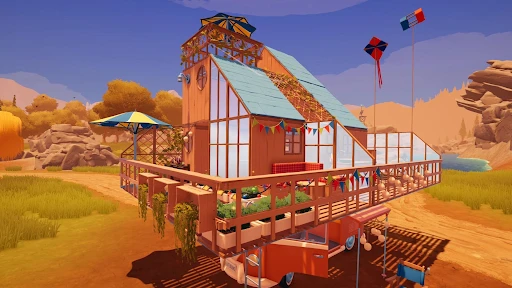
The PlayStation write-up is blunt about the starting point: you begin with an empty camper van, then build up your dream home as you adapt to the changing environment. The Microsoft Store listing adds the key word that makes the fantasy work: modular parts. You scavenge materials, craft, and build in and on top of the vehicle with modular pieces as you advance in tech and energy efficiency.
That modular approach is why people latch onto games like this. It scratches the “make it yours” itch without forcing you into a spreadsheet simulator.
If you’ve ever watched players spend an hour customizing something that technically has no combat advantage, you already get it. Building the van is the dopamine loop.
And from a production angle, modular design is also where 3D modeling choices show their value. Clean connection points. Readable silhouettes. Parts that stack without turning the whole build into visual noise.
Solo Calm vs Co-op Road Trip Energy
This is one of Outbound’s smartest bits of positioning: it admits the game feels different depending on how you play.
On the PlayStation Blog, the team describes solo play as a calm, empowering off-grid experience where you gather resources and build at your own pace. Then it flips the switch. With friends, it becomes a higher-energy road trip, closer to the real-world chaos of traveling together.
That’s not just a “multiplayer feature” bullet. It’s a real design advantage. One world, two moods.
Also, yes, there’s a dog. The team confirms you can pet it, and it’s not only there to be cute. You can teach the dog to fetch resources and carry them back to the van.
That’s the sort of detail that earns wishlists. Not because it’s big, but because it’s human.
Why the Art Style Feels Hopeful Without Feeling Like a Filter
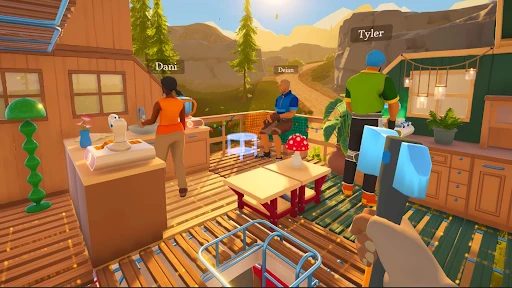
Outbound is aiming for optimism, but it’s not doing it with syrupy lighting and shallow “good vibes only” writing.
The core image behind the game is renewable infrastructure as scenery, not as a lecture. That lands because it feels normal inside the world. Solar panels are not “a statement.” They’re a part of daily life, like a road sign.
If you follow top animation trends, you’ve probably noticed how often bright, hopeful design is showing up right now, especially in projects that lean into solarpunk and near-future comfort. Outbound sits in that neighborhood. It’s the same kind of optimism you see in short-form animation that asks, “What if we built a future we actually want to live in?”
From here, the real test is consistency. Cozy art direction lives or dies on repeat exposure. You can’t rely on one pretty screenshot. The whole world has to feel coherent after ten hours.
A Prolific Studio Take on Why This Concept Is Landing
Outbound is doing something many cozy games miss. It treats comfort as a design pillar, not a post-production polish pass.
That’s the kind of thinking we see when teams come to an animation agency in the USA with a “cozy” brief. The answer is rarely “make it softer.” The answer is pacing, readability, and small details that keep the world from feeling hostile.
In Outbound’s case, the comfort comes from player control. You choose the pace. You choose what to build. You choose whether the session is solo quiet or co-op chaos.
Power Planning That Actually Creates Choices
Outbound’s power pitch is simple on paper: fuel your electric camper with energy from the sun, wind, or water.
The interesting part is what that implies minute to minute.
A single-source setup is clean until the world pushes back. Sun drops at night. Wind is fickle. Water power depends on where you park. That’s where the game’s “adjust your strategy to adapt to new landscapes and changing environmental conditions” line stops being marketing and becomes your daily problem.
If you want a smart early mindset, treat power like camping gear:
- Build around your favorite source, then add a backup that covers its worst hours.
- Plan for “quiet time” power, meaning the minimum you need to keep essentials running when you’re not grinding resources.
- Upgrade in small steps so you can tell what actually improved your day, not just your roofline.
Van Builds That Support Co-op Roles
Outbound sells the van as a modular moving base, not a static house.
That modular idea gets even better in co-op because roles form naturally if the game gives you enough systems to care about.
A practical co-op split usually looks like this:
- One player focuses on scavenging and hauling.
- One player keeps crafting chains moving.
- One player handles farming and cooking.
- One player builds and reorganizes the van for the next biome.
It’s the same reason good set design works in animation. A clear layout makes every action faster. If you’ve seen a 2D animation studio build a “busy” scene that still reads instantly, you know the trick: everything has a home, and the camera always knows where to look.
Crafting and Automation Are the Real Endgame
The best detail in the official overview is the line most cozy games avoid: “craft and automate.”
Automation is what turns a nice crafting loop into a long-term hobby.
Outbound talks about upgrading, connecting, and automating production so you can build more complex parts. That suggests the late game is less “collect 200 sticks” and more “build a system that keeps you moving.” The van becomes a mobile workshop, not just a decorated box.
If the game executes this well, players will start sharing builds the way they share base designs in other sandbox titles:
- “Here’s my power roof.”
- “Here’s my compact crafting wall.”
- “Here’s my co-op van where nobody trips over each other.”
That shareability matters because it creates free marketing without feeling like marketing.
The 1M Wishlists Moment and What Closed Beta Signals
Hitting over 1 million Steam wishlists is already a loud signal of demand.
The better detail is what came with it: closed beta playtests began for Kickstarter Beta Edition and Alpha backers, with more than 3,400 supporters invited to test single-player and multiplayer.
That tells you two things:
- The team is stress-testing co-op systems before launch, not after reviews hit.
- The community is being treated like a final-polish partner, which usually improves balance and quality-of-life.
From a Prolific Studio standpoint, this is also where game animation services can quietly make a difference. Dev diaries, clips, and tutorial moments have to show systems clearly. When a crafting chain looks confusing on video, players assume it will feel confusing in-game. Clean capture and readable motion sells “this is smooth” in a way words never can.
Release Window and Platforms: What’s Actually Confirmed
Steam still frames Outbound as “coming soon,” which is the safest baseline.
Beyond that, a formal platform and window announcement in late 2025 stated Outbound would launch on PC (Steam), PlayStation 5, Xbox Series, and Switch 2 in Q2 2026.
So if you’re tracking it like a normal person:
- Treat Q2 2026 as the announced target window.
- Expect platform-specific details to firm up closer to release.
- Watch for beta feedback shifts, because closed tests often change pacing and progression.
Why the Visual Direction Has a Practical Advantage
Outbound’s whole appeal depends on stacking things on a van without turning it into a messy silhouette. That’s harder than it sounds.
Modular building only stays fun if the parts remain readable:
- Roof pieces should look different at a glance.
- Power parts should have visual “language” that tells you what they do.
- Decorative pieces should not hide functional ones.
This is the kind of constraint a 3D animation studio understands well. When the design team keeps silhouettes clean, the world looks better and plays better, because the player can read their own build instantly.
What a Trailer Should Show to Sell Outbound Fast
Outbound does not need a cinematic storyline trailer to hook people. It needs one thing: proof that building choices change the day.
A smart trailer structure is simple:
- Show a bare van.
- Show three fast upgrade beats that change how you live.
- Show one “problem” moment (night, weather shift, biome change).
- Show the backup plan working.
That’s exactly the type of clarity strong game trailer services aim for. One promise per sequence. No mystery montage. Viewers should understand the loop before the trailer hits 45 seconds.
A Quick Reality Check on Scope and Budget
Outbound’s stylized, cozy direction is not “cheap,” but it’s also not chasing photorealism. That usually gives a team more room to polish the things players feel: responsiveness, building UX, and co-op stability.
On the production side, teams learn this fast: pushing fidelity often explodes 3D animation cost because every asset needs more detail, more variants, more lighting passes, more bug-fixing time. Outbound’s approach is smart because it keeps the focus on what players will share: their van builds and their road-trip moments.
Frequently Asked Questions
Final Words
Outbound is shaping up to be the rare cozy builder where systems actually matter. Power choices create real tradeoffs, automation hints at a long runway, and the closed beta plus 1M wishlists suggest the team is polishing with a big, invested audience watching. The Q2 2026 target window gives it a clear runway.
If Square Glade nails readability in co-op and keeps upgrades feeling meaningful, this could be a “one more stop” game for a long time.
Related Articles: