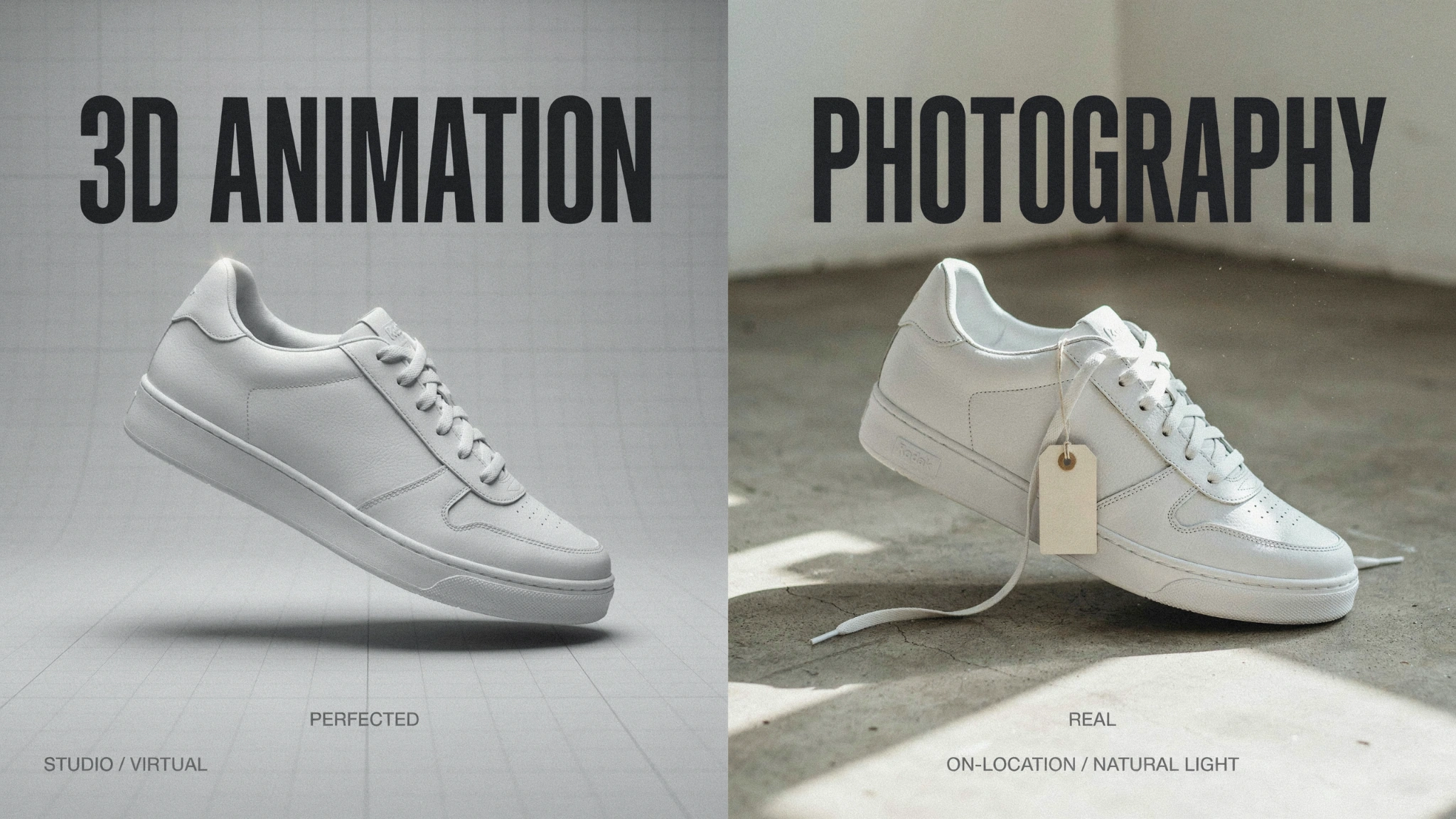
Here is the decision in one line. If your catalog is small, simple, and stable, hire a photographer. If it has variants, complex geometry, or products that need to move, build it in 3D.
Everything below is the reasoning behind that rule, including the point where the math flips and CGI stops being the expensive option.
Both formats produce a good product image. They just fail in different places, and the failure is what should drive your choice. Demand for rendered assets keeps climbing, too.
Key Takeaways
- Photography wins on speed, cost, and realism for small, simple catalogs. One shoot, one day, done.
- 3D wins the moment variants enter the picture. Eleven fabrics means eleven shoots, or one model and eleven material swaps.
- Break-even sits around 20 images per product family, not at a fixed number of SKUs.
- CGI has real downsides. Longer lead time on the first asset, higher upfront cost, and a plastic look if the studio cuts corners on materials.
- Photography cannot show motion, internal structure, or true scale. Those are exactly the things shoppers ask about before buying.
- Most brands end up running both, using photography for lifestyle and 3D for the catalog grid.
The Short Answer, Before the Detail
Choose a camera when the product already exists, comes in one or two finishes, and looks like what it is. A ceramic mug, a candle, a paperback.
Choose 3D when any of these are true: the product has many variants, the product does not exist yet, the buying decision depends on scale or mechanism, or you will need the same asset across web, paid social, marketplace, and print.
A quick vocabulary note, since the terms get used loosely. CGI is the broad category of computer-generated imagery. 3D product animation is CGI that moves. A still render is CGI that does not. If that distinction matters to your brief, the difference between CGI and 3D animation is worth ten minutes before you write one.
Where Product Photography Still Beats CGI
CGI has not made photography obsolete, and any studio that tells you otherwise is selling something.
Real materials photograph better than they render. Worn leather, hand-thrown ceramic, natural stone, linen with genuine slub. These carry microscopic irregularity that takes an expensive artist many hours to model convincingly. A camera captures it for free.
Speed on a single shoot. A good photographer turns around forty shots in two days. A 3D pipeline needs modeling, texturing, lighting, and rendering before the first usable frame exists.
Nobody doubts a photo. There is a trust premium on a camera image that matters in categories built on craft or provenance, and shopper research on product pages consistently shows people scrutinizing imagery harder than copy.
Lower cost at low volume. For ten SKUs in one colorway, a shoot is almost always cheaper. The CGI vs product photography comparison only tilts once repetition enters.
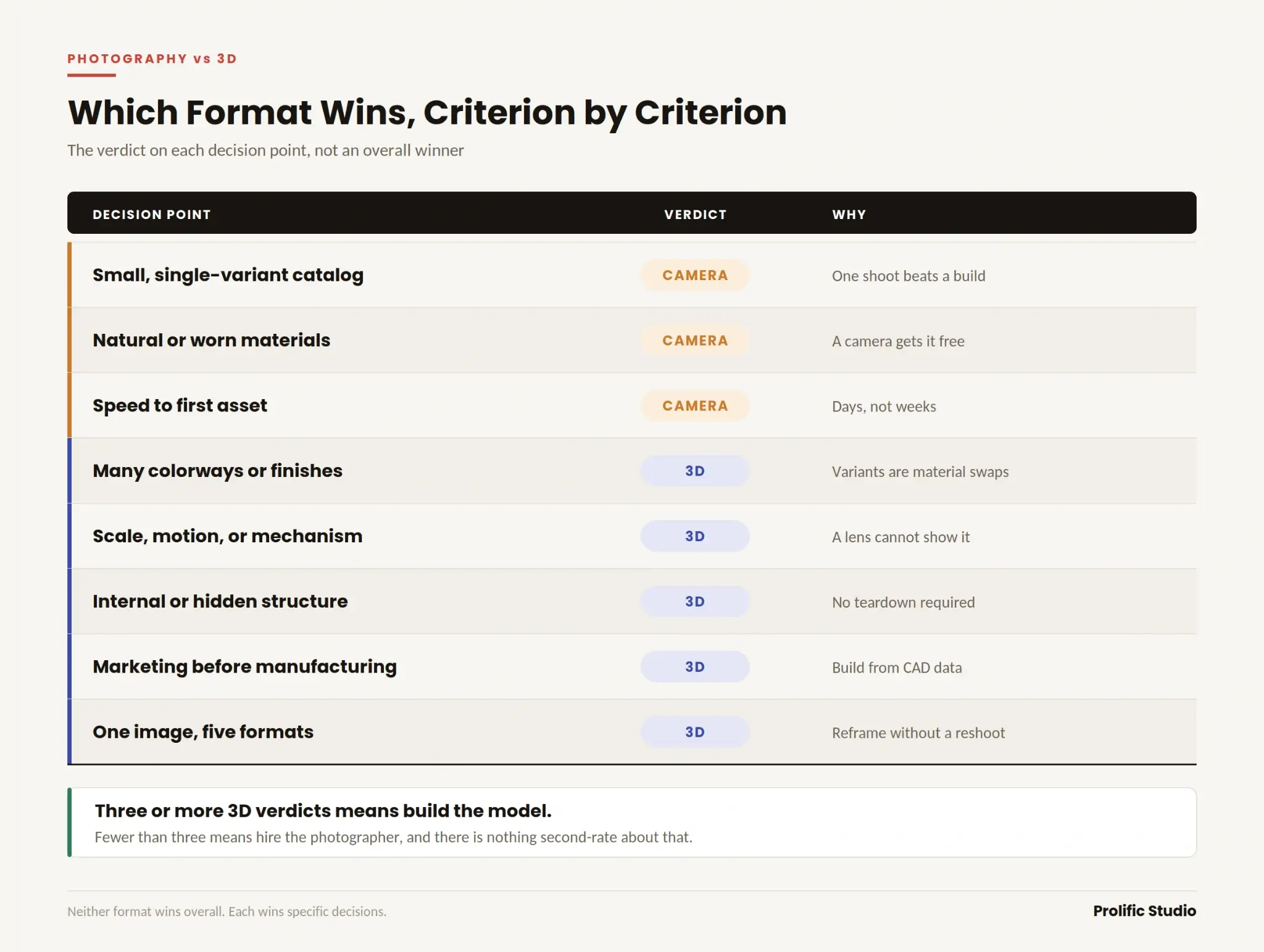
Verdict: photography wins on small, simple, single-variant catalogs where the material itself is the selling point.
Where 3D Product Animation Wins Outright
The advantages of 3D are not about looking better. They are about what a camera physically cannot do.
Variants cost almost nothing. Once a model exists, a new colorway is a material swap. This is the single biggest driver in the product photography vs 3D animation decision.
You can show the invisible. Cutaways, exploded views, internal construction, airflow. A camera cannot open a product without destroying it.
Motion. How a mechanism folds, how a component seats, how a fabric moves. Among the clearest 3D product visualization benefits is that a shopper watches instead of guessing.
The product does not need to exist. You can market from CAD data before manufacturing finishes, which pulls your launch forward by weeks.
One asset, every format. Hero image, spin, paid social cut, marketplace listing, print. Reframing a render costs a re-render. Reframing a photo costs a reshoot. Our library of 3D animated product video examples shows how far one build stretches.
Verdict: 3D wins on variants, complexity, motion, pre-launch timing, and multi-format reuse.
Do 3D Product Images Convert Better Than Photos?
In categories where shoppers have real questions, yes. Retailers adding 3D and AR product experiences report measurable conversion lifts, with the strongest results on configurable and high-consideration items.
The mechanism is not that renders look prettier. An interactive model answers questions a static frame leaves open, so fewer people bounce to a competitor’s page hunting for the answer.
Where the product is simple and familiar, the lift flattens. Nobody needs to rotate a bath towel.
Verdict: 3D converts better where uncertainty exists, and barely moves the needle where it does not.
Is 3D Rendering Cheaper Than Product Photography?
Not at first. Usually cheaper by the second campaign.
A shoot has low setup and high repetition cost. Studio, photographer, stylist, retouching. Call it $150 per finished image for a typical product, and every new colorway or angle means paying again.
A 3D build inverts that. You pay roughly $1,500 up front to carry the modeling and texturing, then about $80 per image after. The first render is expensive. The thirtieth is nearly free.
So the honest answer on the cost of 3D rendering vs photography is that it depends entirely on how many images you need from the same product. Anyone asking how much a CGI product image costs vs a photoshoot is asking a question with no single number attached.
Put plainly, 3D rendering vs product photography is not a price fight. It is a question of how many times you intend to reuse the asset. Any 3D animation studio worth hiring will tell you when the answer is not often enough.
The Break-Even Point Most Brands Miss
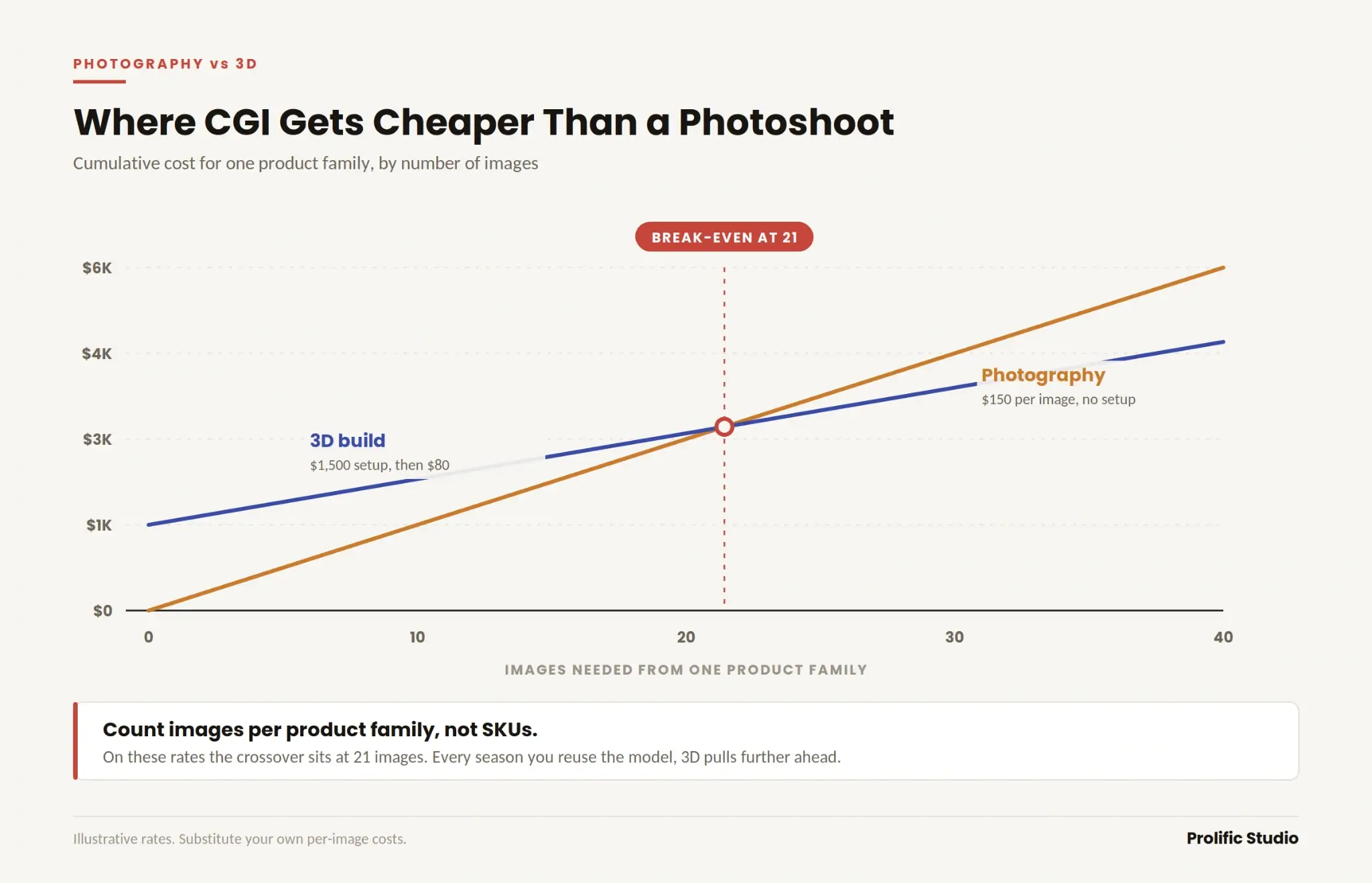
The mistake is counting SKUs. You should be counting images per product family. Software licensing and render infrastructure sit inside that setup cost as well, which is part of why studio rates vary so widely between quotes.
Take a chair sold in eight fabrics, shot from four angles. That is 32 images.
With a camera: 32 at $150 each is $4,800.
In 3D: $1,500 for the build, plus 32 renders at $80, which comes to $4,060.
On those rates the two lines cross at 21 images. Below that, hire the photographer. Above it, build the model. Then look at next season. Three new fabrics means twelve fresh images: $1,800 with a camera, $960 in 3D, because the model already exists. The gap widens every cycle.
Which is why is CGI worth it for a small product catalog is a fair question with an uncomfortable answer. Often not, unless the catalog turns over.
Four Catalogs, Four Different Verdicts
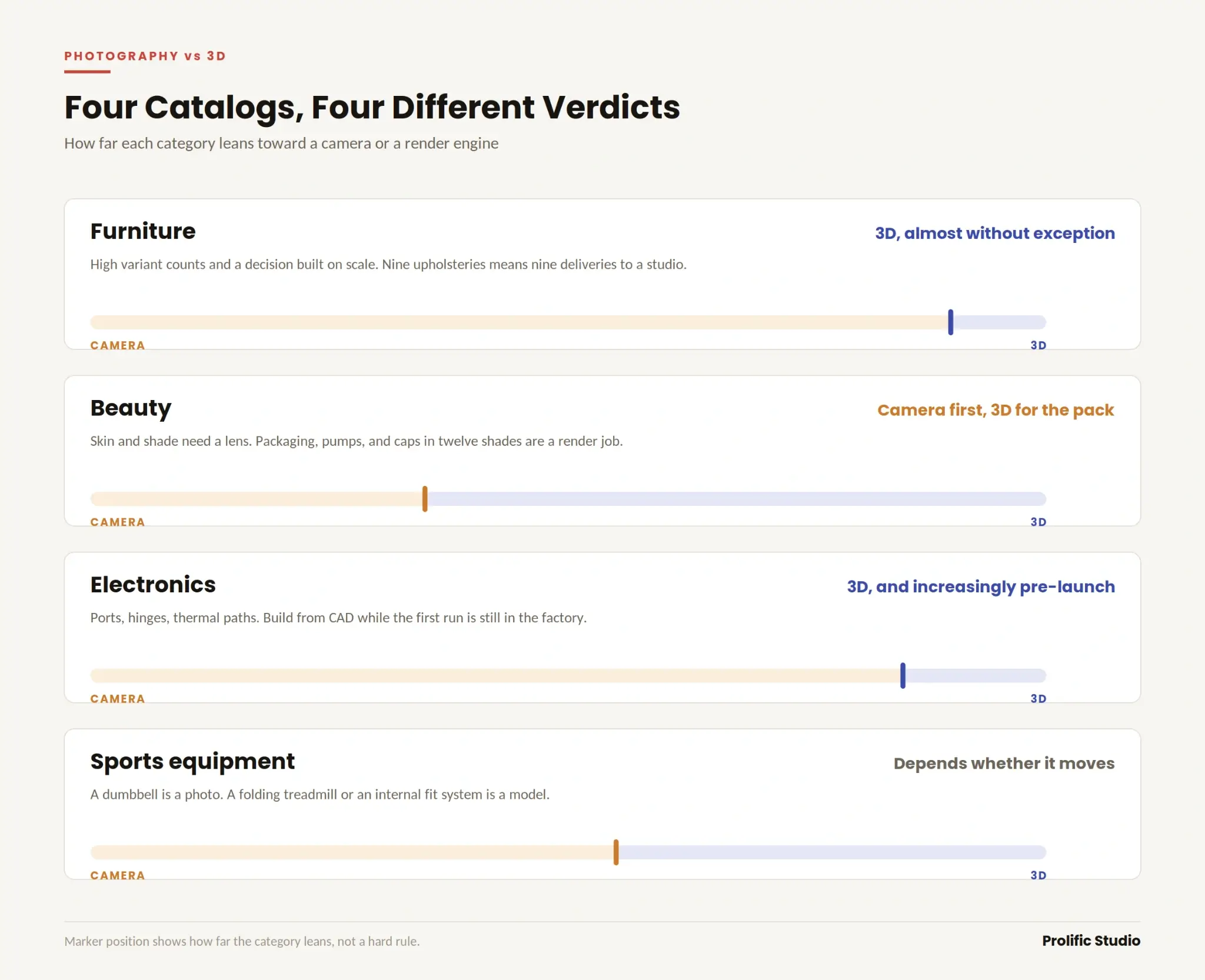
The right answer changes completely depending on what you sell.
Furniture: 3D, Almost Without Exception
Furniture is the clearest case. High variant counts, expensive logistics, and a buying decision built on scale. Photographing a sectional in nine upholsteries means nine deliveries to a studio. Model it once and the material library does the rest.
Beauty: Camera First, 3D for the Pack
Skin, texture, and shade need a lens and a real face. What 3D handles well here is packaging: the bottle, the pump mechanism, the cap in twelve shades. Split the work by subject rather than picking one format.
Electronics: 3D, and Increasingly Pre-Launch
Ports, hinges, internal layout, thermal paths. Electronics sell on detail a camera cannot reach without a teardown. The pre-launch advantage matters more here than anywhere, since you can build assets from CAD while the first production run is still in a factory.
Sports Equipment: It Depends on Whether It Moves
A dumbbell is a photography job. A folding treadmill, a bike with adjustable geometry, or a helmet with an internal fit system is a 3D job. Ask whether the value is in the object or in what the object does.
For catalogs in that second group, 3D product animation services usually earn back their cost inside two seasons.
The Hybrid Setup Most Brands Actually Land On
Very few brands go all in on one format, and the ones that do usually regret it.
The pattern that works: 3D for the catalog grid, where consistency and variant coverage matter most, and photography for lifestyle and campaign work, where atmosphere and human presence carry the message. Your product page shows a render. Your homepage banner shows a photograph. Nobody notices the seam.
This also answers whether you can replace product photography with 3D. You can, technically. Most brands find they do not want to, because the two formats are doing different jobs.
It is also worth knowing the choice is not binary. Among the product photography alternatives brands overlook, motion design and illustrated explanation can carry a product story for far less than either a shoot or full CGI, particularly for software, services, and anything where the value is a process rather than an object.
Five Questions That Settle the Decision
Run your catalog through these. Three or more yes answers point to 3D.
- Does one product come in more than four variants? Repetition is where CGI compounds.
- Does the buying decision depend on scale, motion, or internal structure? A camera cannot answer any of the three.
- Do you need assets before the product physically exists? Only one format can do this.
- Will the same product be shot again within eighteen months? Reshoots are where photography quietly gets expensive.
- Do you need the same image in five or more formats? Reframing is free in 3D and costly with a camera.
Fewer than three yes answers usually means a photographer, and there is nothing second-rate about that answer. Choosing 3D for a fifteen-SKU catalog of simple objects is how brands overspend. If the honest verdict is neither, illustrated motion design can often tell your product story for less than either format.
How Prolific Studio Approaches the Choice
We start by counting images, not SKUs, and by asking how often the catalog turns over.
If the answer points to photography, we say so. The projects that go badly are the ones where a client was sold a 3D pipeline for a catalog that never needed one, and the assets sat unused because nothing changed.
Where 3D does make sense, the job is building a system rather than a set of pictures. Rigged product models, a material library matched to your real finishes, and modular scenes that regenerate every format from one source.
Final Words
Treating this as a rivalry is the mistake. A camera and a render engine are two tools, and asking which is better is like asking whether a wrench beats a screwdriver.
The real question is how many times you will need the same product pictured, in how many states, over how long. Answer that honestly, and the format picks itself.
If your catalog is small and stable, book the photographer. If it multiplies, moves, or ships before it exists, build the model. And if you are somewhere in the middle, which most brands are, run both and stop agonizing about it.
Not sure which side of the line you fall on? As an animation production company, we can run the break-even math on your actual catalog before you commit to anything. Book a call.
Frequently Asked Questions
Is 3D rendering cheaper than photography?
Eventually, not immediately. A shoot costs around $150 per finished image with almost no setup. A 3D build costs roughly $1,500 before the first render lands, then about $80 per image after. Those two lines cross at about twenty images from the same product. Below that, a camera is cheaper. Above it, the model wins, and it wins by more every season you reuse it.
Can CGI replace product photography?
Technically yes, and a few brands have done it entirely. Whether you should is a different question. CGI struggles with irregular natural materials, worn leather, hand-finished ceramic, real skin, and it never quite carries the trust that a photograph does in craft-led categories. Most brands who try full replacement come back to a split: renders for the catalog grid, photography for lifestyle and campaign work.
What are the disadvantages of 3D product rendering?
The pros and cons of 3D product rendering come down to four things on the debit side. The first asset takes longer than a shoot, often three to six weeks. Upfront cost is higher before any reuse. Quality depends heavily on the artist, and weak material work looks plastic in a way shoppers notice without naming it. And you need decent source data, since a studio working from photographs and a tape measure will spend longer and charge more than one working from your CAD files.
Do 3D product images increase sales?
The evidence points that way, particularly for interactive spins and configurable products, where retailers report both higher conversion and lower returns. The mechanism is straightforward: shoppers who can rotate and inspect an item ask fewer unanswered questions and guess less at checkout. The effect is strongest in complex and high-variant categories, and close to negligible for simple products people already understand.
When does CGI make sense for product images?
When repetition, complexity, or timing is working against a camera. Many variants of the same product, a decision that hinges on internal structure or motion, a launch that has to be marketed before manufacturing finishes, or one image needed across five different formats. If none of those apply, a photographer is faster, cheaper, and entirely sufficient.