A strong drug launch video strategy helps pharma teams explain the product story before the market hears five different versions of it.
That is the real problem.
A drug launch is not just one announcement. It touches medical affairs, brand, sales, HCP education, congress planning, internal training, patient support, market access, and review teams. Each group has a slightly different need. Each group may explain the product in a slightly different way.
Without a clear video plan, the launch story can become scattered.
A good video strategy gives everyone a shared visual route. It helps the team show the disease, target, mechanism, treatment rationale, and approved message in a way people can follow.
Not louder.
Clearer.
Why Drug Launch Video Strategy Matters Before Production
A drug launch video strategy should start before anyone talks about scene style, camera movement, or animation length.
Too many pharma teams do it backward.
They wait until the deck is packed, the brand story is heavy, and the launch timeline is already tight. Then someone asks for a video to “make it simple.” That sounds reasonable, but animation cannot magically fix a confused message.
It can reveal the confusion very quickly.
If the team cannot explain the treatment story in a clean order, the video will struggle too. The science may be strong. The data may be important. The brand may have a real point of difference. Still, the viewer needs a route.
That route should be agreed early.
What is the disease problem?
What is the target?
What does the product do?
What can be claimed?
What must stay softer?
Who is the first audience?
A good animation production company should push for those answers before production begins. Otherwise, the team may end up paying for beautiful scenes that do not help sales, medical affairs, or HCP education.
Drug Launch Video Starts With One Core Story
A drug launch video should not try to explain everything at once.
That is where launch content often gets heavy.
The brand team wants the market story. Medical affairs wants more disease biology. Sales wants simple talking points. Legal wants careful language. Scientific reviewers want pathway accuracy. Leadership wants the asset to feel polished and important.
All fair.
But not all in the same cut.
The first job is to build the core story. This is the version everyone can agree on. It does not need every detail. It needs the main logic.
Here is the disease setting.
Here is the unmet need.
Here is the target.
Here is how the treatment fits.
Here is the response the brand can discuss carefully.
That structure gives the rest of the content a foundation. From there, a pharma launch video can become deeper, shorter, quieter, more scientific, or more patient-friendly depending on the audience.
Without that core, every version starts drifting.
Pharma Video Strategy Should Separate Audiences Early
A pharma video strategy only works when the audience is clear.
A healthcare professional does not need the same video as a patient. A sales rep does not need the same version as a medical affairs team. A congress booth visitor may not even hear the voice-over. An internal launch meeting may need more context than a field-facing asset.
One video cannot carry all of that well.
It usually becomes too long for sales, too technical for patients, too shallow for HCPs, and too dependent on sound for congress use.
Better to separate the main audiences early.
For HCPs, the video may need deeper disease context and mechanism detail. For sales training, it may need a repeatable explanation reps can remember. For congress, it may need a visual loop that works in a noisy space. For patient support, it may need plain language and softer visuals.
This does not mean creating completely separate campaigns from scratch.
It means building one approved scientific foundation, then shaping it for each use.
MOA Video for Drug Launch Campaigns
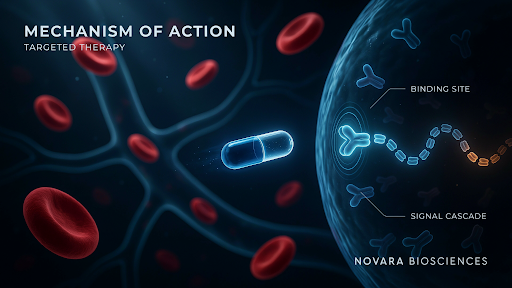
An MOA video for drug launch is often one of the most important assets because it explains what the product is doing at a biological level.
Static slides can show arrows, receptors, cells, and pathway labels. They can be accurate and still hard to absorb. A mechanism of action video gives the science movement. It can slow the difficult step down, highlight the target, and show how the treatment interaction fits into the disease story.
But MOA content can become messy fast.
Every team wants its part included. The receptor. The biomarker. The pathway. The downstream signal. The data point. The phrase that has been sitting in every internal deck for months.
The viewer does not need all of that at once.
A better launch MOA gives the viewer one path first. Disease. Target. Interaction. Response. Then deeper detail can be added in supporting versions.
That keeps the mechanism clear enough for HCP education video use, sales training, medical affairs discussion, and congress content.
Pharmaceutical Marketing Video Content Needs Claim Discipline
A pharmaceutical marketing video has less room to play than ordinary marketing content.
That does not mean it should be dull. It means the visuals have to stay responsible.
A treatment response cannot look instant if the approved message does not support that. A disease marker should not vanish too cleanly. A pathway should not shut down in a way that suggests more certainty than the data allows. Even color, pacing, and visual intensity can change how a claim feels.
This is where pharma product launch video planning needs review early.
Medical, legal, regulatory, brand, and scientific teams should not enter the process only when animation is nearly finished. If they do, the team may have to rewrite voice-over, soften visuals, rebuild scenes, or change the scientific sequence.
That is expensive. Worse, it delays the launch asset when everyone needs it most.
A careful plan saves time.
Not because it slows the video down, but because it catches problems before they become production problems.
HCP Education Video Assets Need Scientific Respect
An HCP education video should not feel like a patient explainer with more technical labels.
Healthcare professionals usually know the disease area. They may know the treatment landscape. They may have questions about clinical relevance, endpoint meaning, target selection, or how the product fits into current practice.
That changes the video.
The animation needs enough scientific depth to feel credible, but not so much that it turns into a moving journal article. It should guide the viewer through the disease context, target, mechanism, and treatment rationale in a clean order.
This is where a medical animation studio can help shape the balance.
Too little science, and HCPs may not take the content seriously. Too much, and the message becomes hard to use in a real conversation. The stronger version usually sits in the middle: accurate, structured, and clear enough to support discussion.
That is the real job of HCP launch content.
Medical Affairs Video Should Not Sound Like Brand Copy
A medical affairs video has a different tone from a commercial launch asset.
It may support advisory boards, KOL discussions, internal scientific alignment, field medical teams, congress meetings, or disease education. The audience is often more technical and less tolerant of anything that feels overstated.
That means the video needs restraint.
A medical affairs video may explain disease biology, unmet need, treatment rationale, biomarker context, mechanism, or scientific background. It can look polished, but it should not feel like it is selling too hard.
This matters during launch because medical affairs often helps shape how the science is discussed before the wider market messaging settles.
If the medical affairs content is clear, other launch assets become easier to build. If it is messy, the confusion travels.
Congress Booth Animation Has to Work in a Noisy Room
Congress booth animation has a different job from a full presentation video.
People are walking past. Some are talking. Some are scanning booths from a distance. Some may stop for ten seconds and leave. Many will not hear the voice-over at all.
So the video cannot depend on a long explanation.
A good congress booth animation should make sense visually. It may show the disease pathway, the target, the treatment action, or the product story in a short loop. The labels should be clear. The pacing should be quick enough to hold attention, but not so fast that the science becomes decoration.
For a drug launch, this matters.
A congress loop is often one of the first public-facing assets people see around the new treatment story. It does not need to carry the full clinical discussion. It needs to create a reason for someone to stop and ask a better question.
That is a win in a crowded hall.
Pharma Sales Training Video Assets Need to Be Usable

A pharma sales training video should help reps explain the launch story without drifting from the approved message.
That sounds simple. It usually is not.
Before launch, sales teams may be learning the disease area, the treatment rationale, the MOA, the differentiators, the safety language, and the approved way to discuss the product. A long deck can cover all of that, but it may not help people remember the story in a real conversation.
Video can help when it breaks the science into pieces.
One section can cover the disease problem. Another can explain the target. Another can show the mechanism. Another can connect the treatment story to the clinical conversation.
This is where pharmaceutical animation services can support the launch beyond one polished master video. The real value may come from shorter clips that reps can review, training teams can reuse, and managers can build into learning modules.
A sales asset should not only look good.
It should help the field explain faster and more consistently.
Production Planning Should Start With Review in Mind
Launch videos move faster when review is planned early.
That may sound obvious, but pharma teams still get burned by this. Medical, legal, regulatory, brand, and scientific reviewers may enter at different points. If they review too late, changes become expensive.
A pathway note at script stage is easy to fix.
A pathway note after animation is not.
A claim adjustment before voice-over is manageable.
A claim adjustment after final edit can affect timing, captions, and scene structure.
A visual concern during storyboard can be solved quietly.
A visual concern after rendering can slow the whole launch timeline.
A strong drug launch video plan should include review checkpoints before major production stages. Script. Storyboard. Scientific sequence. Animatic. Final animation.
This is where a scientific animation company can help by building review-friendly production steps. The goal is not just to finish the video. The goal is to finish the right version without turning every late comment into a rebuild.
Final Words
A strong drug launch video strategy helps pharma marketing teams explain a new treatment story clearly, carefully, and consistently across launch channels.
It can support MOA video for drug launch campaigns, HCP education video content, medical affairs video assets, congress booth animation, pharma sales training video programs, patient education pharma video materials, and internal launch alignment.
The best strategy does not depend on one big video doing everything. It builds a clear core story, then turns that story into the right versions for the right audiences.
That is where launch video becomes more than content.
It becomes the shared visual language of the brand.
Frequently Asked Questions
Related Articles: