Pharmaceutical animation is a specialty within medical animation, and the distinction matters more than it might seem. Both build the same kinds of models from the same kinds of data.
Only one of them has to survive a regulatory review, carry approved claims, and hold up when a prescriber pauses the video to check a detail. This is an overview of what the category covers, who commissions it, how it gets built, and where the money goes.
Key Takeaways
- Pharmaceutical animation is 2D or 3D animation built to explain a drug, its mechanism, or its clinical data to a regulated audience.
- The defining constraint is not artistic. Every claim on screen has to be supportable and cleared for use.
- Mechanism of action films are the largest and most expensive category, typically $25,000 to $75,000 for two to three minutes.
- Production runs eight to fourteen weeks. Medical, legal, and regulatory review is usually the bottleneck rather than the animation.
- Two review gates decide the budget: storyboard and near-final cut. Changes before the first are cheap. After the second, they are not.
- Molecular events cannot be filmed. Light microscopy hits a physical limit well above the size of a single receptor.
- Spend concentrates in the twelve months before launch, then returns at every new indication and market.
What Is Pharmaceutical Animation?
Pharmaceutical animation is visual content, 2D or 3D, designed to explain how a drug works, how it is delivered, or what its clinical data show. It is commissioned by pharma and biotech companies for regulated audiences, which means every visual claim has to be scientifically supportable and cleared before use.
The category exists because the science is invisible and the stakes are unusually high. A molecule that reaches approval represents years of work and an enormous investment.
Congressional Budget Office analysis notes that estimates of average research and development spending per approved drug range from under $1 billion to more than $2 billion. Explaining what that molecule actually does, to a prescriber with eight minutes between patients, is not something a slide deck handles well.
What separates the category from general explainer video is three constraints operating at once. Scientific accuracy verifiable against published data. Regulatory compliance on every claim. And an audience that frequently includes people who know the field better than the people making the video.
What Makes It Different From General Medical Animation
Regulation, mainly. A hospital can publish an educational animation about how the heart works, and nobody reviews it against a label. A pharma company has no such freedom.
Four practical differences follow:
- Claims are the unit of work. Scripts get written against approved claims and reviewed line by line, rather than written for flow and checked afterwards.
- Fair balance applies. Anything promotional that presents benefit has to present risk with comparable prominence.
- Version control becomes serious. The approved cut is a controlled document, and a studio that loses track of which render was cleared creates a real problem rather than an inconvenience.
- Sources travel with the file. Reviewers ask where a visual came from, and the answer needs to be a citation instead of an artist’s judgment.
None of this makes the animation itself harder to build. It makes the process around the animation considerably heavier, which is why a pharmaceutical animation agency with pharma clients already on its books usually costs more than a general studio and usually earns the difference back in avoided review cycles.
Why Pharma Cannot Simply Film the Science
Because the events happen below the size a light microscope can resolve. This is a physical limit rather than an equipment budget problem.
Conventional optical microscopy was long constrained by the diffraction limit of roughly 0.2 micrometers, and the 2014 Nobel Prize in Chemistry was awarded for finding ways around it.
A single receptor protein is far smaller than that threshold. So is the drug molecule binding to it. Even the super-resolution methods that won the prize image prepared or fluorescently tagged samples rather than producing broadcast footage of a mechanism unfolding in real time.
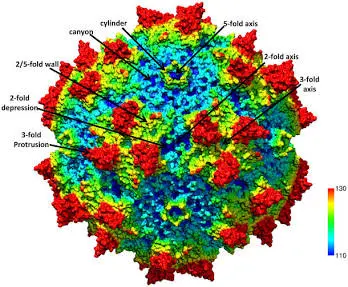
What animators work from instead is structural data. Published crystal structures, cryo-EM models, kinetic measurements, and pathway diagrams get assembled into a reconstruction that matches what the literature describes.
Protein coordinates typically come from public structural repositories, and a studio that can name its sources for a given molecule is telling you something useful about how it works.
The output is therefore an evidence-based interpretation rather than a photograph. Good studios are explicit about that distinction when a reviewer asks, and they document which choices were dictated by data and which were made for legibility.
The Main Types of Pharmaceutical Animation
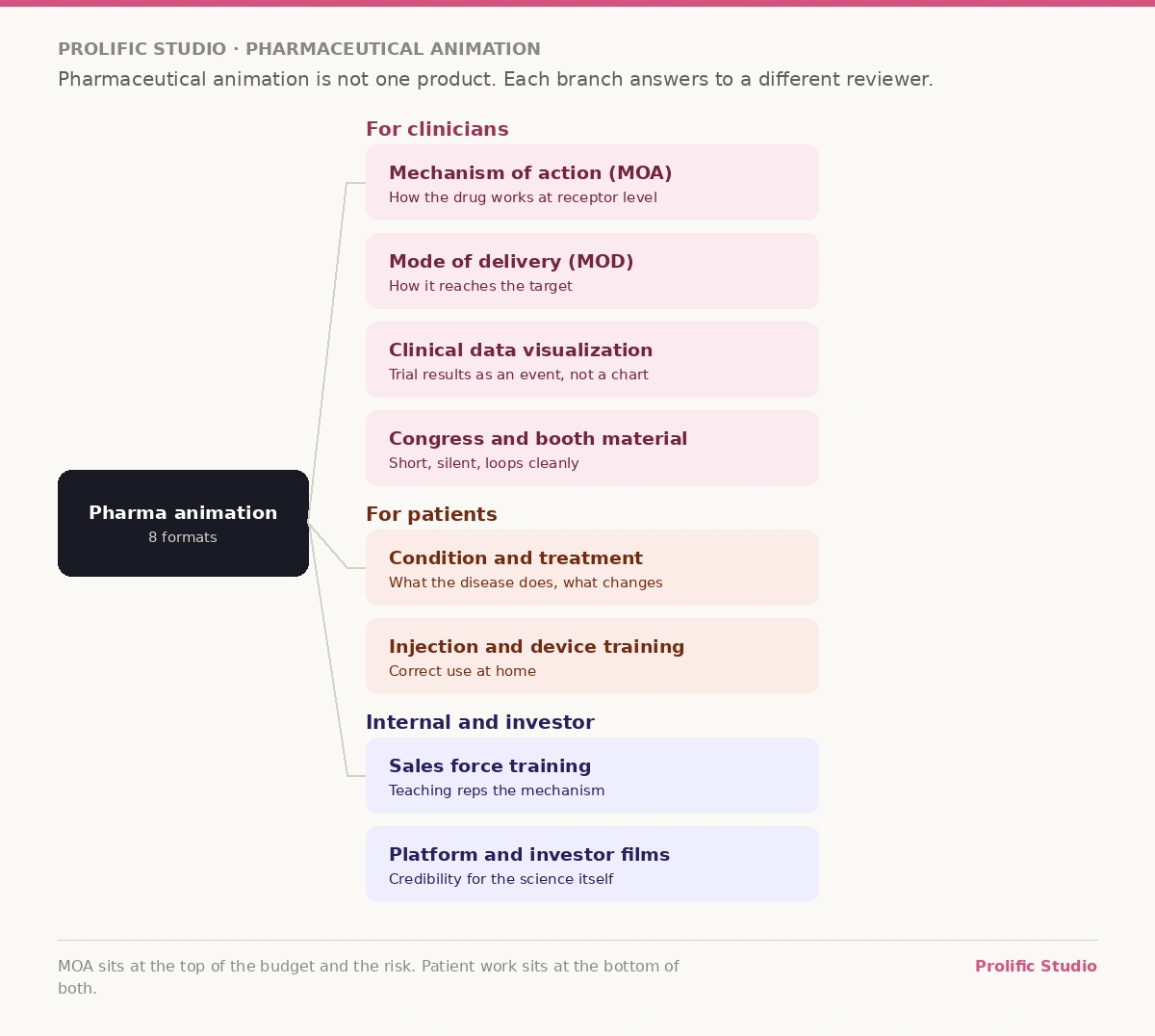
Eight formats cover nearly everything commissioned, and they sort naturally by audience.
For clinicians:
- Mechanism of action (MOA). How the drug works at receptor or pathway level. The flagship asset in most portfolios.
- Mode of delivery (MOD). How the drug reaches its target, covering formulation, release behavior and distribution.
- Clinical data visualization. Trial results animated so a finding reads as an event rather than a static chart.
- Congress and booth material. Short, silent, built to loop cleanly on a stand.
For patients:
- Condition and treatment explainers. What the disease does and what the drug changes about it.
- Injection and device training. Correct use of an autoinjector, pen or inhaler at home.
Internal and investor:
- Sales force training. Teaching representatives the mechanism they will be discussing.
- Platform and investor films. For biotech raising on a technology rather than a single asset.
MOA sits at the top of both the budget and the risk. Any mechanism-of-action animation company you shortlist should be able to walk you through a project where the published literature was genuinely ambiguous, because how a studio handles that situation tells you more than any showreel.
Who Actually Uses It, and For What
Five audiences, with different tolerances and different definitions of success.
Prescribers absorb most of the spend. They want mechanism, comparative context, and enough specificity to trust the source. Sales representatives use the same asset in a completely different setting, so it has to work unattended on a website and also paused halfway through on a tablet in a corridor.
Patients always get a separate build. Vocabulary and pacing that reassure a patient read as imprecise to a clinician, and the reverse holds just as firmly.
Payers and market access teams care about outcomes and economics rather than molecular detail. Animation earns its place with them mainly by showing where in a treatment pathway a product sits.
Investors, in biotech especially, are assessing platform credibility. A clear mechanism film has become close to standard in a Series B deck.
Internal audiences are the most underrated of the five. A sales force that genuinely understands the mechanism sells differently, and training animation costs a fraction of a launch film. Our guide on pharmaceutical animation for HCP education covers what the clinician-facing versions need to carry.
How Is a Pharmaceutical Animation Made?
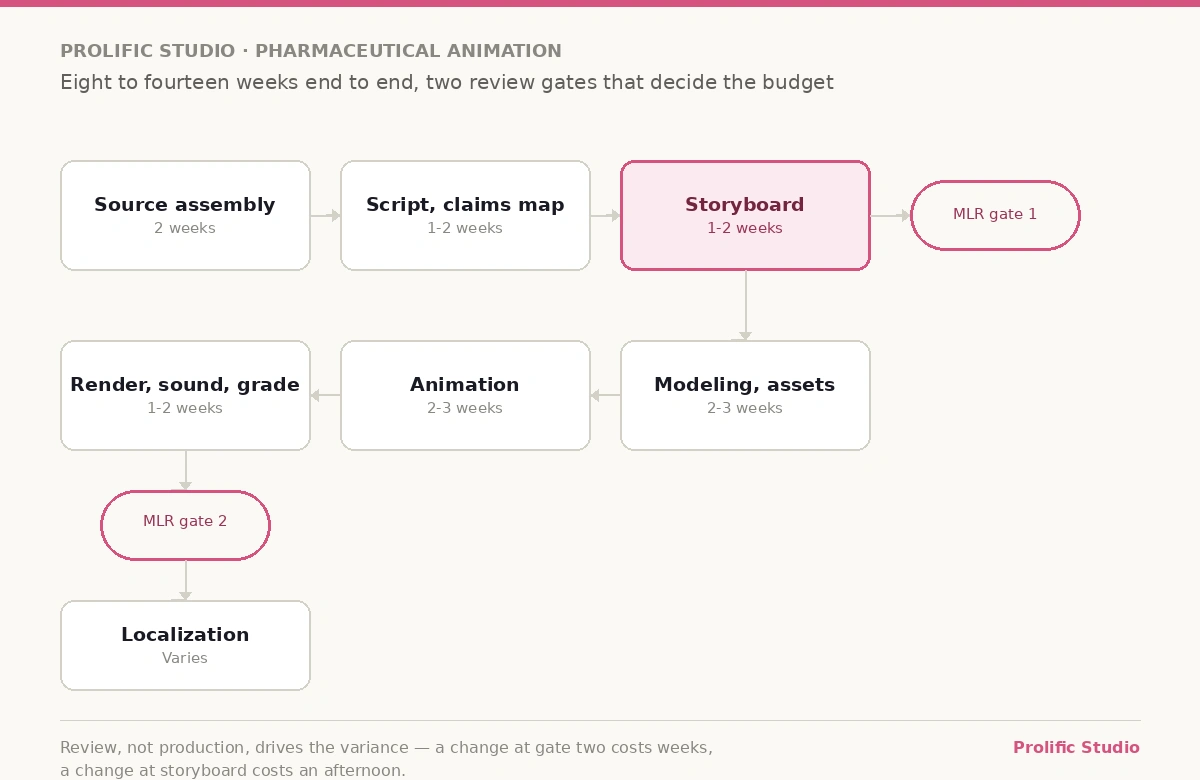
Seven stages across eight to fourteen weeks, with two review gates that largely determine whether the project holds its budget.
It begins with source assembly rather than creative work. Someone gathers the papers, structures, pathway diagrams, and approved claims, then builds a reference document the script will be written against. Skipping this stage is the most common reason a pharma animation runs long.
Scripting follows, written claim by claim. Storyboard comes next, and that is the first review gate. Every stakeholder who will eventually hold an opinion should express it here, because a storyboard change costs an afternoon while the identical change after animation begins costs weeks.
Then production proper: modeling and asset creation, animation, then render, sound, and grade. The second gate sits at near-final cut, where medical, legal, and regulatory sign off on the actual thing rather than on a description of it.
Localization and versioning close the project out, and both are dramatically cheaper when the build anticipated them. A medical animation studio that asks about your market list in week one is thinking about the right problem at the right time.
Where Regulatory Review Fits In
At two formal gates, plus continuously in the background. Knowing what reviewers are actually checking makes the whole process considerably faster.
For promotional material in the United States, FDA rules govern what an advertisement is permitted to say. The agency’s guidance on the basics of drug ads sets out that product claim advertising must present the drug’s name, at least one FDA-approved use, and the most significant risks, with benefit and risk given comparable prominence.
In an animation that has a concrete consequence: risk information cannot be compressed into fast text at the end while benefit receives sixty seconds of hero treatment.
Reviewers are generally checking four things. Whether each visual claim is supportable. Whether balance between benefit and risk holds across the whole piece. Whether any visual implies something the label does not support, which animation does easily and often accidentally. And whether sources are documented.
That last point is where studios without pharma experience come unstuck. A reviewer asking why a receptor is depicted a particular way wants a reference, and an answer about visual clarity will not satisfy them.
How It Gets Used Across a Product Lifecycle
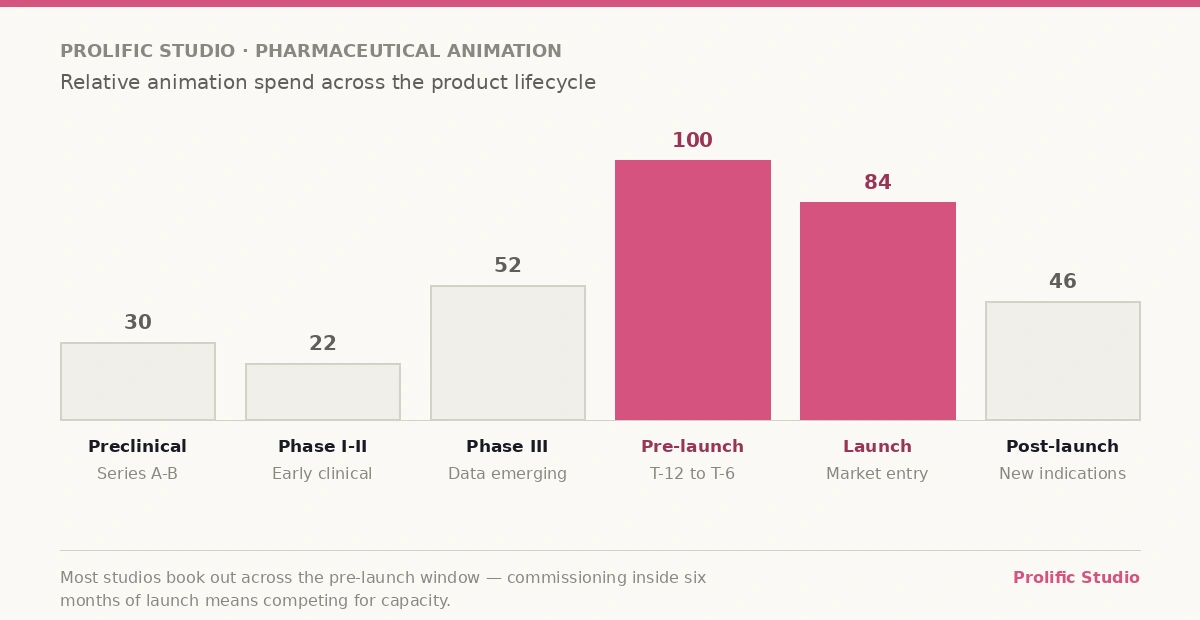
Spend is not spread evenly. It concentrates hard in the twelve months before launch, then returns at each new indication.
Early on, biotech companies commission platform and mechanism films for investors and prospective partners. These are sometimes the highest-fidelity pieces a company ever produces, because the audience is evaluating the underlying science rather than a product.
Through Phase II and III, the work shifts toward congress material and data visualization as results become presentable. Pre-launch is the peak. The MOA film, the MOD animation, sales training, patient material, and booth assets all tend to get commissioned inside the same six-month window, which is exactly why good studios book out.
After launch, the pattern turns to maintenance and expansion. New indications, additional markets, label updates. This is the stage where an asset library repays itself, because a new indication becomes a re-edit rather than a rebuild.
What Does Pharmaceutical Animation Cost?
Between $12,000 and $75,000 for most individual assets, with MOA films at the top of that range and patient explainers at the bottom.
Rough bands per finished minute: patient education $3,000 to $12,000, mode of delivery and device work $8,000 to $18,000, MOA and molecular animation $12,000 to $25,000, and photoreal broadcast material above that again.
Two pharma-specific costs get missed in early budgeting. Review cycles beyond the contracted rounds, which MLR reliably generates. And localization, which multiplies quickly across markets and costs a fraction as much when the build anticipated it.
Our medical animation cost guide lays out the full range across categories and the line items that tend to surface late in an invoice.
Common Mistakes That Waste the Budget
Five of them, in rough order of how much money they cost.
Starting with the visual instead of the claim. Teams arrive with a look they admire and no agreed claim set, then discover during review that the concept cannot be supported.
Bringing reviewers in late. A storyboard seen by three people followed by a final cut seen by eleven is the most expensive sequence in this business.
Building one asset for every audience. It satisfies nobody, and it usually gets rebuilt anyway once someone watches it with a patient.
Treating data as decoration. Animated charts that omit sample size or quietly distort an axis lose a statistically literate audience within seconds. Our piece on how animation explains complex clinical data covers what survives that scrutiny.
Ignoring reuse rights. If your contract does not grant you the models and scene files, the next indication starts from zero at full price.
Final Words
The projects that run smoothly all begin the same way. Somebody writes down the claims the animation has to carry, gets them agreed across medical, legal, and commercial, and only then opens a conversation about how it should look.
Do that and review becomes a formality. Skip it, and you will spend the budget twice.
Send us your claim set and your target audience. Prolific Studio is an animation production company working across mechanism, delivery, clinical data, and patient material, and we will tell you what is buildable, what will struggle in review, and what it should realistically cost.
Frequently Asked Questions
Related Articles: