Animation is everywhere. Browse LinkedIn, YouTube, or Netflix, and it takes only a glance to realize how animation rules every category, from explainer videos to product launches, and from training videos to advertisements. According to Wyzowl’s Video Marketing Report, 86% of businesses use video as a marketing tool in 2025, a significant increase from just a few years ago.
But what is the main challenge for businesses? Unpredictable animation prices. Ask any five studios for an estimate of a 60-second explainer video, and you will get prices from $3,000 to $50,000. Same brief. Same result. Different studios. Completely different prices. Most people do not know what they really pay for. They see the price tag, but not the work, skills, technology, and time behind it.
This guide cuts through that confusion. No matter whether you’re creating your first or tenth animation project, there are three important elements that you will need: accurate cost estimation, knowledge about the costs associated with your project, and proper return-on-investment strategies.

The Cost Reality: 2D vs 3D at a Glance
|
Animation Type |
Cost Range Per Minute | Timeline |
Best For |
| Basic 2D
(Motion Graphics) |
$2,000 – $8,000 | 4–6 weeks | Social media, simple explainers, quick demos |
| Mid-Tier 2D (Character Animation) | $8,000 – $20,000 | 6–9 weeks | Brand storytelling, e-learning, marketing |
| Premium 2D (Frame-by-Frame) | $20,000 – $35,000+ | 9–12 weeks | TV commercials, film sequences, cinematic work |
| Basic 3D
(Simple Renders) |
$15,000 – $30,000 | 8–10 weeks | Product showcases, technical demos |
| Mid-Tier 3D
(Detailed Animation) |
$30,000 – $60,000 | 10–14 weeks | Commercial products, cinematic ads, game assets |
| Premium 3D (Photorealistic) | $60,000 – $150,000+ | 14–20 weeks | Blockbuster-level work, VFX-heavy content |
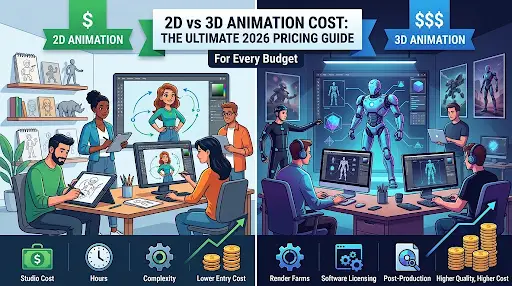
The cost of 2D is normally less than 3D because it entails fewer processes. However, an elaborate 2D animation may end up costing more than a basic 3D video.
What You’re Actually Paying For (Production Breakdown)
The problem that most companies think is that animation is not one single process, but a series of processes.
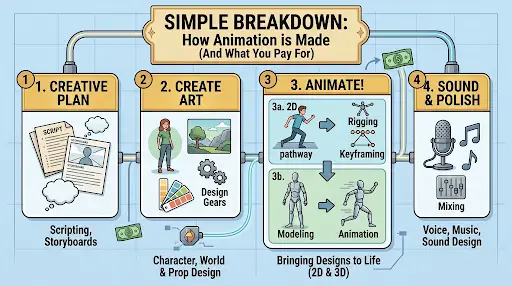
1. Pre-Production (The Foundation)
- Creative brief and goal setting.
- Script writing and revision.
- Storyboarding (visual storyboarding, shot by shot)
- Art Direction and development of style guide.
- Client approval and revisions.
2. Design & Asset Creation
- Designing characters & illustrations.
- Designing backgrounds & environments.
- Creating props & user interface elements.
- Selecting color palette & visual consistency.
- Building an asset library (for reuse)
3. Animation (The Labor-Intensive Stage)
For 2D Animation
- Rigging.
- Keyframing.
- In-betweening.
- Refinement of motion.
For 3D Animation
- Modeling.
- Texturing.
- Rigging.
- Animation.
- VFX & simulations.
4. Audio Production
- Voiceover.
- Music.
- Sound design & SFX.
- Mixing & mastering.
How Much Does 2D Animation Really Cost?
2D animation is the easiest to work with for most companies, but prices differ widely depending on methods used and quality level. Our 2D animation services cover everything from motion graphics to frame-by-frame character work.
|
Tier |
Cost Range (per minute) | What You Get |
Examples |
| Entry-Level 2D | $2,000 – $5,000 |
|
Social media clips, simple explainers, quick demos. |
| Mid-Tier 2D | $8,000 – $15,000 |
|
Explainer videos, e-learning courses, brand storytelling, marketing videos. |
| Premium 2D | $20,000 – $35,000+ |
|
TV commercials, film sequences, animated series, high-end brand content. |
Frame-by-Frame Animation: Why It Costs More
Frame-by-frame animation is the most time-consuming form of 2D animation. Rather than using software methods (tweening), frame-by-frame animation includes drawing or painting each frame by hand.
If you take an animation that lasts for 60 seconds and uses 24 frames per second, it amounts to 1,440 frames altogether.
How Much Does 3D Animation Really Cost?
It is more expensive to use 3D animation because it involves more processes and requires specific computer programs. Our 3D animation services deliver everything from product showcases to photorealistic character work with industry-leading render farms.
|
Tier |
Cost Range (per minute) | What You Get |
Examples |
| Entry-Level 3D | $15,000 – $30,000 | • Basic 3D models (simple geometry)
• Standard textures & materials • Simple rigging (minimal character complexity) • Basic lighting setup • Standard rendering (1080p or lower) • Limited animation (often product rotations or simple movements) • 1–2 revision rounds |
Simple product demos, basic technical visualization, introductory content. |
| Mid-Tier 3D | $30,000 – $60,000 | • Detailed 3D models with proper topology
• Advanced textures & material libraries • Complex character rigging (if applicable) • Professional lighting & shading • 4K rendering capability • VFX & simulations (basic particle effects, cloth, hair) • Professional audio production • 2–3 revision rounds |
Commercial products, cinematic ads, game trailers, product launches, professional explainers. |
| Premium 3D | $60,000 – $150,000+ | • Photorealistic models with extreme detail
• Advanced material systems (subsurface scattering, complex shaders) • Advanced rigging (muscle simulations, cloth sims, hair dynamics) • Cinematic lighting & color grading • 4K or higher rendering with advanced features • Complex character animation with facial expressions & lip-sync • Advanced VFX (fluid simulations, particle systems, motion blur) • Unlimited revision rounds |
Blockbuster-level visual effects, high-end commercial campaigns, AAA game cinematics, film sequences. |
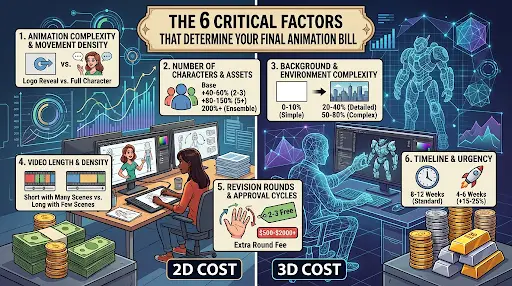
The 6 Critical Factors That Determine Your Final Bill
Not all animations are made equally. The following are six things that determine if your quote is $3,000 or $30,000.
1. Animation Complexity & Movement Density
Motion Complexity refers to how many movements there are in a video, the speed of such movements, and how realistic they are. This is one of the factors that significantly increase production cost.
The production of an easy and simple logo with a static two-second reveal is inexpensive; on the other hand, a character that moves, speaks, and reacts to its surroundings takes much more time and effort.
2. Number of Characters & Assets
The concept of asset complexity is the number of unique characters, objects, and environments a game needs, and for each character, there will be design, illustrations, model making for 3D, rigging, animation cycles, and variations.
One character forms the base cost, and adding two or three characters will increase the cost by around 40% to 60%, adding five or more characters will increase the cost by around 80% to 150%, and adding complex ensemble scenes will result in an increase of over 200%.
3. Background & Environment Complexity
The environment complexity is determined by how detailed and customized your backgrounds must be, starting from a simple white background, which does not cost anything, to an entire city setting, which might take up to several weeks to build.
General and simple backgrounds will have a cost increase of about 0% to 10%, the more detailed and customized backgrounds will have a cost increase of 20% to 40%, whereas the complex environment with a lot of props will have a cost increase of 50% to 80%.
4. Video Length & Density
Content density is the amount of content in the video, and it is related to the cost per minute in addition to the length of the video. A 15-second video that contains ten scene changes is expensive on a per-second basis compared to a three-minute video that contains only three lengthy scenes, because every additional scene will involve setting up the new layout and assets.
Therefore, long videos that have fewer scene changes tend to be cheaper per minute as compared to short videos that have numerous transitions.
5. Revision Rounds & Approval Cycles
Number of revisions refers to the number of times you will ask for revisions without having to pay any further fee. The usual number of revisions included within the total price is about two or three.
Anything over that will incur an additional fee of between $500 and $2,000, depending on the nature of the change.
6. Timeline & Urgency
This term means the speed with which you need to receive the animation and is directly connected with the increase in price due to additional costs for the studio, like extra work hours for animators, faster render hardware, priority of your order in the schedule, and reduced duration of the quality checking procedure.
The standard delivery time of 8 to 12 weeks implies the basic price, while the fast one of 4 to 6 weeks increases the price with a 15 to 25 percent additional fee.
Cost Comparison by Industry & Use Case
The cost of animation is industry-specific since various industries have various quality requirements and ROI requirements.
E-Learning & Educational Content
Educational/training animation is estimated at $5,000 to $15,000 per minute and is created in a 2D motion graphics style or a semi-realistic look. Quality standards for it are medium; the outcome should look polished and professional, yet it does not have to be highly cinematic.
In other words, clarity is of greater importance than the look; stylization and abstraction may be applied here to save money. Voiceover is essential in educational animation due to its instructional nature and the fact that a lot of learning is done via narration.
SaaS & Product Explainers
The cost for creating explainers and product animation ranges from $8,000 to $25,000 per minute and is mostly developed either as 2D motion graphics or as 3D product renders. A lot of effort goes into the creation of these videos since they are supposed to appear professional and convince the viewers.
Accuracy of product demos matters a lot, and 3D product renderings usually make it worth their price since they tend to result in more conversions. Usually, the videos are 60 to 90 seconds long and come with voiceover. The right explainer increases conversion rates by 60 to 80 percent.
According to HubSpot’s research, videos increase landing page conversion rates by up to 80%.
Marketing & Advertising
Most branding and commercial animation costs around $15,000-$60,000 or even more per minute and involves creating high-quality 2D or 3D animation that looks professional or cinematic in nature.
High standards of quality are required since the video is an exact representation of the brand, and it has to be consistent. Approval processes take a long time and involve many stakeholders.
Game Trailers & Gaming Content
Game trailers and cinema animation usually range from $20,000 to $80,000 or more per minute and are usually made in 3D cinematic form, which usually resembles the quality of graphics from the game.
There should be high-quality standards in this case because the trailer should appear just like the video game. Effects can also be simulated in the project, thus increasing its complexity further.
Medical & Scientific Animation
Typical fees for medical or scientific animation range from $15,000 to $50,000 per minute or even higher, and the animations created are mostly of very high quality, in terms of being an exact 3D visualization.
The standard is extremely high, since accuracy is absolutely required. Moreover, there must be a need to review the scientific data presented, along with the production of photorealistic visuals that illustrate the process itself.
Frequently Asked Questions
What's the cheapest way to get animation without it looking cheap?
Select a stylized artistic style so that the look looks like an intended one, and spend good money on a top-notch voiceover to improve cheap visuals. Keep your video short, because 45 well-done seconds are better than two poor minutes. Allocate resources for creating one hero shot, and get the services of a mid-range boutique studio.
Can I get a discount if I order multiple videos?
Absolutely, batch processing will get you between a 15 percent and 30 percent discount. Between two to three video productions, you get a 10 percent to 15 percent discount; more than four videos will give a 20 percent to 30 percent discount; while retainer deals will go from 30 percent to 50 percent.
What's the most cost-effective animation style?
Motion Graphics/Kinetic Typography is the most affordable choice. There are no character designs needed; they use ready-to-go text and shape templates and are quick to create. The costs are $2,000 to $5,000 per minute of animation with a professional, non-film look. It works best for SaaS, data visualization, educational videos, and social media posts.
Should I invest in premium animation or save costs?
It all depends on ROI. Go for premium if animation is core to your message, targets high-value customers, is used in paid media, or impacts brand perception. Cut costs if it’s supplementary, internal, testing a channel, or low-risk. Good mid-tier animation will do the job if the video needs to convert; otherwise, premium animation will pay for itself.
How do I know if a studio's quote is fair?
Some warning signs of an unfair quote are pricing 30 percent or more under the standard price, lack of cost breakdown, unclear revision process, lack of portfolio, and unrealistic time limits. An acceptable quote should provide a cost breakdown, a realistic 8- to 12-week turnaround time, a revision process, an appropriate portfolio, references, and a cost list.
What is the cost per second of a 3D cartoon animation?
The cost of 3D cartoon animation ranges from $15 to $250 per second (1,000-$ 15,000 per minute), based on the character complexity, the quality of the animation, and the geographical location of the studio. At the lower end of this range are simple and templated animations, while at the high end is top-notch television or film quality, which can cost more than $800 per second.
How much does 3D animation production cost?
The cost for a three-minute promotional or explanatory 3D video varies between $3,000 and $20,000. The cost for an animated short film ranges from $20,000 to $150,000, while the price of a complete series episode or feature film can range from several hundred thousand to several million dollars.
Final Words
It costs what it costs because it is complicated and time-consuming and requires expertise, but this doesn’t mean it will ruin your budget. It is all about knowing exactly what you pay for. You do not pay “for a video,” but rather for a creative approach, the work of highly qualified artists, advanced software, quality control, project management, revisions, and professional delivery of a project.
Low-cost animation lacks in one or several aspects, while top-notch animation will excel in all of them. If we talk about most businesses, the ideal price range is $10,000-$25,000 for a 60-90 seconds long professional video, which would help you convert visitors into leads and clients. It is a big amount, but it is justified if we speak about an asset that can bring you profits in the next few years.
Related Articles: