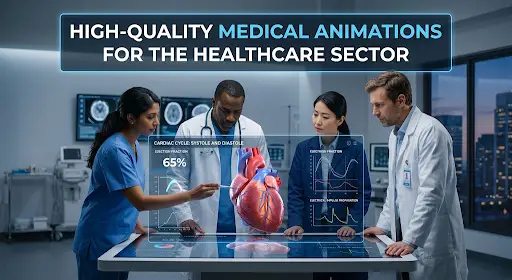
Medical animation for patient education helps patients see what is happening inside the body instead of trying to guess from medical terms alone. That matters because a patient can sit in a consultation, hear every word the doctor says, and still leave unsure.
It happens all the time.
The doctor says “compressed nerve,” “catheter,” “implant placement,” “inflammation,” or “minimally invasive.” The patient nods. Not because everything is clear, but because they do not want to interrupt again.
A short animation can make that moment easier. It gives the patient a visual starting point.
Why Medical Animation for Patient Education Makes Complex Care Easier
Healthcare is full of things people cannot see.
A joint wearing down. A blocked artery opening. A nerve getting pinched. A medication working inside the body. A surgical tool moving through a narrow space. These things are hard enough for medical teams to explain, and even harder for patients to picture when they are already worried.
Patient education animation gives the explanation shape.
A spine clinic can show where the nerve pressure is coming from. A cardiology team can show how a stent opens a vessel. A dental practice can show how an implant sits in the jaw. A hospital can explain a procedure without showing graphic surgical footage.
That last part matters. Many patients do not want to see real surgery. They want to understand the idea without feeling more anxious.
Good animation does that. It shows enough, not everything.
Patients Do Not Remember Everything From the Appointment
Most people forget part of what they are told in a medical setting.
Not because they are careless. Because the situation is stressful, there may be a diagnosis, a treatment option, a cost concern, a recovery question, and family pressure all sitting in the same conversation.
That is a lot to carry.
Medical animation for patients can repeat the important part in a calmer way. The patient can watch it before the appointment, during the consultation, or later at home when they finally have time to think.
This is useful for animated patient education videos on hospital websites, clinic portals, waiting room screens, follow-up emails, and treatment pages.
A good animation studio should understand that patient-facing content is not a conference presentation. It should not feel cold, crowded, or overly technical. The pace should give people room to understand what they are seeing.
The goal is not to impress the patient.
The goal is to help them feel less lost.
Medical Language Needs a Better Bridge
Healthcare teams sometimes forget how unfamiliar basic terms can feel to patients.
A doctor may use a term every day. A patient may hear it once in a scary moment and never fully catch the meaning. That gap is where confusion starts.
A healthcare patient education video can bridge that gap without dumbing things down.
The wording should stay plain. The visuals should move in the right order. The labels should appear only when they help. Too many labels make the video feel like a textbook. Too few details make it feel vague.
This is where a medical animation production company needs to think carefully about the script before the visuals. The animation should not just follow the medical team’s notes line by line. It should translate the idea into something a patient can follow.
For example, instead of starting with a long explanation of disc degeneration, show the healthy spine first. Then show the worn disc. Then show how pressure reaches the nerve. Then explain why pain travels down the leg.
That order feels easier because the patient can see the cause before hearing the full explanation.
3D Medical Animation for Patient Education Shows the Hidden Part
Live-action healthcare video is useful when the patient needs to see a real person.
A doctor speaking on camera can feel reassuring. A clinic tour can make the setting feel less unfamiliar. A nurse explaining aftercare can feel more personal than a slide.
But live action cannot show everything.
It cannot cleanly show what happens inside a joint, artery, nerve, organ, or implant site. Real surgical footage can be too graphic. A doctor pointing at a chart can still leave patients guessing.
That is why 3D medical animation for patient education works so well.
It can show anatomy in a clean way. It can remove the parts that do not help. It can zoom in, pause, repeat, and slow down the exact step the patient needs to understand.
This works well for anatomy animation for patients, medical procedure animation for patients, surgical patient education animation, and treatment explanation animation.
A patient does not need a full medical textbook on screen.
They need the right visual at the right moment.
Better Understanding Leads to Better Questions
When patients understand the basics, they ask better questions.
That changes the consultation.
Instead of sitting quietly and worrying, a patient may ask where the pain is coming from, how the treatment changes the problem, what the recovery step means, or why one option is better than another.
That is good for everyone.
A doctor patient communication video gives both sides the same reference point. The doctor can pause the animation and say, “This is the part we are talking about.” The patient can point to something and ask, “Is that what is happening in my case?”
That kind of conversation is much better than guessing.
It also saves time. Not by rushing the patient, but by making the explanation clearer from the start.
Consent Becomes Clearer When Patients Can Picture the Procedure

Consent should not feel like paperwork only.
A patient needs to know what they are agreeing to. They need a simple understanding of the procedure, the reason for it, the basic steps, and what may happen afterward.
Patient consent animation can support that conversation.
It should never pressure the patient. It should not make a procedure look easier than it is. It should not hide important information. Its job is to explain the process clearly enough that the patient can talk with the provider more confidently.
A dental clinic may use it before implant treatment. An orthopedic practice may use it before joint surgery. A hospital may use it before a cardiac or imaging procedure.
The tone should stay calm. No dramatic music. No frightening detail. No sales-heavy language.
Just a clear explanation.
Hospitals Can Use Patient Education Animation in More Places
Patient education does not only happen in the doctor’s room.
It can happen on a website before the first appointment. It can happen in a waiting room. It can happen through a patient portal. It can happen in a follow-up email after the consultation. It can happen before surgery or during recovery.
That is why hospital patient education videos can be so useful.
A hospital may use animation for cardiac care, orthopedic procedures, cancer treatment, imaging tests, maternity care, chronic disease management, pain treatment, or physical therapy instructions.
Patient onboarding animation can also help new patients understand what to expect. Where to go. What to bring. What the test may involve. What recovery steps matter. Which warning signs should not be ignored.
Not every topic needs 3D. Some instructions are better as simple text or 2D graphics.
But when the topic involves the body, a procedure, or a medical device, animation can make the explanation much easier to follow.
Device Videos Should Explain the “What Is This Thing?” Moment
Patients often hear the name of a device before they understand the device itself.
A doctor may say stent, implant, port, sensor, catheter, aligner, screw, valve, or spacer. The patient hears the word, but the picture in their head is still blurry. They may know the device is supposed to help. They may even trust the doctor. Still, the actual function can feel unclear.
That is where a medical device patient education video helps.
A stent can be shown opening inside a narrowed artery. A dental implant can be shown in three calm steps: post, abutment, crown. A wearable sensor can show where it sits and what kind of data it reads. An orthopedic implant can be placed inside a simplified joint so the patient understands the position without seeing anything graphic.
A medical device animation company has to be careful with this kind of work. The device should not look magical. It should not look risk-free. It should not promise what the provider has not explained. The job is simpler than that: show what the device is, where it goes, and how it supports treatment.
That alone can remove a lot of confusion.
Treatment Instructions Make More Sense When Patients See Why

A patient may leave the clinic with clear instructions and still miss the reason behind them.
Take medication at this time.
Avoid this movement.
Clean the area like this.
Come back if this symptom appears.
Use the device this way.
Those instructions are important, but they can feel like a list. And lists are easy to forget when someone is tired, worried, or in pain.
A treatment explanation animation can connect the instruction to the body.
A wound-care animation can show why cleaning matters. A physical therapy clip can show why a certain movement protects the joint. A post-surgery animation can show what stress on the treated area may do. A medication video can show the basic effect of taking doses on time.
This is where medical animation for patients feels practical, not decorative. It gives people a reason to follow the step, not just a rule to remember.
Start With the Patient’s Worry, Not the Clinic’s Script
Healthcare teams usually know what they want to say.
Patients usually know what they are afraid of.
Those are not always the same thing.
Good medical explainer video production should begin with the patient’s worry. The worry may be simple: Will this hurt? Why do I need this? What happens during the procedure? What will be placed in my body? What should I expect afterward?
If the video answers that one worry clearly, it has done real work.
The problem starts when a patient video tries to cover everything. The condition, the treatment, the risks, the doctor’s background, the equipment, the recovery, the hospital process, the brand message, and five extra details from the internal team.
That becomes too much.
A healthcare explainer video for patients should usually stay narrow. One video for the condition. One for the procedure. One for aftercare. One for device use. Patients do not need every answer in one sitting.
They need the next confusing part made clear.
Final Words
Medical animation for patient education makes it easier for patients to understand conditions, processes, devices, treatment steps, and how to get better without having to guess everything from medical terms.
The best animation for a patient is calm, correct, and clear. It doesn’t show everything. It gives the patient the information they need to understand the next choice, question, or step in their care. When animation is used correctly, it helps doctors, clears up things, and makes healthcare less stressful.
Frequently Asked Questions
Why is animation a good way to teach patients?
It's easier to remember medical directions when animations show what's going on inside the body, slow down difficult steps, and get rid of graphic details.
Can medical animations take the place of a doctor's explanation?
Not at all. It should back up what the doctor said. The video helps the patient understand, but the provider still talks about what is important for that patient.
Where Can Clinics Use Animation to Teach Patients?
Clinics can use it on their websites, patient apps, assessment screens, displays in the waiting room, follow-up emails, pages before surgery, and directions for patients to be sent home.
What Does a Good Video Teach Patients?
A good movie is correct, calm, on-topic, and written in language that is easy for patients to understand. It shouldn't try to explain everything at once; it should just answer one main question.