Get three studios to quote the same two-minute medical animation, and you can easily get prices ranging from $8,000 to $30,000, or even $95,000. The general perception is that someone is trying to pad, but not really: the three have silently scoped three different products. It’s not markup; it’s scoping.
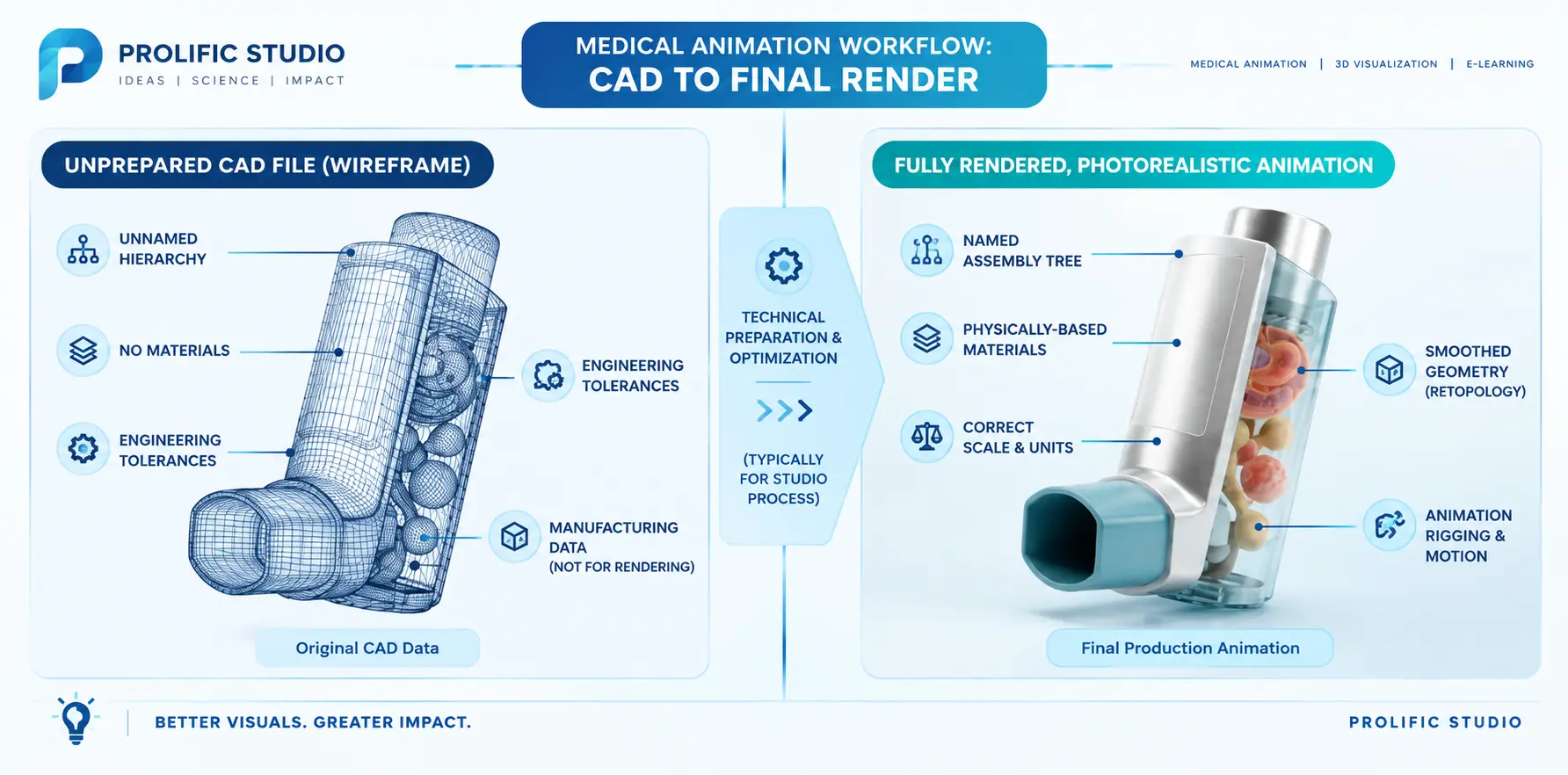
CAD-to-rendering is a complex process with many layers that most people don’t know about. All CAD systems are loaded with engineering data, which is great for manufacturing, but doesn’t include anything for rendering. What happens in between, from geometry to materials, determines your timeline, budget, and final result.
This comprehensive guide reveals what drives costs in medical animation and how technical preparation directly impacts your final invoice.
What Determines the Cost of a Medical Animation
Medical animation is priced differently from a standard explainer or marketing video, and the reason comes down to what’s actually being asked of the studio. A general explainer just needs to look good and communicate an idea clearly. A medical animation needs to be anatomically and scientifically accurate, often needs sign-off from a subject-matter expert or medical reviewer, and frequently starts from technical source material, CAD files, imaging data, or clinical documentation, rather than a blank creative brief.
That combination of accuracy requirements, expert review cycles, and technical source-data handling is why medical animation typically costs more per minute than a comparable general-audience animation, even at the same visual complexity.
The Critical Role Of CAD File Preparation
The quality and format of your CAD files directly affect the cost and timeline for production. Correct preparation could save you 30-40% on your quote, while incorrect preparation will add unnecessary rework cycles to the process.
| Format | Best For | Limitations |
| STEP AP242 | Animation production (recommended) | Industry standard; carries geometry, assembly, color. |
| STEP AP214 | Legacy systems | Adds color/materials but is an older standard. |
| STEP AP203 | Basic geometry | No color or material references. |
| Parasolid | High-fidelity geometry | Excellent quality if the studio can read it. |
| IGES | Surface-based work | Prone to gaps; requires manual repair. |
| JT | Visualization/review | Lightweight; not for production animation. |
| Native Files | Complete preservation | Retains feature history and internal structures. |
Any provider of medical device animation services should tell you which of these they prefer before you send anything.
The Geometry Conversion Challenge: Tessellation
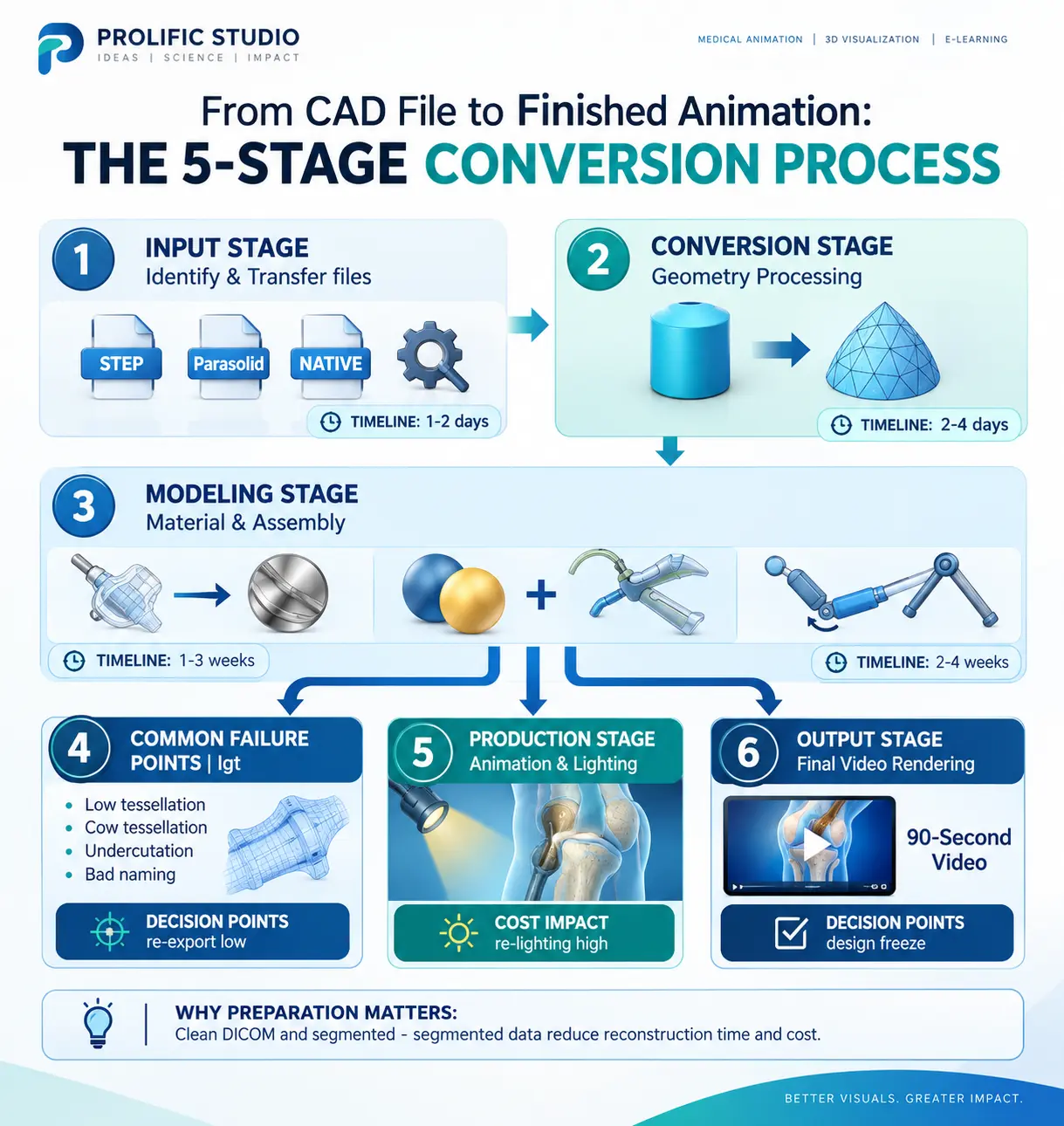
The CAD modeling system uses the mathematical description of surfaces based on boundary representation through NURBS and splines. The process of surface representation in rendering is done through a polygon mesh. In a CAD modeling system, the cylinder is a perfect mathematical model of infinite precision; in rendering, it needs to be converted into flat surfaces.
CAD File Security and Confidentiality
The CAD file is one of the most sensitive documents that companies possess because they contain all the information about manufacturing and design. In the case of unlaunched products, it can disclose commercial timing. However, our guide on how 3D animation helps medical device product launches covers why pre-clearance secrecy matters commercially.
Four practical control measures:
- Sign the non-disclosure agreement before transferring any file (and not together with the first invoice).
- Transfer the defeatured configuration file instead of the whole manufacturing file (this minimizes the exposure level).
- Use controlled document transfer protocol instead of e-mail or consumer file sharing.
- Document in writing how the documents should be treated after the end of the project (deletion or archiving).
Typical Added Cost and Time for CAD Cleanup
Preparation for CAD is generally quoted separately from the animation process because the workload for it is entirely dependent on the clarity and complexity of the files provided.
Typical billing rates: $1,500-$6,000 per device or asset, 3 to 10 business days depending on the complexity of the files and level of retopology required.
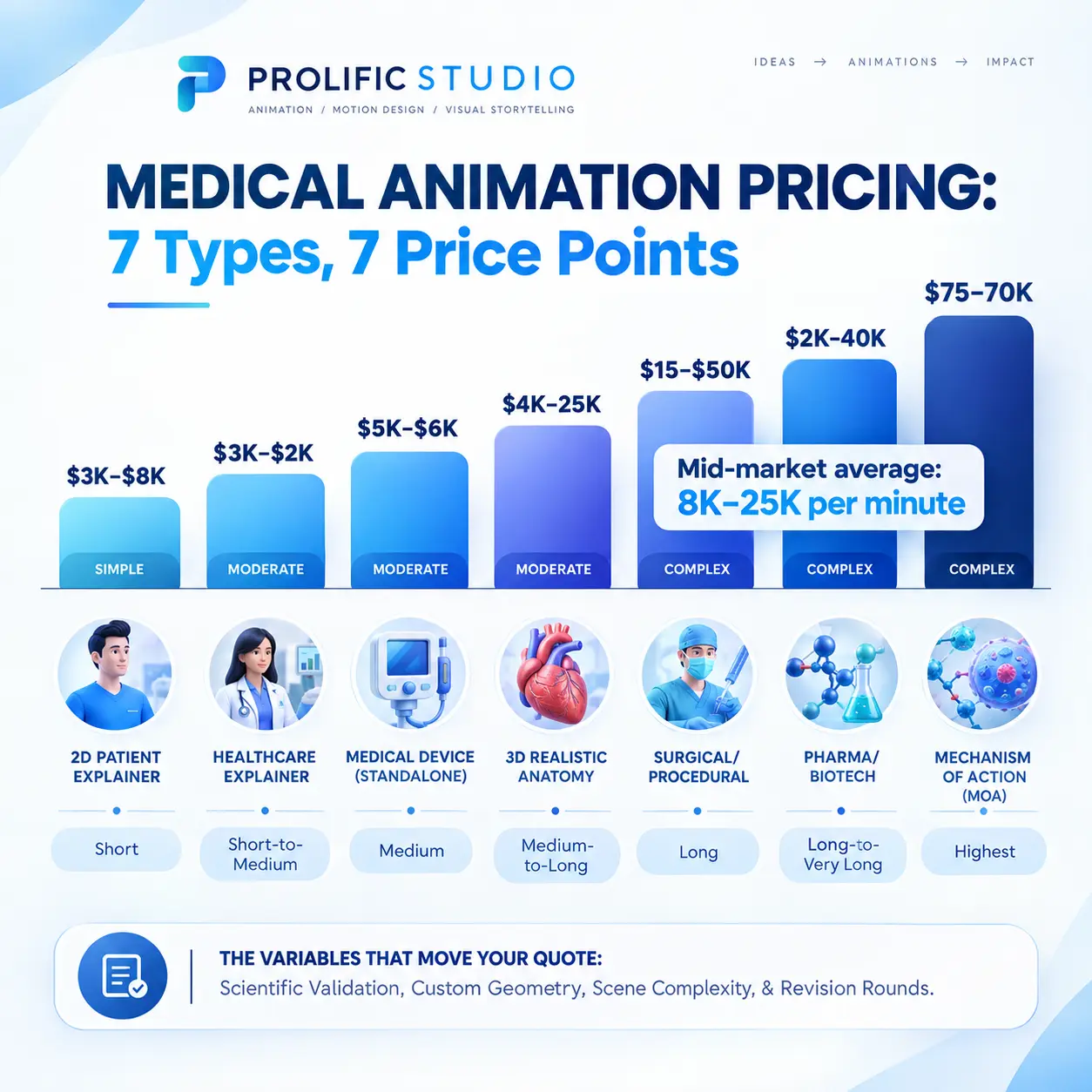
Medical Animation Pricing By Type
Seven major formats cover all types of commissioned projects; each has its own price range. What pushes an innovation up the scale is how much is created from scratch and how scientific it is to prove.
|
Animation Type |
Cost Range (per finished minute) |
Typical Scope |
| 2D Patient Explainer | $3,000 – $8,000 | Simple concepts, patient education, minimal research. |
| Healthcare Explainer (Light 3D/Motion Graphics) | $5,000 – $12,000 | Mixed 2D/3D, business concepts, moderate complexity. |
| Medical Device Animation (Standalone) | $8,000 – $18,000 | CAD-based device, limited complexity, no integration. |
| 3D Realistic Anatomy | $10,000 – $30,000 | Anatomically correct structures, custom modeling, research-intensive. |
| Surgical/Procedural Animation | $15,000 – $40,000+ | Step-by-step procedures, complex mechanisms, high accuracy requirements. |
| Pharma/Biotech Scientific Animation | $12,000 – $35,000+ | Molecular interactions, cellular processes, clinical review required. |
| Mechanism of Action (MOA) | $25,000 – $75,000 (2–3 min total) | Drug binding, cellular pathways, FDA/regulatory review, highest accuracy standards. |
3D Animation vs. 2D: The Cost Equation
3D is 3- 8 times more expensive than 2D. Everything needs to be created in three dimensions before movement can happen. A structure that is drawn by a 2D animator needs 3D geometry, textures, lighting, and cameras.
Cost alone doesn’t define the issue. It’s perfect to animate the process of using an inhaler with a 2D animation, but not how monoclonal antibodies can locate their receptors. On the other hand, sometimes shooting in the real world can even be more expensive than 3D modeling.
The Six Factors That Drive Medical Animation Pricing
Scientific/Anatomical accuracy level required. A stylized and simplified explanation will be cheaper compared to one that should withstand a critical analysis by doctors or regulatory authorities.
- Subject-matter expert or medical reviewer participation. Many rounds of reviews by a paid clinical consultant increase both the cost and the timeline.
- Source materials. Use of CAD models, medical imagery such as MRI/CT, or pre-existing 3D anatomical models saves money rather than creating them through reference research.
- Animation technique. Animation can be done in 2D, 3D, or a combination thereof; 3D usually costs more because of modeling and rendering time.
- Sequence duration and complexity. One-loop MoA animation is cheaper than a multi-sequence procedural animation.
- Usage right. The cost of internal use for training purposes is usually less expensive than content meant for conference presentation, broadcast, and advertisements because of usage rights.
- Cost Breakdown, per production phase of expert
A typical medical animation project moves through six stages, and cost is distributed across all of them, not just “the animation part.”
Hidden Costs: The 15–20% You Should Expect
Save 15–20% for predictable overruns:
- More revisions than contracted.
- Aspect ratios other than contracted.
- Captioning and localization versions.
- Narrower usage licenses than expected.
- Stock music and format variants.
Before price comparisons, insist on each vendor breaking down all of these. Film studios including their costs in one flat rate seem more costly than lean estimates, until the change orders come in.
Industry-Specific Pricing Examples
Medical Device Companies
Being one of the most CAD-dependent categories, price depends greatly on the availability of CAD for a clean device. The use of CAD is usually divided into sales-enablement, regulatory submittal, and show-floor display.
Pharmaceutical / Biotech
Usually MOA-oriented projects without physical prototypes, hence expensive from the point of view of research and scientific accuracy, but usually cheaper in relation to CAD modeling due to the absence of a physical prototype.
Hospitals & Patient Education
Usually prioritizes clarity over complexity, 2D and simple 3D illustrations can be used, and costs remain towards the lower end of the spectrum because the target audience is the patients.
Medical Marketing Agencies
Animation resellers require faster turnarounds and detailed usage rights information because their work will be used on many platforms for different clients’ campaigns.
|
Industry |
Pricing Drivers | Typical Scope / Use Cases |
Cost Position |
| Medical Device Companies | Availability and cleanliness of CAD files; one of the most CAD-dependent categories | Sales enablement, regulatory submittal, show-floor display | Varies widely, depending on CAD readiness. |
| Pharmaceutical / Biotech | Research depth and scientific accuracy; no physical prototype means little CAD modeling | Mechanism of action (MOA) projects | High on research and accuracy, lower on CAD modeling. |
| Hospitals & Patient Education | Clarity prioritized over complexity; patient-facing audience | 2D and simple 3D illustrations | Lower end of the spectrum. |
| Medical Marketing Agencies | Fast turnarounds; detailed usage rights, since work is reused across platforms and client campaigns | Animation resale for multiple clients and channels | Driven by speed and licensing terms rather than complexity. |
Choosing Your Vendor: Freelancer vs. BOUTIQUE VS. AGENCY
| Vendor Type | Cost | Risk | Best For |
| Freelancer | Lowest | High; limited resources | Single patient explainers |
| Boutique Studio | Medium | Medium; specialized expertise | Most mid-market projects |
| Full Agency | Highest | Low; comprehensive support | Launches, regulatory work, complex projects |
How to Get an Accurate Quote
Before sending for a quote, you should have the following items on hand, as it will help you decide that the quote you receive is much more precise and minimize any potential scope changes once the project gets underway:
- CAD drawings, if applicable (with the software used to produce them confirmed).
- An overview or even a rough draft of what must be communicated through the animation.
- Who the target audience is (clinicians, patients, sales forces, regulators), this impacts both style and precision considerations.
- Usage requirements (for internal purposes only, at conferences, advertising paid, broadcasting).
- Reference material already produced (medical imaging, diagrams, physical samples, other animations).
Best Practices For Project Success
- Provide STEP AP242 and native file formats at the beginning of the project.
- Label all components appropriately before export.
- Check unit and up-axis information in writing.
- Identify early which components will be flexible or deforming.
- Design freeze with a revised number needs agreement.
- Provide images of actual devices and materials used.
- Inquire about internal processes: Who is working with this model and where?
- List all hidden costs before comparing quotes.
- Question storyboards before animating.
- Construct modules for reuse of assets.
Frequently Asked Questions
Why is medical animation more expensive than regular explainer animation?
Medical animation involves additional expense through scientific accuracy, expert review iterations, and source data preparation (such as CAD editing) that is not required by an ordinary marketing explainer video.
How long does CAD preparation typically take?
Normally 3-10 business days per device or asset, depending on how complicated and "animation-ready" the initial files are.
Can you animate from imaging data (MRI/CT) instead of CAD?
Yes. Medical images can be used as a reference or, in some cases, they can be converted into a 3D model by segmentation, although this process is associated with preparation costs, just like CAD cleanup.
Do medical animations require a scientific reviewer?
Not always, but usually when something is intended for clinical, regulatory, or professional audiences. Material for patient education that is written for a general audience may not require review approval based on the client's internal policy.
What's the cost difference between 2D and 3D medical animation?
While 3D generally tends to be significantly more expensive than 2D per minute because of the need for modeling, rigging, lighting, and rendering, which are not necessary in 2D, it is often inevitable when the goal of the animation is precision.
Final Words
Medical animation is expensive because accuracy is expensive. Modeling and rendering are real costs, but they’re the visible ones. What you’re buying is confidence that what appears on screen is true and will survive clinical scrutiny.
The technical work, proper file preparation, geometry conversion, and material building represent the foundation of that confidence. Skipping corners here creates beautiful animations built on broken mechanisms. Clinicians and engineers spot that immediately.
Start with a test part. It’s the cheapest de-risking available, converting defensive quotes into accurate ones. Provide clear files, meaningful naming, and specifications upfront. Build modular. Interrogate storyboards. These practices transform budgets from unpredictable to manageable.
Ready to get accurate pricing? Send your brief and reference materials. Prolific Studio works across every category described here, from simple patient explainers to complex molecular builds, and we’ll tell you what your project should cost, including the parts other estimates leave out.
Related Articles: