Mechanism of action animation is the most expensive asset in pharmaceutical communication and the most heavily scrutinized. It is also the one most often commissioned before anyone has agreed on what it needs to prove.
This covers what an MOA animation actually is, where its science comes from, how the strong ones are structured, and the specific craft decisions that separate a film clinicians trust from one they stop watching halfway through.
Key Takeaways
- An MOA animation shows how a drug produces its therapeutic effect, usually at molecular or cellular level, for an audience that can check your work.
- The science comes from public structural and pathway databases plus published literature, not from artistic interpretation.
- Strong MOA films follow a six-beat spine: patient context, pathology, target, binding, downstream effect, clinical outcome.
- The craft problem is scale. A film travels roughly nine orders of magnitude from patient to protein and has to stay legible throughout.
- Molecules move by diffusion, not intention. Animating purposeful movement is the most common scientific error in the category.
- Two to three minutes is the working length. $25,000 to $75,000 is the working budget.
- When the mechanism is contested, show the uncertainty. Depicting a debated pathway as settled is what loses specialists.
Understanding Mechanism of Action Animation
A mechanism of action animation is a 2D or 3D animated film showing how a drug produces its therapeutic effect, typically at the receptor, pathway, or cellular level. It is built from published scientific data and produced for regulated audiences, which means every visual claim has to be supportable.
The format exists because the events are invisible and consequential. A prescriber deciding whether to use a product wants to understand what it does inside the body, and no photograph, scan or microscope image shows a drug molecule engaging its target. The animation is a reconstruction assembled from evidence.
MOA films sit at the top of the medical animation market on both cost and risk. They carry scientific claims, pass through medical, legal, and regulatory review, and frequently anchor an entire commercial narrative. They also tend to become the asset library everything else is cut from, which is why the decisions made during an MOA build propagate across a whole launch.
For the wider category this sits inside, our overview of what is pharmaceutical animation covers the other formats and how they relate.
Where the Science Actually Comes From
Public structural databases, pathway repositories and the primary literature. Almost nothing in a credible MOA film originates as an artistic choice.
Protein geometry comes from experimentally determined structures. The RCSB Protein Data Bank now holds well over 200,000 such structures, resolved by X-ray crystallography, cryo-electron microscopy and NMR, and it is the reference animators use to build a receptor or an antibody with correct shape and binding geometry.
Pathway context comes from curated databases and review literature, which establish what interacts with what and in which order. Kinetic data from published studies informs timing, so a binding event that takes milliseconds is not shown taking the same screen time as a process that takes hours.
The practical upshot for a buyer: ask any studio which structures it used and where they came from. A team that answers with PDB accession codes is working from evidence. A team that answers in terms of visual style is improvising, and a reviewer will find that out later at your expense.
The Six-Beat Story Spine Every Strong MOA Film Follows
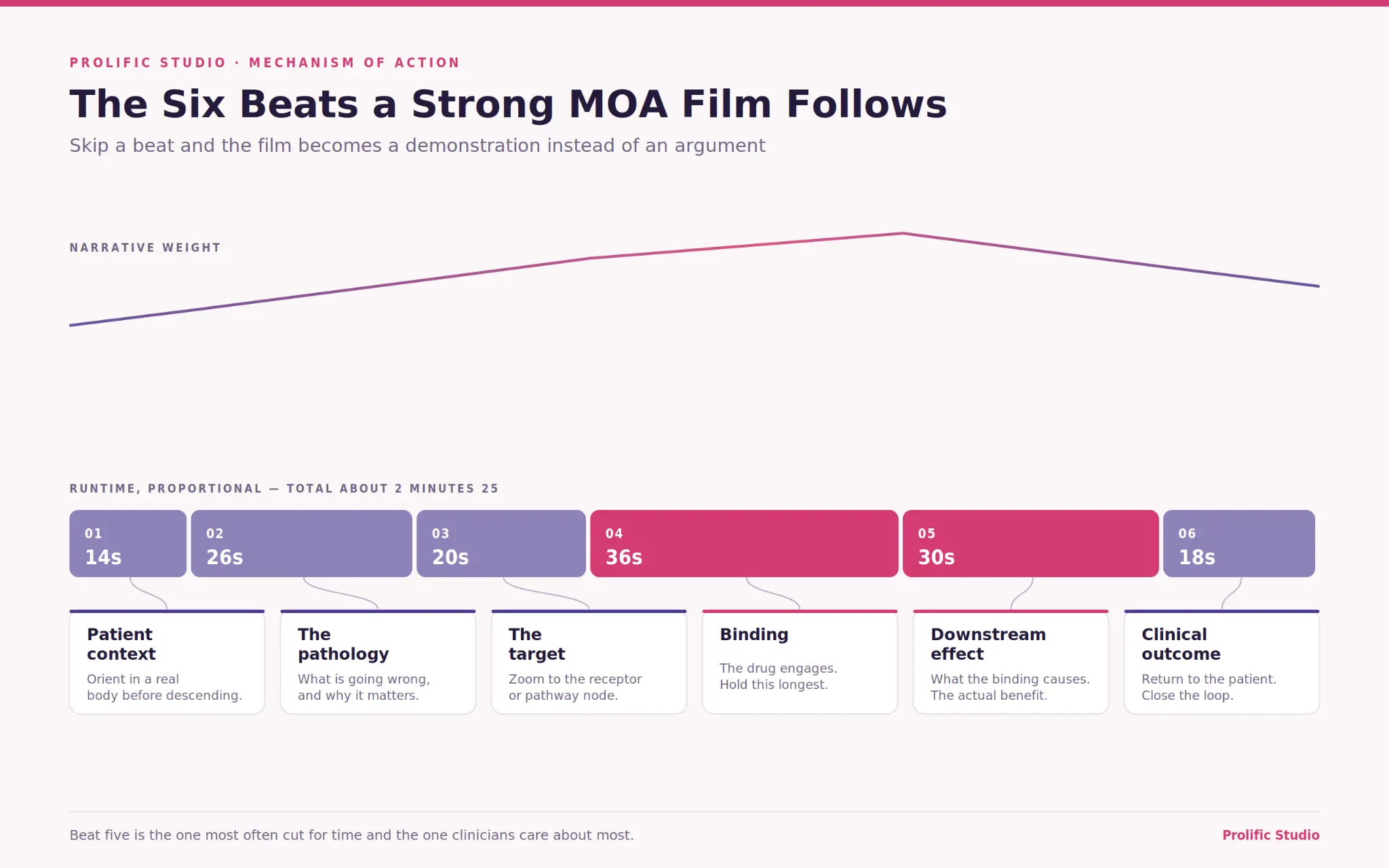
Patient context, pathology, target, binding, downstream effect, clinical outcome. Nearly every MOA film that works uses that sequence, and nearly every one that fails has skipped a beat.
The first beat orients the viewer in a recognizable body. Skipping it and opening inside a cell is the fastest way to disorient an audience, and it happens constantly because the molecular material is more visually exciting.
The second beat establishes what is going wrong. Without it, the drug has nothing to act against, and the film becomes a demonstration rather than an argument.
Beats three and four are the ones teams want to spend everything on. The target gets established, then the drug arrives and engages it. This is the sequence to hold longest.
Beat five is the one most often cut for time and the one clinicians care about most. Binding is not a benefit. What the binding causes downstream is the benefit, and a film that stops at engagement has stopped one beat early.
The sixth returns to the patient and closes the loop. Studios offering mechanism of action animation services should be arguing for all six beats even when the brief asks only for the molecular sequence.
Handling the Scale Jump From Patient to Molecule
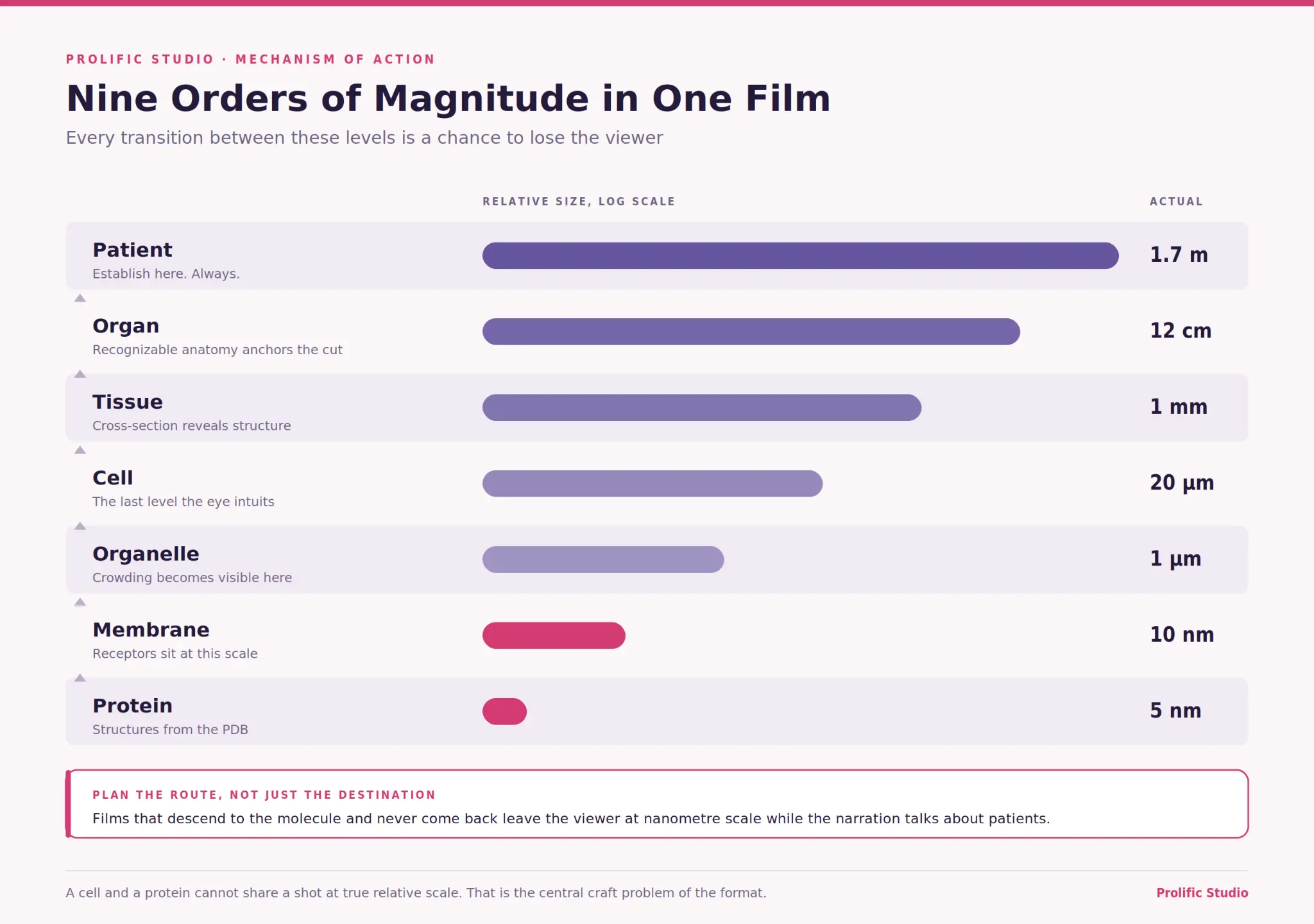
An MOA film travels from roughly a metre and a half down to a few nanometres. That is around nine orders of magnitude, and every transition is a chance to lose the viewer.
The interactive cell size and scale resource from the University of Utah is the clearest available demonstration of how vast that range is. A typical human cell measures tens of micrometres. A protein measures a few nanometres. Those two things cannot appear in the same shot at true relative scale, which is the central craft problem of the format.
Three techniques handle it. Continuous camera moves through nested scales, which are expensive but preserve orientation perfectly. Anchored cuts, where a recognizable structure stays on screen across the transition. And explicit scale indicators, which some studios avoid as inelegant and which clinical audiences generally appreciate.
What does not work is the hard cut with no reference. The viewer arrives somewhere new, spends four seconds working out where they are, and misses whatever happened in those four seconds.
Plan the scale route at storyboard and draw it as a route. Which levels does the film visit, in which order, and does it come back out? Films that descend to the molecular level and never return leave the viewer stranded at the nanometre scale while the narration talks about patients, which is a disconnect audiences feel even when they cannot name it.
Should Molecules Move Purposefully or Randomly?
Randomly, if you want to be accurate. Molecules in cytoplasm move by diffusion, and a drug molecule does not travel toward its target with intent.
This is the most common scientific error in the category, and it is committed deliberately more often than accidentally. Purposeful motion reads clearly. A molecule gliding in a clean arc toward a receptor communicates the idea in two seconds. The same molecule executing a realistic random walk takes far longer and looks like nothing is happening.
The compromise most experienced studios reach is jitter plus statistical bias. Individual molecules move erratically, in a crowded environment, while the overall population drifts toward the target. That reads as biology rather than as a guided missile, and it survives a specialist’s scrutiny.
The related error is the empty cell. Cytoplasm is densely packed, and rendering a molecule crossing open space is quietly wrong in a way that biophysically literate viewers notice immediately. A scientific animation production company that raises molecular crowding unprompted has thought about this before.
What to Do When the Mechanism Is Not Fully Understood
Show the uncertainty rather than resolving it visually. This situation is far more common than marketing teams expect, and how a studio handles it is the best single test of whether they belong on your project.
Plenty of approved drugs have mechanisms that are partially characterized. A binding step may be well established while the downstream signalling remains contested, or a pathway may have two competing proposed routes with reasonable evidence for each.
Curated pathway resources such as Reactome, which now catalogues many thousands of curated human reactions, make it easy to see how much of a given pathway is actually documented and how much is inference.
Three workable approaches. Depict only the well-supported steps and say plainly that the remainder is under investigation. Show both proposed routes with equal visual weight. Or use visual language that signals inference, such as reduced opacity or a dotted connection, with an on-screen note.
What loses a specialist is a confident, fully rendered depiction of something the literature has not settled. Our walkthrough of the drug MOA animation process covers where in the pipeline these decisions have to be locked.
MOA, MOD and Why the Acronyms Get Confused
MOA means mechanism of action. MOD is the problem, because it is used for two entirely different things: mode of delivery and mechanism of disease.
Mode of delivery covers how a drug reaches its target, meaning formulation, release profile, absorption and distribution. Mechanism of disease covers the pathology the drug is intended to interrupt, with no drug in the film at all.
The distinction matters commercially because the three formats have different audiences and different review paths. A mechanism of disease film can often run unbranded before approval, since it names no product. An MOA film cannot.
Get the terminology agreed at kickoff. Briefs that say MOD without specifying which one produce scope disagreements weeks later. Our comparison of MOA animation vs MOD animation works through the differences and when each is the right commission.
Who Watches an MOA Film and What Each Audience Needs
Five audiences, and they want genuinely different films cut from the same models.
Prescribers are the primary audience and want pathway-level specificity with honest treatment of what is unsettled. Medical science liaisons need a deeper version, chaptered so they can answer a specific question rather than play a film.
Sales representatives need a shorter, interruptible cut that survives being stopped ninety seconds in. Investors, particularly for platform biotech, are assessing whether the science is credible at all, which usually means the highest-fidelity version a company produces.
Patients need a different film entirely, not a simplified edit of the clinical one. The vocabulary and the level of detail that reassure a prescriber tend to alarm a patient.
Build one asset library and cut versions from it rather than commissioning separately. Our guide on pharmaceutical animation for HCP education covers how to calibrate the clinical versions by specialty.
How Long Should an MOA Animation Run, and What Does It Cost?
Two to three minutes, and $25,000 to $75,000. Both ranges hold across most therapeutic areas.
Runtime is driven by the six beats rather than by preference. Compressing below ninety seconds usually means dropping the downstream effect or the pathology, which removes the argument and leaves a demonstration. Running past four minutes generally means two mechanisms are competing for one film.
Cost tracks the molecular complexity and the amount that has to be built from scratch. A single receptor interaction with well-documented structures sits near the bottom of the range. A multi-step intracellular cascade with novel structures sits at the top.
Derivatives are where the economics improve. Once the models exist, a rep version, a chaptered MSL cut, and a congress loop each cost a fraction of the original. Patient-facing versions built as medical explainer video services from the same library are cheaper again, provided the reuse rights were secured in the original contract.
The Errors That Make Clinicians Stop Watching
Six, and they are all avoidable at the storyboard stage.
Opening inside the cell. No orientation, no patient, no idea what part of the body this is. Establish scale before you exploit it.
Everything glowing. When every element is emphasized, nothing is. Reserve emphasis for the binding event and the downstream consequence.
Empty cytoplasm. Molecules crossing open space read as wrong to anyone who knows the environment is crowded.
Purposeful molecular motion. Covered above, and worth repeating because it is the single most frequent error.
Stopping at binding. The engagement is not the benefit. Clinicians want the consequence.
Data handled loosely. MOA films often close on efficacy figures, and a truncated axis or a missing sample size there undoes the credibility the mechanism just earned. Our piece on how animation explains complex clinical data covers what survives that scrutiny.
Final Words
Every MOA film that runs to schedule began with a written, signed-off description of the mechanism, including the parts that are uncertain. Every one that overran began with a visual reference and an assumption.
Write the mechanism down as prose first. Circulate it to medical and to a practising specialist. Resolve the disagreements on paper, where a disagreement costs an email rather than a re-render.
Send us that document and the structures you are working from. Prolific Studio is an animation studio working across mechanism, delivery, clinical data and patient material, and we will tell you what is buildable from the evidence you have and what needs more of it.
Frequently Asked Questions
What does MOA stand for in pharma animation?
Mechanism of action, meaning the specific biochemical interaction through which a drug produces its therapeutic effect. An MOA animation visualizes that interaction and its consequences.
How long does an MOA animation take to produce?
Eight to fourteen weeks for a two to three minute film. Medical, legal and regulatory review accounts for most of the variability, so assemble your full reviewer list before scripting begins.
Is MOA animation 2D or 3D?
Usually 3D, because binding geometry and spatial relationships carry the meaning. 2D can work for pathway-level explanations where the story is sequence rather than structure, and it costs considerably less.
What if our drug’s mechanism is not fully characterized?
Depict what the evidence supports and signal the rest as under investigation. Showing a contested pathway as settled is the fastest way to lose a specialist audience and will usually be flagged in review.
Can an MOA animation be reused for a new indication?
Yes, provided you own or licensed the models and scene files. A new indication is typically a re-edit rather than a rebuild, which commonly costs 30 to 40 percent less than the original.
What source material should we give a studio at kickoff?
Structure identifiers for the relevant proteins, the pathway diagrams your medical team works from, key publications on the mechanism, and a written description of which steps are well established versus inferred. Handing over that package rather than a mood board removes weeks from the schedule.
Who should sign off on the science?
Medical affairs plus at least one practising specialist in the relevant field, both reviewing at storyboard stage rather than at final cut. An objection at storyboard costs an afternoon.