
The difference between MOA animation vs MOD animation comes down to how close the video gets to the science.
An MOA video usually focuses on the treatment’s exact interaction with a biological target. It may show a molecule binding to a receptor, blocking an enzyme, activating a protein, or interrupting a signal.
A MOD video steps back. Instead of concentrating only on the target, it shows the wider biological result. That might be reduced inflammation, slower tumor growth, disrupted bacterial activity, or a change in cell behavior.
One explains the precise action.
The other explains what that action does to the biological system.
They often appear in the same pharma video, which is why people confuse them.
MOA Animation vs MOD Animation: The Short Answer
A mechanism of action animation shows how a drug works at a specific molecular target.
A mode of action animation shows the broader functional or cellular effect that follows.
Suppose a treatment binds to a receptor responsible for sending an inflammatory signal.
The MOA section would show the treatment approaching the receptor, binding to it, and changing or blocking its activity.
The MOD section would move beyond that event. It might show fewer inflammatory signals moving through the cell, reduced immune activity in the surrounding tissue, and a broader change in the disease process.
Same treatment.
Different level of explanation.
This is why the comparison is not really about which animation is better. The right choice depends on what the audience needs to understand.
The Acronyms Can Be Messy
There is a small naming problem that should be cleared up early.
Mechanism of action is commonly shortened to MOA. Mode of action is often shortened to MoA as well. That creates obvious confusion in scripts, emails, storyboards, and review comments.
Some teams use MOD when referring to mode of action simply to keep the terms separate.
MOD is useful in production language, but it is not a universal scientific abbreviation. A medical affairs team may use different terminology. A toxicology team may define mode of action differently from a commercial pharma team. Researchers may even use mechanism and mode interchangeably.
Before an animation production company begins scripting, everyone should agree on what the terms mean for that project.
Otherwise, the client may ask for a mode of action video while expecting a close receptor-binding sequence. The production team may prepare a broader cellular explanation instead.
Both can be scientifically valid.
Only one may match the brief.
What an MOA Animation Usually Shows
An MOA animation gets close to the treatment target.
The target may be a receptor, enzyme, protein, antibody, ion channel, pathogen, or genetic process. The video shows how the treatment interacts with it and what changes directly because of that interaction.
This type of mechanism of action video often uses a molecular or close cellular view.
A small-molecule drug may fit into an enzyme’s active site. An antibody may attach to a surface protein. A receptor antagonist may prevent another molecule from binding. A therapy may activate a target that was previously inactive.
The important word here is specific.
MOA content is strongest when the treatment-target relationship matters to the product story. If a new drug has a distinct binding method or acts on a target that separates it from existing options, a drug mechanism animation can make that difference visible.
This is also why MOA videos are common in drug launches, medical affairs presentations, HCP education, congress content, and sales training.
The science is usually microscopic.
Animation brings it into view.
What a MOD Animation Shows Instead
A MOD animation pulls back from the exact target and shows the larger biological change.
The molecular interaction may appear briefly, but it is not always the main event. The video is more interested in what happens to the cell, tissue, pathogen, or disease process afterward.
A mode of action video might show an inflammatory pathway becoming less active. It might show bacterial replication slowing down. It could show cancer-cell division being interrupted or immune activity changing within a tissue environment.
This wider view can be useful when the exact target is not the main communication point.
Sometimes the molecular mechanism is still being studied. In other cases, the audience simply does not need that depth. A patient, non-specialist investor, sales team, or general healthcare audience may understand the treatment better through its broader biological action.
That is where drug action animation becomes more useful than a detailed molecular sequence.
The viewer sees the outcome of the treatment’s action without having to study every target interaction behind it.
One Treatment Can Need Both Stories
Consider a therapy designed to reduce an inflammatory response.
An MOA sequence may begin at the cell surface. The treatment binds to a receptor and prevents a signaling molecule from activating it. That is the precise treatment-target interaction.
The camera then moves inside the cell.
The signal that would normally travel through the pathway is reduced. Fewer inflammatory mediators are released. Activity in the surrounding tissue changes.
That second part is closer to MOD.
The first scene explains what the treatment touches. The next scenes explain what happens because of that contact.
This combination is common in pharmaceutical animation because treatment stories rarely stop at receptor binding. Pharma teams often need to connect a molecular event to a biological effect that HCPs, investors, internal teams, or patients can understand.
The problem begins when the video does not clearly separate those levels.
The camera dives into a receptor, jumps into a pathway, moves to tissue, and reaches an outcome without telling the viewer why the scale keeps changing.
The science may be correct.
The explanation feels scattered.
MOA Videos Usually Rely More on Molecular Animation
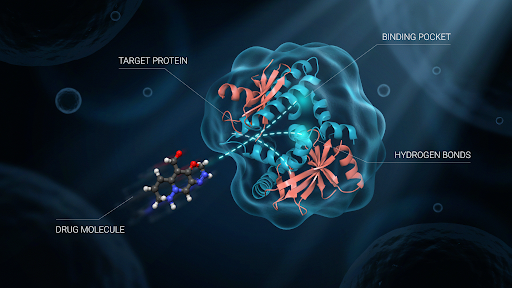
Molecular animation is often central to an MOA project.
The audience may need to see the shape of a target, the location of a binding site, or the structural relationship between the treatment and the receptor. Small differences can matter.
A molecular scene may show inhibition, activation, binding, competition, or conformational change. The visual focus stays close to the target so the audience can understand the exact interaction.
That level of detail is useful, but it comes with a risk.
Molecular environments can become visually busy. If the production team adds too many proteins, particles, labels, and camera moves, the treatment gets lost inside the scene.
Good mechanism of action animation services simplify with care.
The target receives attention. Background activity is reduced. Motion slows at the important moment. Color helps distinguish one structure from another without making the biology look like a fantasy sequence.
The goal is not maximum realism.
It is readable science.
MOD Videos Often Use Cellular and Tissue-Level Views
MOD content usually needs more distance.
A cellular animation can show what changes after the treatment acts. A signal may weaken. A cell may stop producing a certain mediator. A pathogen may lose the ability to reproduce. A disease-related process may become less active.
The video may then move to tissue or organ level to show the larger effect.
This does not make a MOD video less scientific. It simply places the scientific emphasis somewhere else.
For HCP education animation, the cellular view may help connect the treatment mechanism to disease biology. For patient education, the animation may move even further back and explain how the change relates to symptoms or treatment goals.
A strong MOD sequence answers a broader question:
What changes in the biological system after exposure to this treatment?
That is different from asking exactly which target the drug binds to.
A Side-by-Side Example Makes the Difference Clearer
Take a therapy designed to reduce an overactive inflammatory response.
A mechanism of action animation might open at the cell membrane. A signaling molecule approaches a receptor. The treatment reaches that receptor first and prevents activation. The scene stays close because the exact treatment-target interaction is the point.
Now step back.
A mode of action animation may show what happens across the cell after receptor activity is reduced. Fewer inflammatory signals travel through the pathway. The cell releases fewer mediators. Activity in the surrounding tissue changes.
The first video answers:
How does the treatment act on its target?
The second answers:
What broader biological effect follows that action?
A combined video can answer both. It just needs to make the shift obvious. The viewer should know when the explanation leaves the target and moves into the wider biological response.
MOA Animation vs MOD Animation for HCP Education
The choice between MOA animation vs MOD animation becomes more difficult when the audience is made up of healthcare professionals.
HCPs may want both levels.
They may need to understand the target interaction, especially if the treatment has a novel mechanism. But they may also want to see how that interaction connects to disease biology and treatment rationale.
A strong HCP education animation may begin with the relevant disease process, move into the molecular target, and then return to the wider cellular response.
The key is proportion.
If the mechanism is the product’s main point of difference, spend more time there. If the target is familiar and the wider response matters more, keep the molecular section short.
A healthcare animation production company should ask where and how the asset will be used. A self-guided education module can carry more detail than a short field presentation. A medical affairs discussion can pause at key scenes. A congress loop may need to communicate the idea with little or no narration.
The same science needs different pacing in each setting.
Build Reusable Scientific Sections
A well-planned project should produce more than one exported video.
The target-binding scene can become a standalone scientific clip. The cellular response can support internal training. A tissue-level sequence can be used in a congress presentation. A simplified version may work as a digital explainer.
This is where scientific animation video services can provide more value than a single production.
The project should be built in sections. Models should remain organized. Labels should be editable. The molecular and cellular scenes should not depend completely on one voice-over track.
That structure makes later updates easier too.
Scientific understanding changes. New data appears. Launch messaging develops. A modular visual library can be revised without rebuilding the entire project.
Final Words
MOA animation vs MOD animation is mainly a question of scale.
MOA focuses on the specific treatment-target interaction. MOD shows the wider cellular or biological response that follows. Some therapies need a close molecular explanation. Others are easier to understand through their broader action. Many pharma stories need both.
The strongest video begins with a clear question.
What does this audience truly need to understand?
Once that is settled, the visual scale, scientific detail, format, and runtime become much easier to choose.
Frequently Asked Questions
Related Articles: