Medical Animation Effectiveness: What the Research Actually Shows
Javeria
Table of Contents
Ask an animation studio whether medical animation works and you will get an enthusiastic yes. Ask for the study behind it and the room goes quiet.
There is a study. Several dozen, actually. Randomized trials, appraised with the same risk-of-bias tools used on drug research, published in journals your medical affairs team would recognize on sight. They just do not say quite what the sales deck says.
Medical animation effectiveness is well established for exactly one outcome. Patients who watch an animation understand and remember more than patients handed a leaflet, consistently, across cardiology, surgery, diabetes care and a dozen other settings. Push past comprehension into satisfaction, anxiety or behavior change and the evidence thins out fast.
That distinction is worth more to you than another vendor claim, because it is the difference between a budget you can defend and one you cannot. Here is what the research supports, what it does not, and the finding a 3D studio would rather not publish.
Key Takeaways
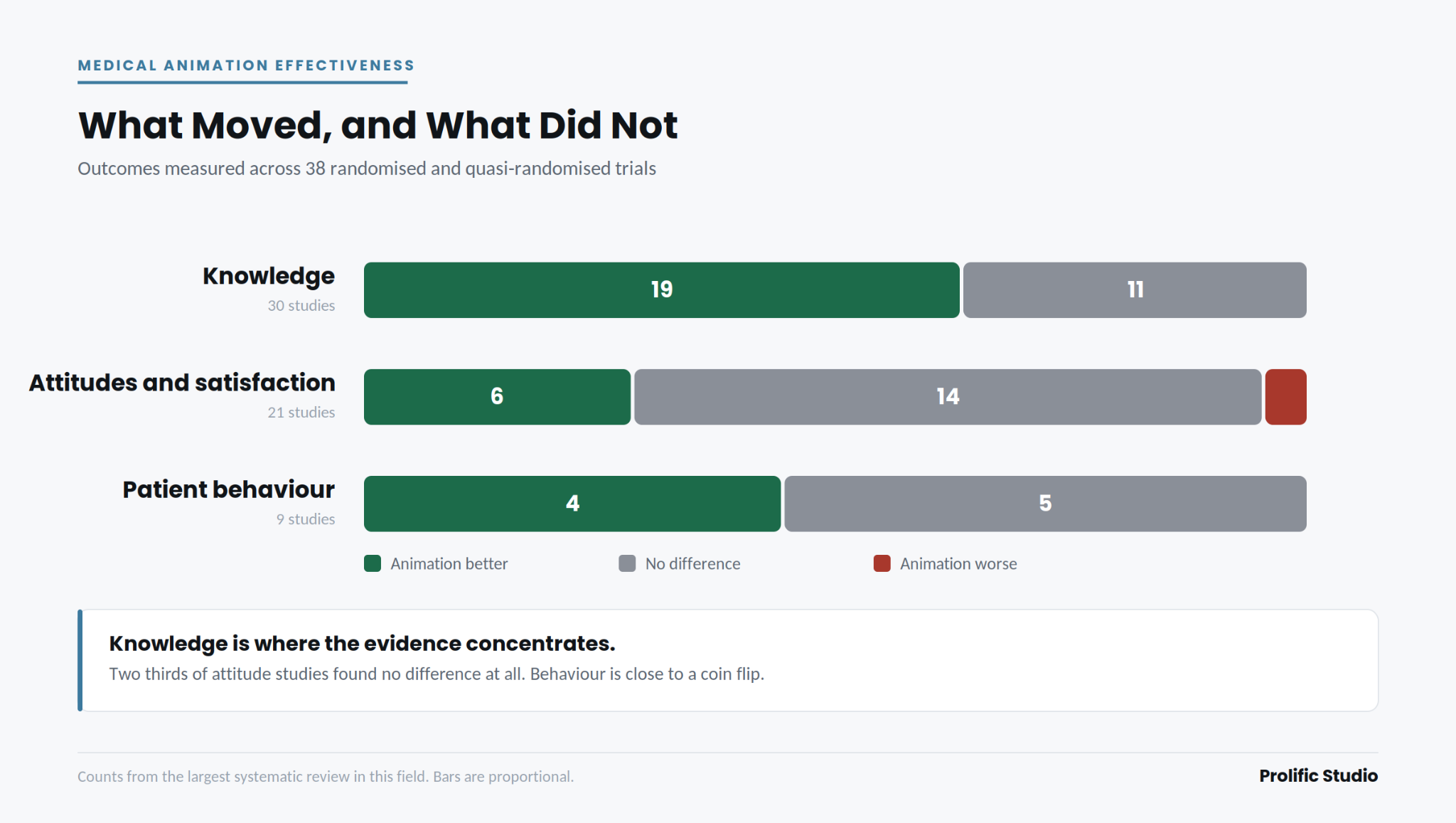
Animation reliably improves short-term knowledge. Across 30 studies measuring it, 19 found better knowledge from animation than the comparator.
The effect is modest, not dramatic. Pooled across 21 studies, the average viewer outperforms about 64% of people given standard information.
Attitudes barely move. Of 21 studies measuring attitudes, 14 found no difference at all.
Long-term retention is essentially unstudied. Only 3 of 15 recent trials measured anything beyond immediate recall.
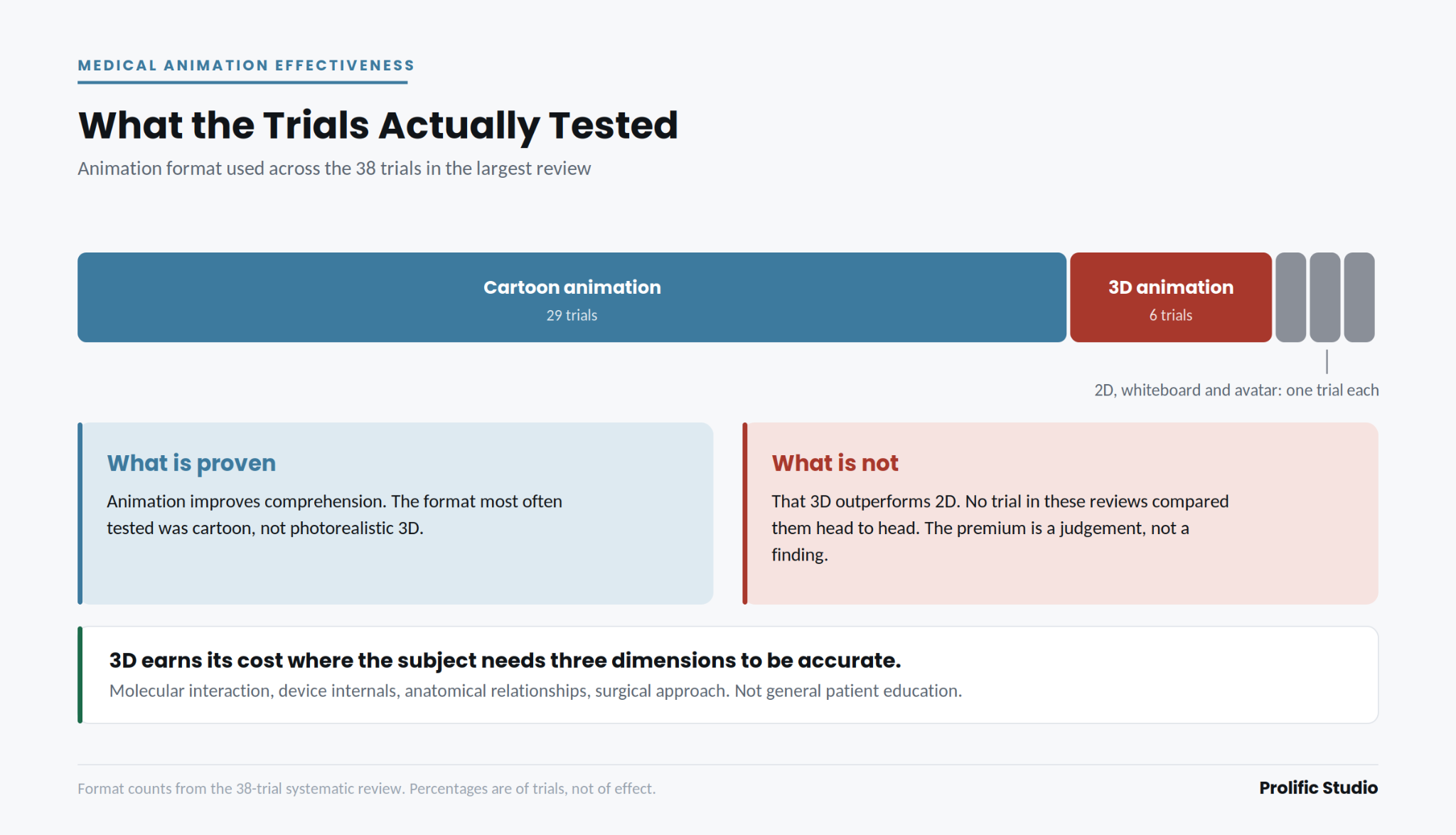
Most trials tested 2D and cartoon animation, not 3D. Only 6 of 38 trials used 3D.
Length matters. In the trials that worked, most animations ran between 1 and 8 minutes.
What the Research Actually Found
Three bodies of evidence matter here, and they broadly agree.
A systematic review covering38 randomized and quasi-randomized trials assessed animations against printed information, standard consultation, and static images. Knowledge was measured in 30 of those studies, and animation produced greater knowledge in 19 of them. The trials covered explaining medical and surgical procedures, managing long-term conditions, and public health.
Ameta-analysis of 21 studies in Health Education & Behavior pooled the effect statistically rather than narratively, arriving at d = 0.35 across clinical and non-clinical settings, including surgery and diabetes. Notably, learning effects were larger in patient samples than in other groups.
A2024 systematic review in the Journal of Medical Internet Research examined 15 randomized controlled trials covering 2,454 patients across ten countries. Eleven of the fifteen reported statistically significant improvements in health information recall compared with usual care, which is the strongest single answer available to whether animated videos improve health information recall.
So does medical animation work? On knowledge, consistently yes. On everything else, the picture gets complicated. Put plainly: yes, medical animation does improve patient understanding, and that is the claim the data will carry.
How Strong Is Each Claim? A Claim-by-Claim Assessment
Most content on this subject treats every benefit as equally proven. The trials do not support that.
Claim
What the trials show
Strength
Improves short-term knowledge
19 of 30 studies positive; 11 of 15 RCTs on recall
Strong
Outperforms printed information
Consistent direction across reviews
Moderate
Improves satisfaction and attitudes
6 positive, 14 null, 1 negative of 21
Weak
Changes patient behavior
4 positive of 9 studies
Weak
Reduces anxiety
2 of 4 trials in one condition-specific review
Weak
Benefits persist long-term
Only 3 of 15 trials measured beyond immediate recall
Unproven
3D outperforms 2D or cartoon
Only 6 of 38 trials used 3D; no head-to-head comparison
Untested
Read that table before you write a brief. It tells you which outcomes to promise a stakeholder and which to leave alone, and our breakdown of the different medical animation formats sets out which format belongs against which claim.
The honest summary of the evidence for medical animation is narrow but solid. So what does the research say about medical animation overall? That medical animation patient comprehension gains are real and repeatable, and that claims beyond comprehension are currently ahead of the data.
Does Animation Beat Printed Patient Information?
Usually, on recall specifically. The medical animation vs printed patient information comparison is the one the trials test most often, because printed leaflets are what animation is realistically replacing.
How effective are animated patient education videos against a leaflet? The JMIR review found 73% of its trials reported statistically significant recall improvements over usual care, which in most cases meant a leaflet, a verbal explanation, or both.
So yes, animated videos do improve health information recall, and that is the outcome most consistently demonstrated. Animations in those trials ranged from 1 to 15 minutes and used 2D cartoon, 3D computer and whiteboard styles.
What the reviews do not show is animation replacing consultation. In nearly every trial, the animation was delivered in addition to standard care, not instead of it. That distinction matters commercially: the evidence supports animation as a supplement that improves comprehension, not as a substitute for clinical conversation.
Which is a more useful pitch anyway. Nobody in a hospital is trying to remove the clinician. Animation sits alongside the consultation and makes the twenty minutes a clinician already has go further.
Beyond Knowledge: What Else Actually Changes
This is where the claims usually outrun the evidence, so it is worth being precise.
A2026 systematic review in the British Journal of Cardiology examined five randomized trials in coronary artery disease. Patient knowledge improved in all four trials that measured it. Anxiety, by contrast, was reduced in only two of the four trials measuring it, with some evidence of benefit for satisfaction and health behaviors.
That pattern holds across the wider literature. Knowledge moves reliably. Anxiety, satisfaction, and behavior move sometimes.
No format has been shown to reliably shift attitudes. If a stakeholder expects an animation to change how patients feel rather than what they know, adjust the expectation early.
Does Animation Improve Medical Student Learning?
There is a separate evidence stream for this, and it points in the same direction with the same caveats.
A systematic review inPerspectives on Medical Education collated 13 controlled trials covering 1,068 students and qualified healthcare practitioners, comparing animation against textbooks, lectures and static images. Knowledge was assessed in ten studies, and animation produced greater knowledge in eight of them.
Attitudes were assessed in five studies: positive in three, no difference in one, worse in one. Behaviors were assessed in three: positive in two.
So animation in medical education has roughly the same profile as patient education. Good for knowledge, uncertain for everything else. The authors were direct about the limitation: risk of bias was rated high in ten of the thirteen studies.
Where the Research Stops Short
Any honest read of medical animation research has to include this section, and no competitor page does.
Anupdated systematic review running to April 2025 concluded that animations improve patient knowledge and behavior in the short term, with some positive effects on attitudes, but that higher quality and larger randomized trials are needed to evaluate longer-term outcomes, particularly for people with low health literacy.
Three specific gaps are worth naming.
Almost nothing is measured beyond the immediate. Twelve of the fifteen JMIR trials assessed recall right after viewing. Only three followed up later. We genuinely do not know whether the benefit survives a week.
Risk of bias is high. In the 38-trial review, 18 studies were rated high risk and only 4 were rated low. Common problems were randomization processes, small samples, and missing outcome data.
Low health literacy is under-tested, which is awkward, because those are the patients animation is most often proposed for.
None of this means animation does not work. It means the confident claims you see elsewhere are running ahead of what has been demonstrated.
How Long Should a Patient Education Animation Be?
Between one and eight minutes, based on what actually got tested.
Across the fifteen JMIR trials, animations ranged from 1 to 15 minutes, and ten of the fifteen fell in the 1 to 8 minute band. That is not a proven optimum, since no trial compared lengths head to head, but it is the range in which measured effects were achieved.
Practically, that argues against two common briefs. The 30-second patient explainer is shorter than anything the research tested. The 12-minute comprehensive walkthrough is longer than almost all of it. Most medical animation for patient education should be sized to the decision the patient is about to make, not to the volume of information available.
Three to five minutes sits comfortably inside the evidence-based range and matches most conditions. If you are commissioning healthcare animation services for patient education, that is the band to brief to.
The Finding That Should Give 3D Studios Pause
Here is the part that costs us something to publish.
Of the 38 trials in the largest review, 29 used cartoon animation. Six used 3D. One each used 2D, whiteboard, and avatar formats.
The research supports animation. It does not specifically support 3D animation. No trial in these reviews compared 3D against 2D directly, so there is currently no evidence that photorealistic 3D produces better comprehension than a well-made cartoon.
That does not make 3D pointless. It makes the case for it being different. 3D earns its cost where the subject genuinely requires dimensional accuracy: molecular interaction, device internals, anatomical spatial relationships, surgical approach. Those are the situations where a flat illustration cannot represent the thing correctly.
But if the goal is patient comprehension of a procedure, and someone is quoting you 3D on the basis that it works better, ask them for the study. There isn’t one.
This is not an argument for cheaper work. It is an argument for matching the technique to what the subject actually demands. A cartoon that correctly explains a treatment pathway does more for a patient than a photorealistic render that looks impressive and communicates the same thing.
Where the anatomy or the mechanism genuinely needs three dimensions to be accurate, 3D is not a luxury. Where it does not, the evidence gives you no reason to pay for it.
What This Means for Your Next Project
Translating the evidence into a brief changes four things.
Set the outcome you claim internally. Comprehension and recall are defensible. Satisfaction, anxiety reduction and behavior change are not, on current data. If your business case rests on those, it rests on thin ground.
Choose format by subject, not by budget tier. The benefits of 3D medical animation are real in molecular and device contexts and unevidenced in general patient education.
Measure something. Almost no commissioned medical animation is evaluated after delivery. A ten-question comprehension check before and after would put you ahead of most of the published literature, and it gives you a number for the next budget conversation.
Weigh it against cost. Is medical animation worth the investment? On knowledge outcomes the evidence says yes, with a modest effect. For a pharmaceutical launch where physician understanding shortens the sales conversation, a small effect across a large audience is easily worth it.
For a single clinic explaining one procedure, the calculation is tighter, and our breakdown of medical animation pricing covers the production side of that equation.
Final Words
The evidence base for medical animation is narrower than the marketing and stronger than the skeptics assume.
Both halves of that matter. Anyone selling animation as a proven driver of behavior change or patient satisfaction is describing something the trials have not demonstrated. Anyone dismissing it as expensive decoration is ignoring several dozen randomized trials pointing the same direction.
What survives scrutiny is a narrower claim. It reliably helps people understand and remember health information. It does so with a modest effect size, mostly measured immediately after viewing, mostly using 2D and cartoon animation, in trials that are frequently small and often at risk of bias.
That is a genuinely useful thing to say to a stakeholder, precisely because it is qualified. Overclaiming is what gets a medical animation budget cut the following year, when the promised satisfaction scores fail to move and nobody can point to what the project was actually supposed to achieve.
The practical version is short. Promise comprehension. Measure comprehension. Size the animation to the decision the viewer is making. Pick the format the subject requires rather than the one the budget allows. Everything past that is currently opinion dressed as evidence, including a good deal of what this industry publishes.
None of that requires overstating anything, which is the point. A qualified claim you can defend in a room full of medical reviewers is worth more than a confident one that collapses the moment somebody asks for the citation.
Building a case for a medical animation project? As a medical animation studio working with pharma, MedTech, and healthcare teams, we would rather help you scope something the evidence supports than sell you something it does not. Book a call.
Frequently Asked Questions
Does medical animation actually improve patient understanding?
Yes, and this is the best-supported claim in the field. Across 30 studies measuring knowledge, 19 found animation produced better understanding than the comparator, and a meta-analysis of 21 studies found a pooled effect of d = 0.35. On the narrow question of does medical animation improve patient understanding, that is about as clear as evidence in this field gets. That is a small-to-moderate improvement rather than a dramatic one, but it is consistent across settings and it holds against printed leaflets and standard verbal explanation.
What does the research say about animated patient education?
That it works for comprehension and recall, and that almost everything else is unproven. Reviews covering 38 trials and separately 15 randomized controlled trials with 2,454 patients both find reliable knowledge gains. Attitudes, satisfaction and behavior change show mixed results, with the majority of studies finding no significant difference. Long-term retention is barely studied at all.
Is medical animation more effective than printed information?
On recall, usually. In the JMIR review, 73% of trials found statistically significant improvements over usual care, which typically meant a leaflet or verbal explanation. One important caveat: in nearly all trials the animation was given in addition to standard care rather than instead of it, so the evidence supports animation as a supplement rather than a replacement.
How long should a patient education animation be?
Between one and eight minutes, based on the trials that demonstrated effects. Animations in the research ranged from 1 to 15 minutes, with ten of fifteen falling in that shorter band. No study compared lengths directly, so this is the evidenced range rather than a proven optimum. Three to five minutes is a sensible default for most procedures.
Does animation help medical students learn better than lectures?
The evidence points that way but is thinner than for patients. A systematic review of 13 trials covering 1,068 students and practitioners found animation produced greater knowledge in eight of the ten studies that measured it, compared against textbooks, lectures and static images. The authors rated risk of bias as high in ten of the thirteen studies, so treat the direction as more reliable than the magnitude.
Javeria is an animation expert at Prolific Studio, with expertise in 2D and 3D animation, motion graphics, VFX, and visual storytelling. With knowledge across industries including healthcare, technology, education, entertainment, finance, and product development, she explores how animation turns complex ideas into engaging visual experiences. Through her insights, Javeria shares practical perspectives on animation, creative trends, production techniques, and digital innovation.