Device animation quotes vary more than almost any other category, and the reason is usually invisible to the person requesting them. Two manufacturers can ask for the same two-minute film and receive quotes $40,000 apart, not because one studio is expensive but because one set of CAD files is clean and the other is not.
This guide sets out the real ranges by device category, explains the variables that actually move a number, and shows you what a full launch package costs when it is scoped properly.
Key Takeaways
- Most medical device animation runs $8,000 to $20,000 per finished minute. Interventional work with simulation sits at the top.
- CAD condition is the single largest variable. Poor files can add 50 to 100 percent to a build.
- The device is often the cheap part. Anatomy has to be built or licensed, and it frequently costs more than the product.
- Anything that flexes costs more than anything rigid. Simulation is specialist time and it does not scale down.
- A full launch package runs $70,000 to $130,000 when the assets are scoped together, and 40 to 60 percent more when they are not.
- Engineering changes after animation begins are the most expensive avoidable cost in the category.
- Ask any studio to quote CAD conversion as a separate line. If they will not, they are absorbing a risk and pricing for it.
What Does Medical Device Animation Cost?

Between $8,000 and $20,000 per finished minute for most work, with simple 2D explainers below that range and heavily simulated interventional sequences above it.
A typical single asset lands as follows. A 90-second surgeon-facing technique film runs $14,000 to $28,000. A 60-second committee or workflow piece runs $8,000 to $16,000. A 30-second trade show loop runs $5,000 to $9,000. A two-minute implant deployment sequence runs $20,000 to $40,000.
Those numbers sit below molecular mechanism work for a specific reason: your geometry already exists. A drug mechanism has to be reconstructed from published structures, while a device arrives as a precise digital model. What you pay for instead is conversion, anatomy, simulation and the audiences you need to serve.
For pricing across the wider field, including pharmaceutical and patient categories, our medical animation cost guide covers every category in one place. This guide goes deeper on the device-specific variables.
Why CAD Condition Swings a Quote More Than Anything Else

Because file preparation is real work and its volume is unpredictable until somebody opens the files.
CAD, meaning computer-aided design, is the engineering data your device was designed in. Well-prepared files arrive as a neutral STEP export with a named assembly hierarchy and internals already removed. Badly prepared files arrive as a single fused solid, or as native files nobody can open, or as an assembly of four thousand parts named Part1 through Part4000.
The difference is not cosmetic. Clean files might need two days of conversion. Poor files can need two weeks, and no studio can tell which you have from a description.
As a rough multiplier against a clean baseline: typical files add 15 to 30 percent, poor files add 50 to 100 percent, and no usable CAD at all, meaning a rebuild from drawings and photographs, can multiply the modeling stage by three or four.
This is why a studio quoting without seeing a sample export is either guessing or padding. Our technical guide on medical device animation from CAD files covers exactly what to send and how to check it before you do.
Cost by Device Category
Device type predicts price better than runtime does, because it predicts how much has to be built and simulated.
Simple 2D device explainers sit at $2,000 to $5,000 per minute. Suitable for workflow, setup and anything where mechanism detail is not the point.
Disposables and simple mechanical devices run $8,000 to $12,000. Rigid parts, straightforward motion, minimal anatomy.
Implants run $10,000 to $16,000. The device is simple, the surrounding anatomy usually is not.
Wearables and at-home devices run $8,000 to $14,000, rising if you need the drug delivery pathway shown as well.
Capital equipment runs $12,000 to $20,000, because you are building a room rather than a body.
Interventional and catheter systems run $14,000 to $22,000, the highest band, because the parts flex and flexing requires simulation.
Diagnostics and laboratory workflow runs $8,000 to $14,000, depending on how much of the instrument interior has to be shown.
Any provider of medical device animation services should be able to place your product in one of these bands within a phone call.
Why the Anatomy Often Costs More Than the Device
Your CAD is free. The body around it is not, and this surprises almost every first-time buyer.
A device arrives as exact geometry that somebody else already paid to create. The vessel it sits in, the bone it anchors to, the tissue it passes through: none of that exists in your files. It has to be modeled, licensed from an anatomical library, or derived from imaging data.
Cost scales with specificity. Generic anatomy from a library is cheapest and works for most marketing use. Anatomy accurate to a particular patient population, disease state or pathology costs considerably more. Anatomy that has to deform as the device interacts with it costs more again.
Reference material comes from somewhere real. Public anatomical datasets such as the National Library of Medicine’s Visible Human Project provide cross-sectional data that underpins a great deal of medical visualization, but adapting any of it into an animation-ready, deformable model is skilled work rather than a download.
One practical saving. If several products in your portfolio sit in the same anatomical region, commission that anatomy once and reuse it. A cardiovascular portfolio that builds one good vascular model can amortize it across four launches, provided the contract grants you the files.
Ask explicitly what anatomy is included in a quote. It is the most common place for scope to be quietly thin.
What Simulation Adds When Parts Flex
Anything that bends, expands, inflates, or changes shape moves you into simulation, and simulation is the most expensive hour in device animation.
Rigid parts are cheap to animate. A housing rotating or a shaft translating is keyframe work. A balloon inflating against a vessel wall, a Nitinol frame recovering its shape at body temperature, a catheter navigating tortuous anatomy, a suture drawing tissue together: each of those is a physics problem that has to be solved, tuned, and often re-run.
Simulation costs are also unpredictable in a way modeling is not. A soft body setup can behave correctly on the first attempt or need a week of tuning, and nobody can promise which in advance.
The cost base underneath all of this is specialist labor. The US Bureau of Labor Statistics publishes wage data for special effects artists and animators, and the people who can make a superelastic frame deploy convincingly sit well above those medians.
There is a legitimate shortcut worth asking about. Not every flexing component needs full physics. A stent expanding on a fixed path can often be hand-animated convincingly at a fraction of simulation cost, and only becomes a simulation problem when it has to respond to irregular anatomy. Ask which approach a quote assumes.
If your device flexes, say so in the first email. It changes the quote materially, and studios that find out later will have priced for the risk anyway.
Pricing a Full Launch Package Instead of Single Assets
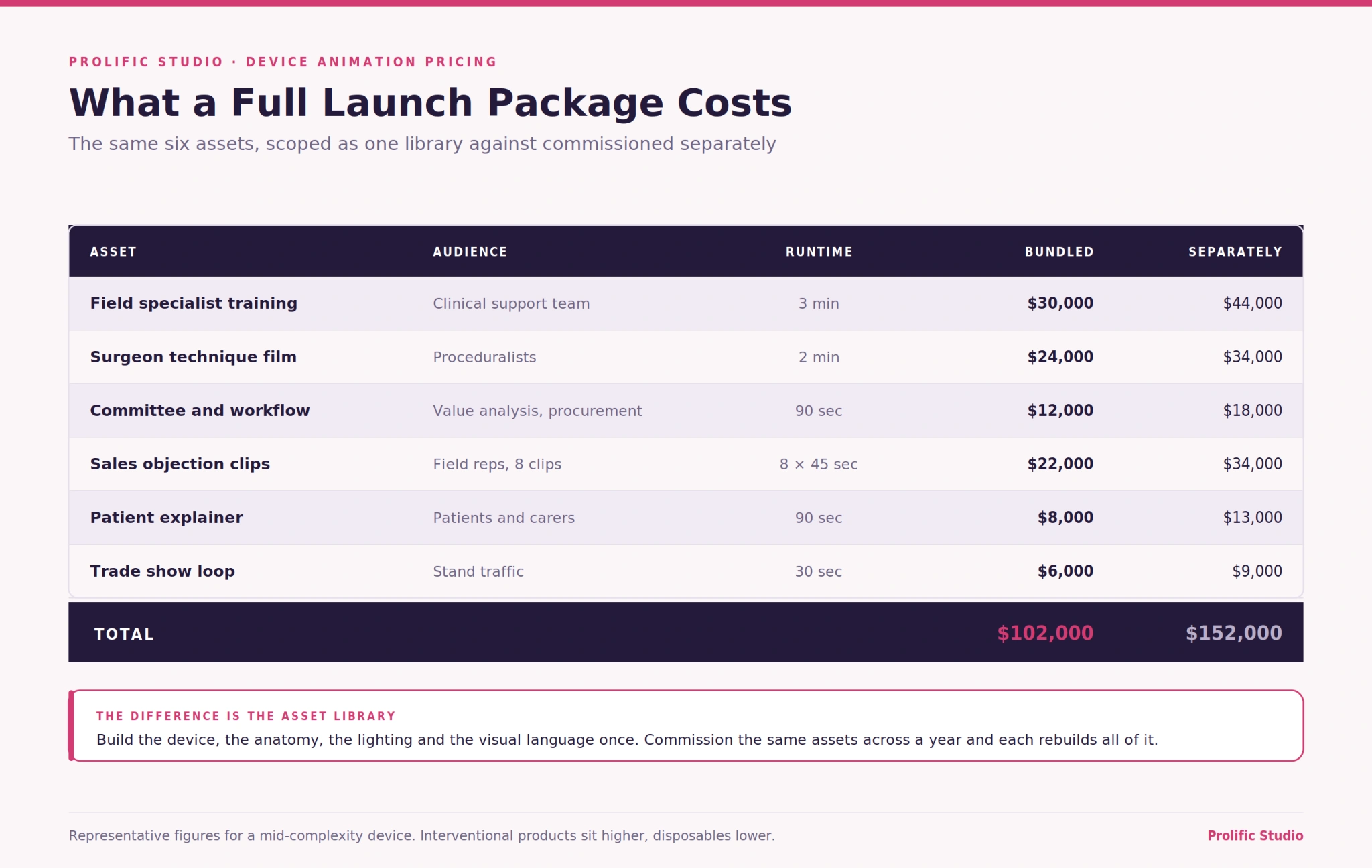
A complete device launch set runs $70,000 to $130,000 when scoped together, against $110,000 to $200,000 for the same assets commissioned piecemeal.
The savings come from the asset library. Build the device, the anatomy, the lighting, and the visual language once, and every subsequent cut draws on them. Commission the same assets from different vendors across a year, and each rebuilds all of it.
A representative package covers the field specialist training film, the surgeon technique piece, a committee and workflow asset, a trade show loop, a patient explainer, and a set of short sales clips. That combination serves every audience in a device launch.
Sequence matters as much as bundling. Build the deepest asset first, because everything else cuts down from it, and a medical animation studio used to device launches will propose that order rather than starting with the most visible film.
What Sales Enablement Libraries Cost
A set of eight to twelve short clips runs $18,000 to $40,000, which is usually less than one hero film and gets used considerably more.
Individual clips of 30 to 60 seconds cost $2,500 to $5,000 each once the core library exists. Built from scratch with no existing models, the first clip carries the full setup cost and the rest drop sharply.
Budget for refresh rather than treating it as a one-off. Objections change as competitors respond, and a library that is two years stale gets abandoned. Setting aside 15 to 20 percent of the original library cost annually keeps it current without a fresh procurement cycle each time.
How Much Do Engineering Changes Cost Mid-Project?
It depends entirely on timing, and the curve is steep. A change before modeling is a re-export. The same change after lighting can mean revisiting every shot the part appears in.
Rough guidance. Before modeling begins, minimal. During modeling, a day or two. After animation is blocked, a week. After lighting and rendering, expect to redo the affected sequences at close to their original cost.
Device projects face this more than pharmaceutical ones because geometry keeps moving. Design changes continue through verification and validation, and change control is a formal requirement under the quality management systems device manufacturers operate.
Two protections cost nothing. Agree on a documented design freeze on the revision being animated, and name one person on the engineering side responsible for telling the studio when geometry moves.
Regulatory and Instructions-for-Use Content Is Priced Differently
Content that forms part of your instructions for use carries review requirements that marketing content does not, and that shows up in the quote.
The animation work is comparable. What differs is process: additional review cycles, controlled versioning, documented approval, and translation obligations tied to the markets you sell into. Expect 15 to 30 percent above an equivalent marketing asset, and a longer schedule.
Decide early which category a film falls into. An asset built as marketing and later repurposed into instructions for use generally needs rebuilding, because the approval trail does not exist retrospectively.
Device review is lighter than pharmaceutical promotional review, where a pharmaceutical animation agency routinely budgets for four or five review rounds. Device teams usually plan for two or three, which is one of the reasons device animation is cheaper overall.
What Makes One Quote Three Times Another?
Six variables, and only one of them is the studio’s rate.
CAD condition, covered above, and the largest single factor.
Anatomy scope, meaning whether you need generic library anatomy or something specific and deformable.
Simulation, meaning whether anything flexes.
Audience count, meaning how many versions come out of one build.
Runtime, which matters less than people expect once the library exists.
Review burden, meaning marketing versus regulatory content.
When two quotes differ wildly, the cause is almost always that they assumed different answers to these questions rather than that one is overpriced. Ask both studios to itemize against this list, and the gap usually explains itself. Our overview of what is medical device animation covers the formats these variables apply to.
Final Words
The fastest route to an accurate quote is to invert the usual order. Send a representative CAD export and a one-line description of what the film must achieve, before writing a brief.
A studio that has seen your geometry can quote from evidence. One that has not is pricing for the worst case, and you pay for that uncertainty whether or not it materializes.
Send us a test part and your audience list. Prolific Studio is an animation company working across device, mechanism, clinical data, and patient material, and we will tell you which band your project sits in before you commit to anything.
Frequently Asked Questions
How much does medical device animation cost per minute?
Most work runs $8,000 to $20,000 per finished minute. Simple 2D explainers sit at $2,000 to $5,000, and interventional sequences requiring simulation reach $22,000.
Why are device animation quotes so different from each other?
Usually because studios assumed different things about CAD condition, anatomy scope and whether components flex. Ask each to itemize those assumptions, and the difference normally explains itself.
Does the quality of our CAD files really affect the price?
Substantially. Clean, defeatured files with a named assembly hierarchy convert in days. Fused solids or unnamed assemblies can take weeks, adding 50 to 100 percent to the build.
Is device animation cheaper than pharmaceutical animation?
Generally yes. Your geometry already exists, and device review cycles are typically shorter than pharmaceutical promotional review. Molecular mechanism work has to be built from published structures instead.
What does a full device launch package cost?
Roughly $70,000 to $130,000 when the assets are scoped together as one library, covering field training, surgeon technique, committee material, trade show, patient explanation and sales clips.
Should we pay for a storyboard before committing to the full build?
It is often worth it. A paid storyboard phase of $3,000 to $8,000 gives you a concrete artifact to approve, exposes scope disagreements before production, and is deductible against the full project with most studios. It is the cheapest way to de-risk a large commission.
How do we avoid paying for the same anatomy twice?
Secure reuse rights and source file delivery in the original contract. A second product in the same anatomical region should be a re-edit rather than a rebuild.