
Biotech animation is usually described as pharmaceutical animation for smaller companies. That misses what makes it a distinct discipline. The audience is often investors rather than prescribers, the product frequently does not exist yet, and the science being explained may have no visual precedent because nobody has ever needed to draw it before.
This covers what the category is, who commissions it, what it has to explain, and what it costs.
Key Takeaways
- Biotech animation explains platform science to audiences deciding whether to fund, partner with, or believe in a company.
- The commercial job differs from pharma. There is usually no product to promote and no prescriber to persuade.
- Novel modalities are the hard part. Cell therapy, gene editing and targeted protein degradation have no established visual language.
- Platform stories are harder to tell than single-asset stories, and animation handles them better than any other format.
- Pre-commercial companies face investor communication rules rather than promotional advertising rules.
- Scientific audiences check the work. Accuracy is the whole product.
- Expect $12,000 to $30,000 per finished minute, with investor-grade platform films at the top of that.
Understanding Biotech Animation
Biotech animation is animated visual content that explains a biotechnology company’s science, usually its platform or lead mechanism, to audiences making decisions about it. Those audiences are investors, potential partners, scientific peers, regulators and prospective employees.
It is built from published structural and pathway data in the same way pharmaceutical animation is, but its commercial purpose is different. A pharma company animates a mechanism to support prescribing. A biotech company animates a mechanism to establish that the science is real, credible and worth backing.
The category covers therapeutic companies at every clinical stage, platform technology companies with no single lead asset, and research tools and services businesses selling to other scientists.
Most work sits in one of four formats: a platform or mechanism film, a conference and poster asset, a website explainer, and a set of short sequences for partnering and investor decks. A biotech animation production company should be able to scope all four from one asset library.
How It Differs From Pharmaceutical Animation
Four differences, and they compound.
No approved product to promote. Most biotech animation is produced before there is anything to sell, which removes the promotional advertising framework entirely and replaces it with investor communication obligations.
The audience is often not clinical. A prescriber can evaluate mechanism claims directly. An investment analyst frequently cannot, which means the film is doing two jobs at once: transmitting science and demonstrating that the team can explain it.
The subject is often a platform. Pharma animates one molecule doing one thing. Biotech frequently has to show one mechanism generalizing across several targets, which is a harder argument to make visually.
The science may be genuinely new. A small-molecule inhibitor has decades of visual convention behind it. A prime editing complex or a molecular glue does not.
The comparison is worth understanding before you brief either. A pharmaceutical animation agency and a biotech-focused studio genuinely do approach the same molecule differently, because one is building toward a prescribing decision and the other toward an investment decision.
The Modalities It Has to Explain
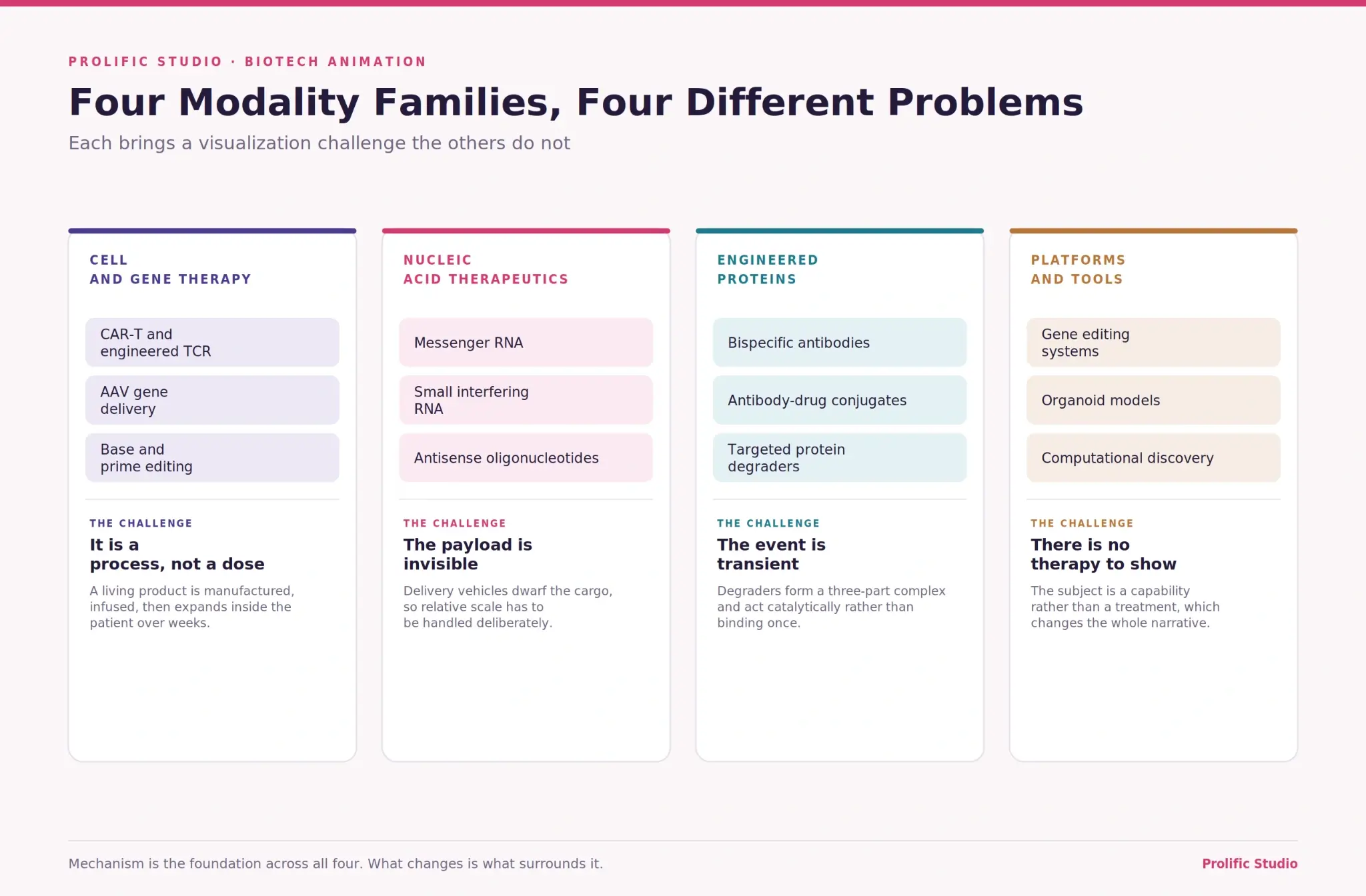
Four families of modality account for most biotech animation, and each brings its own visualization problem.
Cell and gene therapy. Chimeric antigen receptor T-cell therapy, engineered T-cell receptors, adeno-associated virus gene delivery, base and prime editing. The visualization challenge is that these are processes rather than doses. A living product is manufactured, infused, and then expands inside the patient over weeks.
Nucleic acid therapeutics. Messenger RNA, small interfering RNA, antisense oligonucleotides, and the lipid nanoparticle systems that deliver them. The challenge here is showing delivery and uptake at a scale where the payload is invisible relative to the vehicle.
Engineered proteins. Bispecific antibodies, antibody-drug conjugates, nanobodies, and targeted protein degraders. Degraders in particular are hard, because the mechanism is catalytic and involves a transient three-part complex rather than a simple binding event.
Platforms and tools. Gene editing systems, organoid models, synthetic biology chassis, and computational discovery. These are not therapies at all, which changes the entire narrative structure.
Mechanism remains the foundation across all of them, and our explainer on what is mechanism of action animation covers how that core deliverable is built.
Explaining a Platform Rather Than a Single Product
A platform claim is that one mechanism will work across many targets. That claim is invisible in text and difficult in a slide, which is why animation earns its place here more than anywhere else in biotech.
The structure that works is consistent. Show the mechanism once, in full, applied to a single concrete example. Then show the same mechanism operating in a second and third context, changing only the target. The repetition is the argument.
What fails is showing the pipeline table. A pipeline communicates breadth to someone who already believes the platform works, and communicates nothing to someone who does not.
A useful test before scripting: can somebody who watched the film describe the mechanism to a colleague the next day without using your company’s terminology? If the answer depends on proprietary vocabulary, the platform has not been explained, it has been named.
Two disciplines keep platform films honest. Be explicit about which programs are validated and which are theoretical, because a viewer who later discovers the third example was aspirational will discount the first two. And resist showing more than three applications, since the audience remembers the mechanism rather than the count.
Our piece on how MOA videos help pharma and biotech brands covers the commercial case for this asset in more depth.
Who Is Actually Watching
Five audiences, with genuinely different questions.
Investors and analysts are asking whether the science is credible and whether the team understands it. Some are scientifically trained, many are not, and the film is assessed on both dimensions simultaneously.
Potential partners send your film inward. A business development team at a larger company will show it to their own scientists, which means it has to survive an expert audience you never meet.
Scientific peers encounter it at conferences and on your website. This is the least forgiving group and the one most likely to notice an inaccuracy.
Regulators may see mechanism material as supporting context during interactions, though it never substitutes for data.
Prospective employees are an underrated audience. Scientists choose employers partly on whether the science looks interesting, and biotech recruitment is competitive against an enormous publicly funded research base. The National Institutes of Health alone invests on the order of tens of billions of dollars annually, as its budget overview sets out, which is the environment your company recruits against.
Why Pre-Commercial Companies Face Different Constraints
Not promotional advertising rules, but investor communication rules, and they behave differently.
A company without an approved product is not making promotional claims to prescribers. What it is doing, particularly if public or approaching a public offering, is communicating with investors, and that carries its own obligations around forward-looking statements and material information.
The practical effect on animation is specific. Anything depicting a future capability, an unvalidated application or an anticipated result is a forward-looking statement, and the conventions around those apply to video as much as to a slide deck.
Three practical consequences. Distinguish validated from aspirational content visually, not just in a disclaimer nobody reads. Date your assets, because a film showing a preclinical program as current becomes misleading once that program is discontinued. And involve whoever handles investor relations at storyboard, not at delivery.
Animating Science With No Precedent
Some biotech mechanisms have never been drawn, and that changes the process.
With an established target class, a studio can reference decades of prior visualization and published structures, which is the settled world our overview of what is pharmaceutical animation describes. With a novel modality there may be no reference imagery, contested structural detail, and mechanisms that are partially characterized even by the team that discovered them.
The work then becomes interpretive in a way that has to be documented. Every visual decision needs a source or an explicit note that it is an interpretation. Gene editing is a useful example: the molecular machinery is now well described in resources such as the Broad Institute’s material on CRISPR, but a proprietary variant of that machinery may have almost nothing published about it.
For a scientific audience, honesty about that is an asset rather than a weakness. A film that visually signals where the evidence ends earns more credibility than one that renders speculation at the same fidelity as fact.
Give your studio the unpublished internal data under an agreement. Working from the public literature alone produces a generic film.
Biotech Animation for Research Tools and Services
Not every biotech company is developing a therapy. Instrument makers, reagent suppliers, contract development and manufacturing organizations, and software platforms all sell to scientists, and they need a different film again.
The audience here is a working researcher evaluating whether a tool fits their workflow. They are not investors and not clinicians, and they respond to specificity rather than to narrative. What resolution, what throughput, what sample requirement, what it replaces on the bench.
Animation earns its place by showing what happens inside an instrument or a reaction that a product photograph cannot. The rest of the story is usually better told in a specification sheet, and saying so is more persuasive than pretending video answers everything.
Length runs shorter here, typically 60 to 90 seconds, and volume matters more than polish since a catalog may need dozens of short pieces. Providers of medical animation services working with tools companies should be scoping for a library rather than a hero film.
Build a reusable style system rather than treating each product separately. A consistent visual grammar for sample, reaction, readout and result lets you add a new product animation in days rather than restarting, which is the only way a catalog of that size stays affordable.
What Does Biotech Animation Cost?
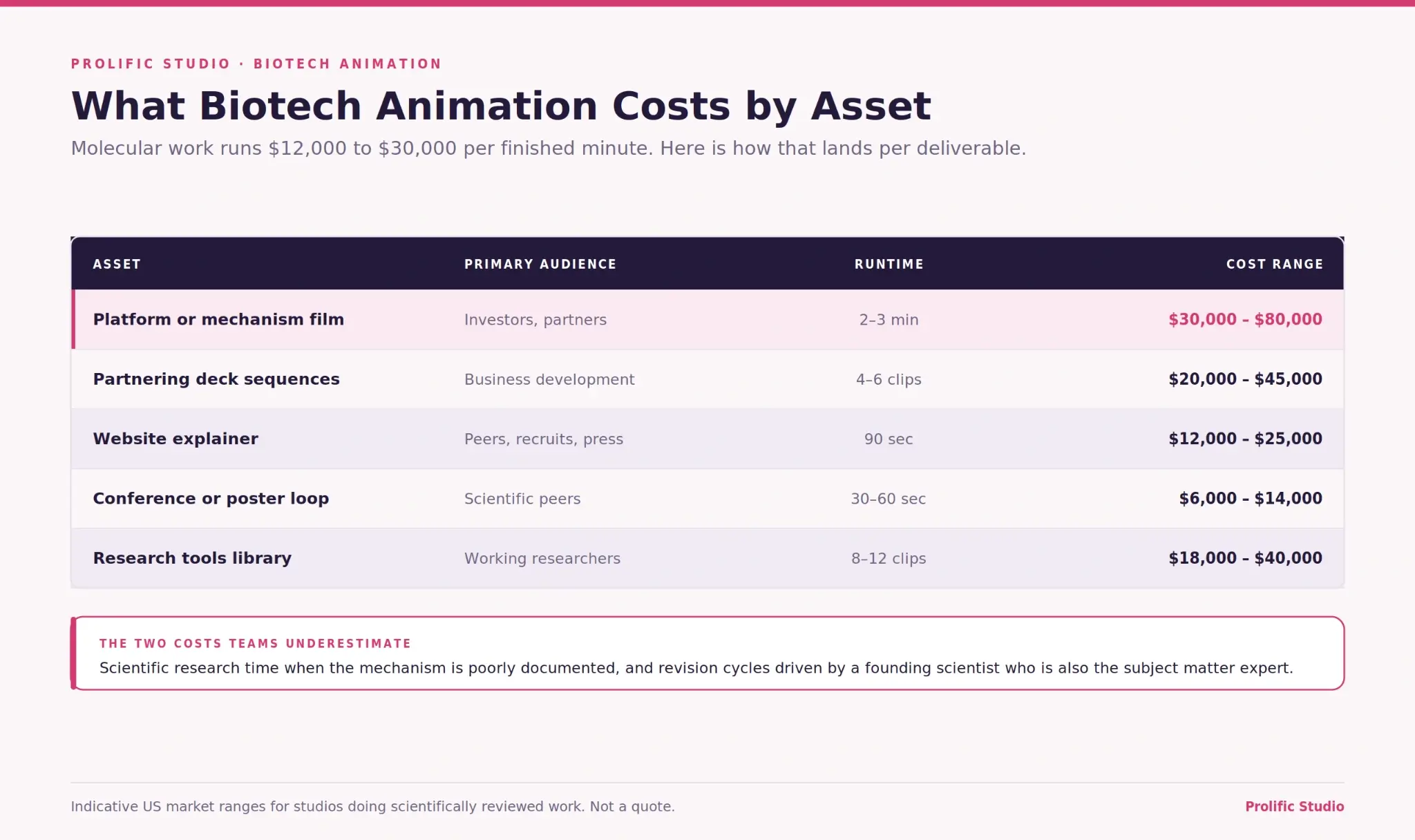
Between $12,000 and $30,000 per finished minute for molecular work, with investor-grade platform films at the upper end and website explainers below it.
By asset: a two to three minute platform or mechanism film runs $30,000 to $80,000. A 90-second website explainer runs $12,000 to $25,000. A conference or poster loop of 30 to 60 seconds runs $6,000 to $14,000. A set of short sequences for a partnering deck runs $20,000 to $45,000.
Biotech sits above device animation and roughly level with pharmaceutical mechanism work, for the same reason: everything is built from published data rather than from existing geometry, and novel modalities have no library to draw on.
Two costs get underestimated. Scientific research time when the mechanism is poorly documented, and revision cycles driven by a founding scientist who is also the subject matter expert. Our medical animation cost guide sets out ranges across every category.
When Should You Commission It?
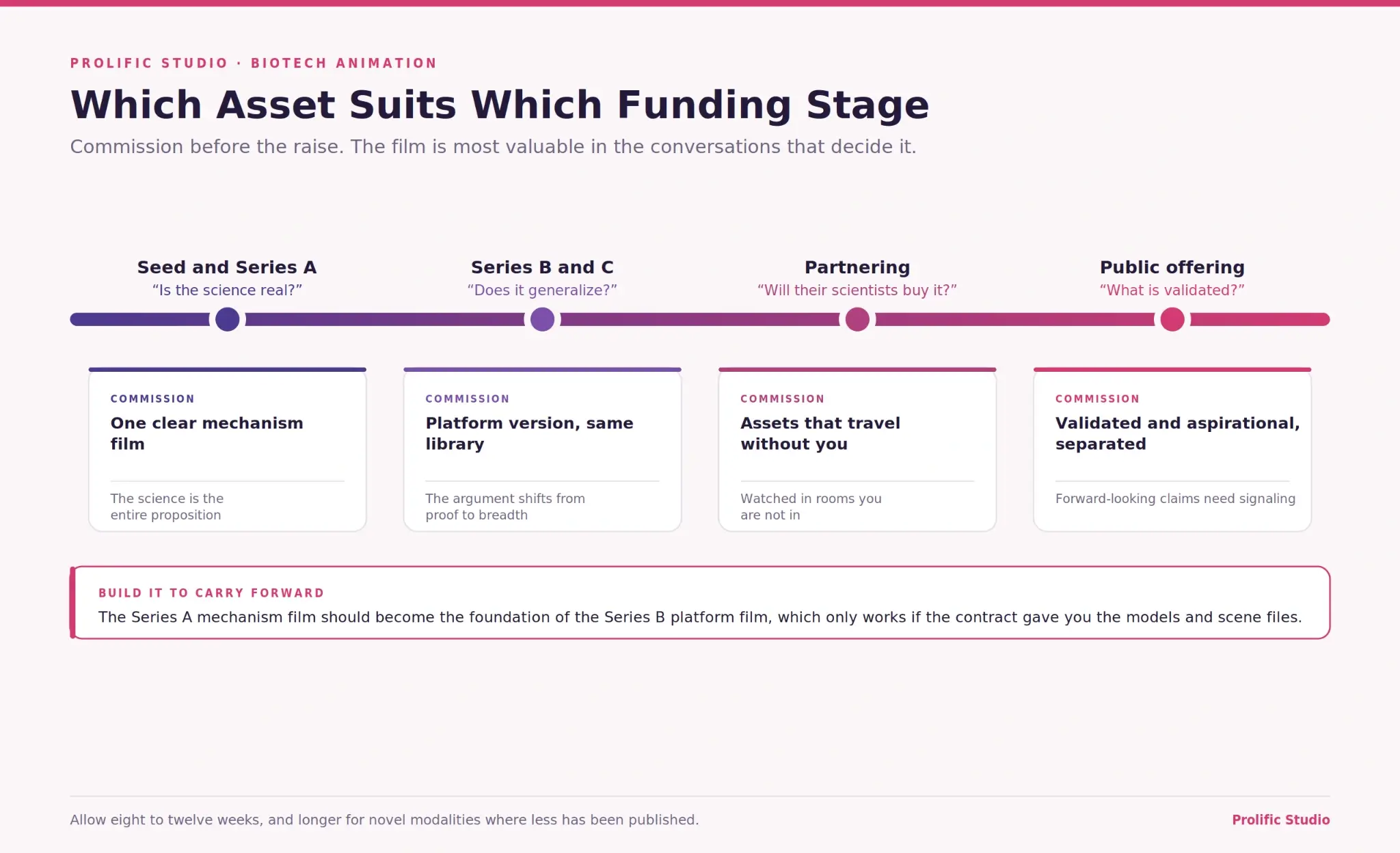
Before the raise rather than after it, and the same logic applies at each subsequent stage.
The pattern across funding cycles is consistent. Seed and Series A companies benefit from a single clear mechanism film, because the science is the entire proposition. Series B and C companies need the platform version, since the argument has shifted to breadth. Companies approaching partnering or a public offering need assets that travel without them, because the film will be watched in rooms they are not in.
Commissioning after a raise is the common error. The film is most valuable in the conversations that determine whether funding happens, and buying it afterwards means paying for an asset whose highest-value window has closed.
Allow eight to twelve weeks, and start earlier than feels necessary if your mechanism is novel, because the research phase runs longer when there is less published.
Plan for the asset to carry forward. The mechanism film built at Series A should become the foundation of the platform film at Series B rather than being replaced by it, which only works if the original contract gave you the models and scene files.
Final Words
The most useful thing to establish before briefing is which specific claim the film has to make credible. Not what the science is, but what a viewer should believe afterwards that they did not believe before.
For most biotech companies that claim is one of three: the mechanism works, it generalizes, or the team understands it well enough to execute. Those produce different films.
Send us the claim and your stage. Prolific Studio is an animation studio working across mechanism, platform, clinical data and device material, and we will tell you what the evidence supports and what it does not.
Frequently Asked Questions
How is biotech animation different from pharmaceutical animation?
The audience is often investors rather than prescribers, there is usually no approved product, the subject is frequently a platform rather than a single molecule, and the science may have no visual precedent.
What does biotech animation cost?
Roughly $12,000 to $30,000 per finished minute for molecular work. A platform film runs $30,000 to $80,000, a website explainer $12,000 to $25,000, and a conference loop $6,000 to $14,000.
When should a pre-revenue company commission animation?
Before a raise rather than after. The film is most useful in the conversations that decide whether funding happens, so buying it afterwards misses its highest-value window.
Can we animate a mechanism that is not fully characterized?
Yes, provided the film signals where evidence ends. Rendering speculation at the same fidelity as established science is what loses a scientific audience.
Do we need to share unpublished data with the studio?
It produces a materially better film. Working from public literature alone tends to produce something generic. Put a confidentiality agreement in place first.
Who should sign off on a biotech animation?
The founding scientist or chief scientific officer, plus whoever handles investor relations if the company is public or approaching a raise. The second reviewer is the one teams forget, and their objections tend to arrive late and concern forward-looking content.
How long does biotech animation take to produce?
Eight to twelve weeks typically, longer for novel modalities where the research phase extends because less has been published.