Researchers commission animation for a different reason than companies do. There is no product, no prescriber, and usually no revenue attached. What there is instead is a finding that took four years to produce and that almost nobody outside a narrow field will ever read, plus a set of obligations to disseminate it.
Animation is one of the few formats that serves peers, funders, students, and the public from a single build. This covers where it genuinely helps in research communication, what it costs on an academic budget, and where it is the wrong tool.
Key Takeaways
- One build can serve several obligations at once: a journal submission, a conference poster, a press release, and a public engagement requirement.
- Journals differ enormously on what they accept. Check the specification before commissioning, not after.
- Funder expectations around dissemination and broader impacts are a legitimate reason to budget for this at proposal stage.
- Methods animation supports reproducibility in a way a written protocol cannot, because sequence and spatial relationships are hard to write.
- The accuracy tension is sharper in research than in commercial work, because your audience includes people who will check.
- Academic budgets are a fraction of commercial ones, and the work has to be scoped differently rather than discounted.
- The principal investigator is both client and subject expert, which changes how review should run.
What Research Communication Needs From Animation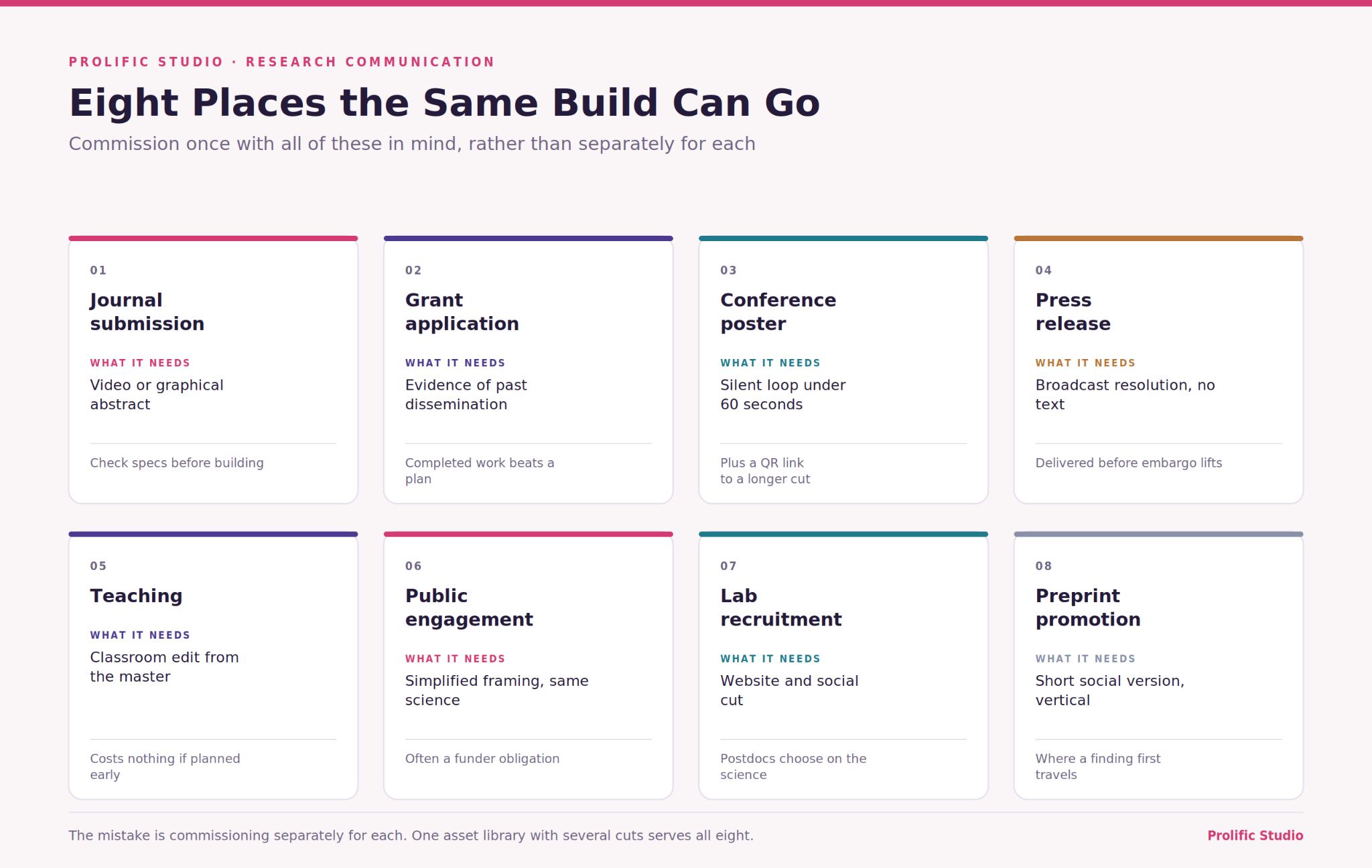
Four distinct jobs, and most projects are asked to do at least two.
Explaining to peers. A mechanism, a structure, a process that a figure compresses into something static. This is the highest-accuracy use and the one your reputation sits behind.
Satisfying dissemination obligations. Funders increasingly expect research to reach beyond the specialist literature, and a well-made animation is evidence of that effort rather than a claim about it.
Teaching. Material built for a paper frequently ends up in lectures, and building with that in mind costs nothing extra.
Attracting people. Postdocs and graduate students choose labs partly on whether the science looks interesting, and a group with a clear explanation of its work has an advantage over one without.
The mistake is commissioning separately for each. One asset library with several cuts serves all four, and a scientific animation agency used to academic work should propose that structure rather than a single film.
What Do Journals Actually Accept as a Video Abstract?
It varies by publisher and by journal within a publisher, which is why this is the first thing to check rather than the last.
Some journals accept full video abstracts, typically one to five minutes, with specifications covering resolution, file format, captioning, and whether narration is permitted. Others accept only a graphical abstract, meaning a single static image summarizing the finding, which is now standard across much of the literature.
Publisher guidance such as Elsevier’s material on graphical abstracts sets out format expectations for that static form.
Two practical points. Build the animation so a strong single frame can be exported as the graphical abstract, since you will likely need both, and designing for it afterwards produces a weak still. And check whether narration is allowed, because some journals require silent video with captions.
Submission deadlines matter here more than in commercial work. A video abstract arriving after acceptance is often too late to be included, so commission alongside manuscript preparation rather than after.
There is a scheduling risk worth planning around. Manuscripts get rejected and resubmitted elsewhere, and the new journal may have entirely different specifications. Keep the master build format-agnostic and treat the journal-specific export as a final step rather than baking one publisher’s requirements into the whole project.
Animation in Grant Applications and Broader Impacts
Most funders do not accept video inside the application itself. Where animation earns its place is in what you promise to do with the results and in demonstrating a track record of doing it.
Broader impacts is the clearest example. It sits as a formal review criterion in United States federal science funding, and the National Science Foundation’s guidance on broader impacts describes the range of activities that count, including public engagement and dissemination beyond the research community.
A completed animation from previous work is stronger evidence than a plan to make one. If your group has produced something and can point to where it was used, that is concrete in a way an intention is not.
Budget for it at proposal stage rather than finding money afterwards. Dissemination costs are frequently allowable, and a line item written into the original budget is far easier than a mid-award reallocation.
Explaining a Method So Others Can Reproduce It
Written protocols are poor at conveying sequence, timing and spatial relationships, and those are exactly the details on which reproduction fails.
A methods animation is not a replacement for the written protocol. It is a companion that shows the parts a paragraph handles badly: the order of operations, what the intermediate state should look like, how components sit relative to each other, and what a correct result looks like against a failed one.
This use has grown as reproducibility has become a more explicit concern. It also has a practical benefit inside your own group, since a new student can watch the sequence before touching anything.
Keep it plain. Methods animation rewards clarity over polish, and an expensive rendering of a pipetting step is money misallocated.
Where a method produces quantitative output, the way that output is presented deserves the same care. Our piece on how animation explains complex clinical data covers what survives scrutiny from a numerate audience.
The Accuracy Tension Researchers Feel Most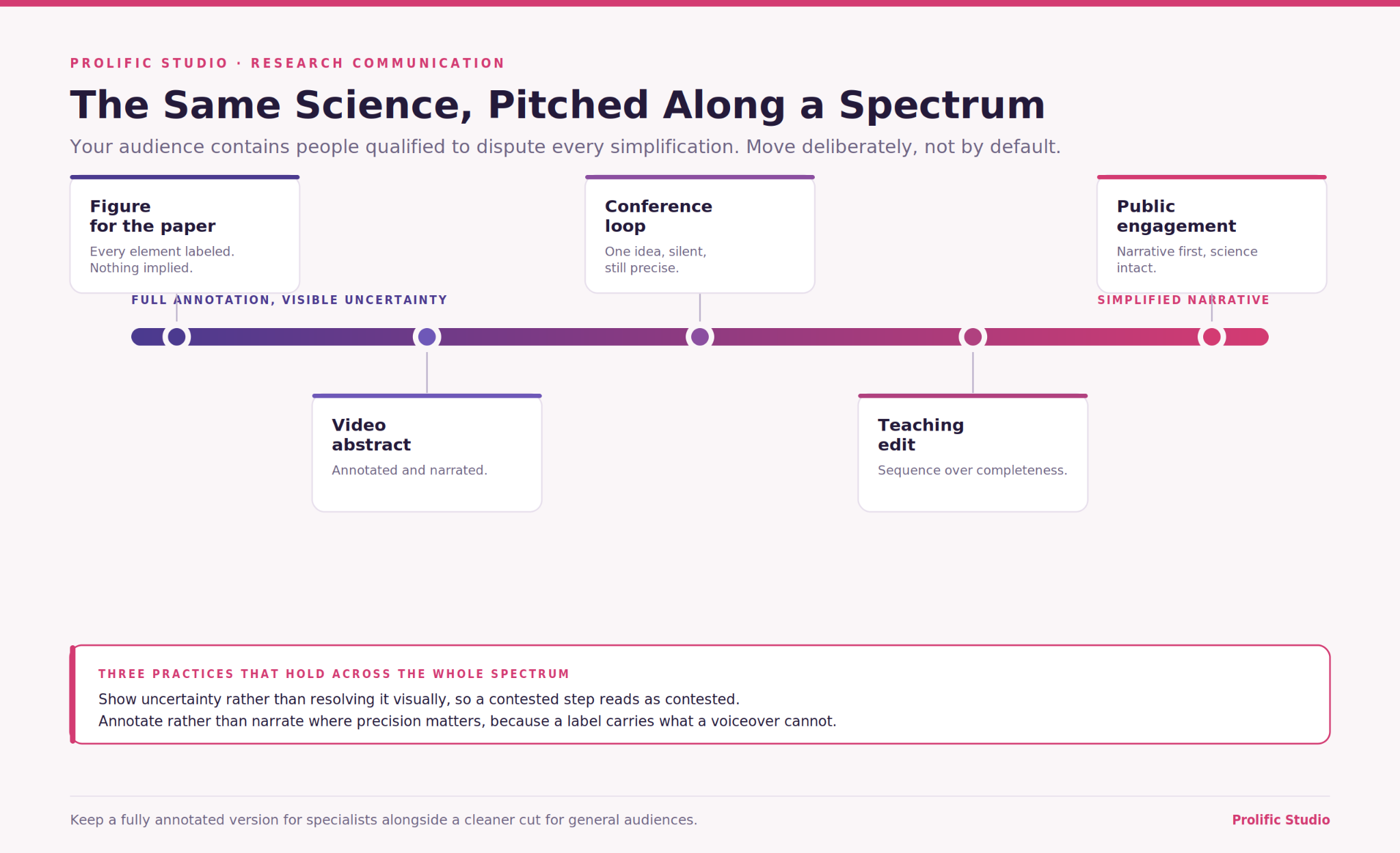
Every simplification is a small claim, and in research communication your audience contains people qualified to dispute it.
Commercial work simplifies for a lay audience and accepts the loss. Research communication cannot do that as freely, because the same asset may be seen by a reviewer, a competitor, and a student in the same week. A simplification that helps the student may misrepresent the mechanism to the reviewer.
Three practices resolve most of it. Show uncertainty rather than resolving it visually, so a contested step reads as contested. Annotate rather than narrate where precision matters, because a label can carry specificity the voiceover cannot. And keep a version with full annotation for specialist audiences alongside a cleaner cut for general ones.
The canonical institutional animations set the standard here, and studying them is more useful than any checklist. Our roundup of best medical animation examples for healthcare brands includes several pieces produced by research institutions rather than agencies.
Conference Posters and the Ninety-Second Version
A poster session is a corridor with better lighting. You have seconds to stop someone and ninety more to explain a finding.
Animation helps in two ways here. A short loop playing on a tablet or a small screen attached to the poster stops people who would otherwise walk past. And a QR code linking to a slightly longer version means the person who is interested but rushed can watch it later, which is often when they actually engage.
Build the loop silent and under sixty seconds. Conference halls are loud, nobody is wearing headphones, and a loop that requires audio communicates nothing.
Keep the linked version separate and slightly longer, with narration and captions, since it will be watched alone rather than with you standing beside it.
For groups producing several of these across a department, medical explainer video services are usually scoped as a small library with a shared visual system rather than as individual commissions, which is what makes the per-poster cost manageable.
What a Press Office Actually Needs From You
More than the finished film, and earlier than you think.
Institutional communications teams work to embargo schedules tied to publication. What they need is a package: the animation in broadcast-usable resolution, a version without text for outlets that add their own, still frames at print resolution, a plain-language caption describing what is shown, and clear credit lines.
They also need it before the embargo lifts, not on the day. A press office that receives assets late will run the story without them.
Talk to your communications office at the start rather than at the end. They often know which outlets take video, what formats those outlets require, and occasionally they have budget.
The most common failure here is not technical. It is that the animation depicts the finding accurately but not the part the press release leads on, because the two were written independently. Share the draft release and the storyboard before either is finalized.
The framing for a general audience differs from the framing for peers in ways researchers consistently underestimate. Our guide on how medical animation helps patient education covers the comprehension principles that apply whenever a non-specialist audience is involved.
Who Pays for Research Animation?
Four sources, and most projects assemble the budget from more than one.
Grant funds. Dissemination and outreach costs are frequently allowable, and the terms governing what can be charged sit in the funder’s policy documents, such as the NIH Grants Policy Statement. Check the specific mechanism, because rules vary.
Institutional funds. Many universities hold central pots for public engagement, impact case studies, or communications, and these are often underspent because researchers do not know they exist.
Core facilities. Some institutions run in-house visualization or media units at internal rates far below commercial ones. Ask before going outside.
Departmental and research center budgets. Where a group is building a shared visual identity across several projects, splitting one commission across labs works better than each lab commissioning separately.
Write the request as a communications cost rather than a design cost. It is easier to justify against dissemination objectives than against aesthetics.
What Does It Cost on an Academic Budget?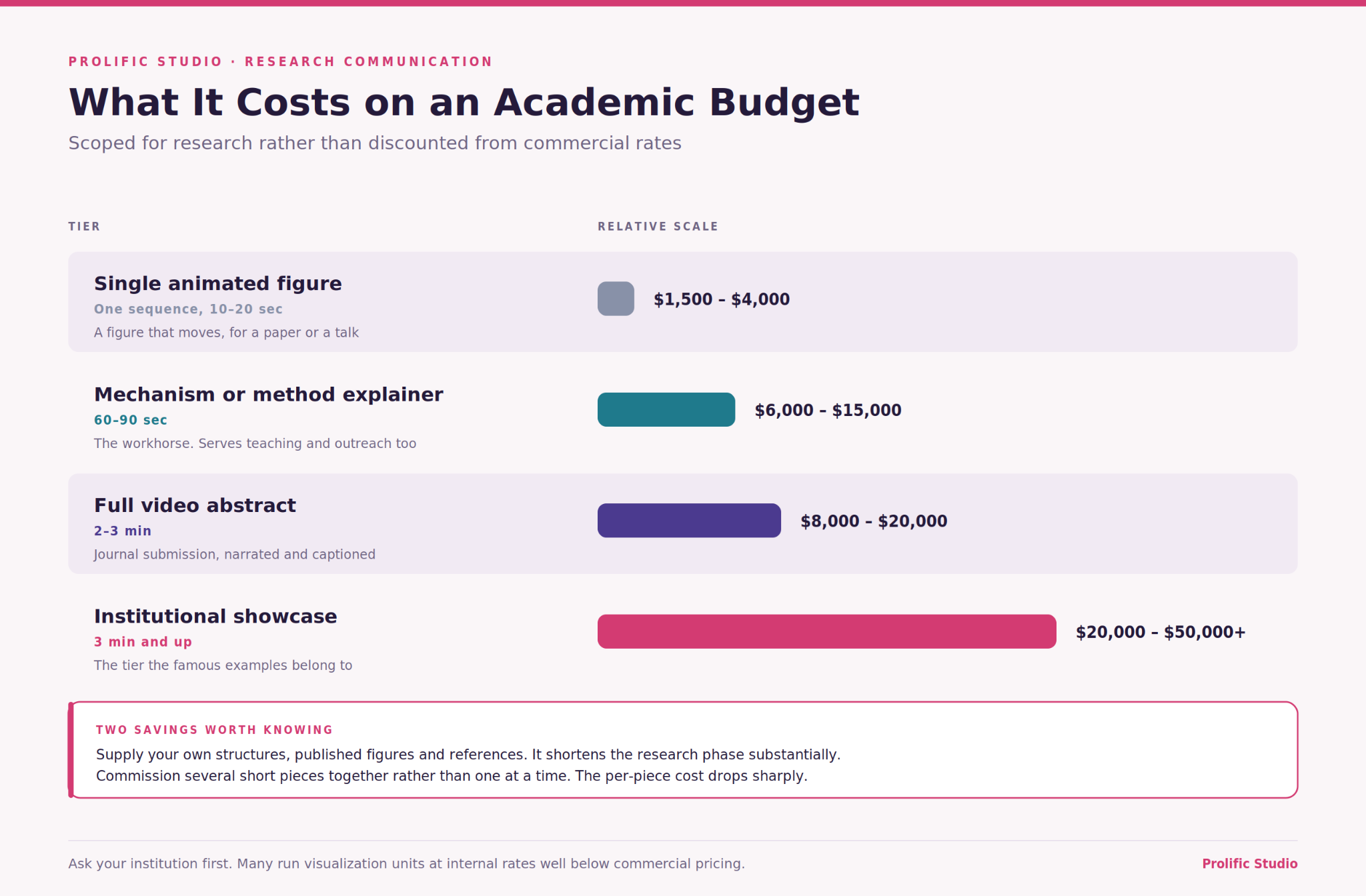
Considerably less than commercial work, provided the scope reflects that rather than simply asking for a discount.
A single animated figure or short sequence runs $1,500 to $4,000. A 60 to 90 second mechanism or method explainer runs $6,000 to $15,000. A full video abstract of two to three minutes runs $8,000 to $20,000. A high-fidelity institutional showcase piece runs $20,000 to $50,000 and upward, which is the tier the famous examples belong to.
The variables that move the number are the same as in commercial work: molecular complexity, how much is built from scratch, and simulation. What differs is that academic projects can often accept a simpler visual treatment without losing anything, because the audience is there for the science.
Two savings worth knowing. Supplying your own structural files, published figures and reference material shortens the research phase substantially. And commissioning several short pieces together rather than one at a time reduces the per-piece cost sharply. Our medical animation cost guide sets out the full commercial ranges for comparison.
Working With a Principal Investigator as Both Client and Expert
The person paying is also the person who knows the science best, which is unusual and changes how review should run.
In commercial work, the client and the subject expert are different people, and disagreements between them surface early. In research work they are the same person, which removes a useful check. The risk is a film that is scientifically impeccable and incomprehensible to anyone outside the group.
Three things help. Bring in a second reader from outside the immediate field, ideally a colleague in an adjacent discipline, and ask what they did not follow. Separate scientific corrections from stylistic preferences explicitly, because the two get conflated when one person holds both roles.
And agree upfront how many revision rounds are included, since a researcher reviewing their own work will always find something to refine.
A medical animation production company working with academic groups should be raising the outside-reader suggestion rather than waiting to be asked.
Final Words
The most useful starting point is already written. Take the sentence in your abstract that states the finding, and ask whether a viewer could understand it from watching alone.
That sentence is the brief. If it needs three subordinate clauses, the animation has an impossible job, and the problem is upstream in how the finding is framed rather than in the visualization.
Send us that sentence and the venue you need it for. Prolific Studio is an animation studio working across mechanism, method, clinical data, and public-facing science, and we will tell you what a single build can cover and what needs its own version.
Frequently Asked Questions
Do journals accept video abstracts?
Some do, with specifications varying by publisher and by journal. Many more require a graphical abstract, meaning a single static image. Check the specific journal’s author guidelines before commissioning anything.
Can animation costs be charged to a grant?
Frequently yes, as dissemination or outreach costs, though it depends on the funder and mechanism. Write it into the original budget rather than reallocating mid-award, and check your institution’s policy alongside the funder’s.
How much does a video abstract cost?
Roughly $8,000 to $20,000 for two to three minutes. A shorter single-mechanism explainer runs $6,000 to $15,000, and an individual animated figure can be $1,500 to $4,000.
Should a conference poster loop have narration?
No. Conference halls are loud and nobody is wearing headphones. Build the loop silent and under sixty seconds, with a QR code linking to a narrated version people can watch later.
Does our institution have someone who can do this in-house?
Often, and it is worth asking first. Many universities run visualization or media units at internal rates well below commercial pricing, particularly for teaching and outreach material.
Can we reuse a video abstract for teaching and outreach?
Yes, and planning for it costs nothing. Ask for the master files and an untitled version, then cut a shorter classroom edit and a public-facing one from the same build. The scientific content stays identical while the framing and pacing change.
How do we keep the animation accurate without making it impenetrable?
Annotate rather than narrate where precision matters, show uncertainty rather than resolving it visually, and keep a fully annotated version for specialists alongside a cleaner cut for general audiences.
Related Articles
- How 3D Medical Device Animation Helps Product Launches
- How Healthcare Video Production Helps Build Patient Trust
- Why MOA Animation for HCP Education Matters