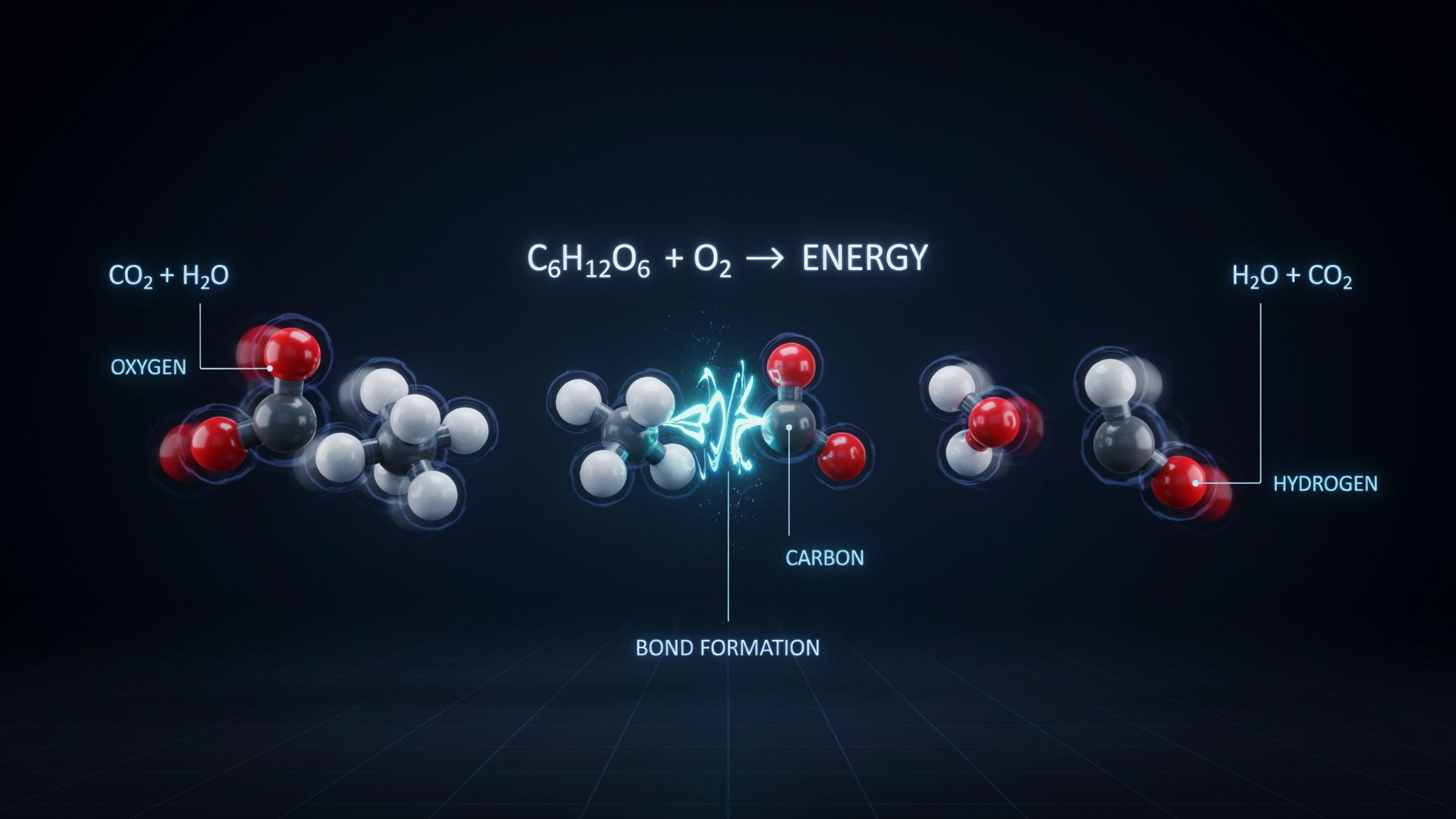
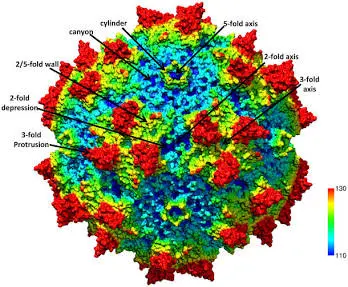
Molecular animation looks like it must be filmed from somewhere. It is not. Every frame is assembled from numbers, and understanding which numbers are measured and which are chosen tells you most of what you need to know about whether a piece is trustworthy.
This is a technical walkthrough of how the work is actually made: where the atoms come from, how coordinates become renderable geometry, where the motion originates, and which parts of any molecular animation are honestly inferred rather than observed.
Key Takeaways
Molecular animation starts from atomic coordinate files, not from imagery. Nothing is photographed.
The same molecule can be drawn four fundamentally different ways, and the choice changes what the viewer understands.
Resolution and confidence scores tell you which parts of a structure are reliable. Good animators read them before modeling.
Motion has three possible sources: simulation data, hand animation, or procedural noise. Only the first is measured.
Interpolating between two known shapes is not a real pathway. It is a plausible-looking guess.
Molecular scenes are computationally heavy because of atom counts, which is why instancing does the work.
Almost every molecular animation contains measured structure and invented timing. Saying so builds credibility.
Where Do the Atoms Actually Come From?
From coordinate files. A structure file lists every atom in a molecule with an x, y, and z position, plus information about how reliable each position is.
Those files come from three sources. X-ray crystallography remains the largest contributor. Cryo-electron microscopy has grown rapidly and handles large complexes that resist crystallization.
Nuclear magnetic resonance covers smaller, flexible molecules in solution. All three deposit into the global archive, and theworldwide Protein Data Bank deposition statistics show the scale and the shift in method mix over time.
The fourth source is prediction rather than measurement. Computational structure prediction now supplies models for proteins nobody has solved experimentally, and those come with per-residue confidence scores rather than experimental resolution.
Two numbers matter before anyone models anything. Resolution, measured in ångströms, tells you how much detail is real, and at lower resolution individual side chains may be unreliable even when the overall fold is solid. B-factor, or its equivalent in other methods, indicates how much each atom moves, which is a direct hint about flexibility.
One practical caution about predicted structures. Confidence is reported per residue rather than for the whole model, so a protein can be highly reliable through its core and near-meaningless in its flexible loops. Animating those loops with the same crispness as the core is a common and avoidable error.
A studio that asks for accession codes rather than reference images is working from data.
Four Ways to Draw the Same Molecule
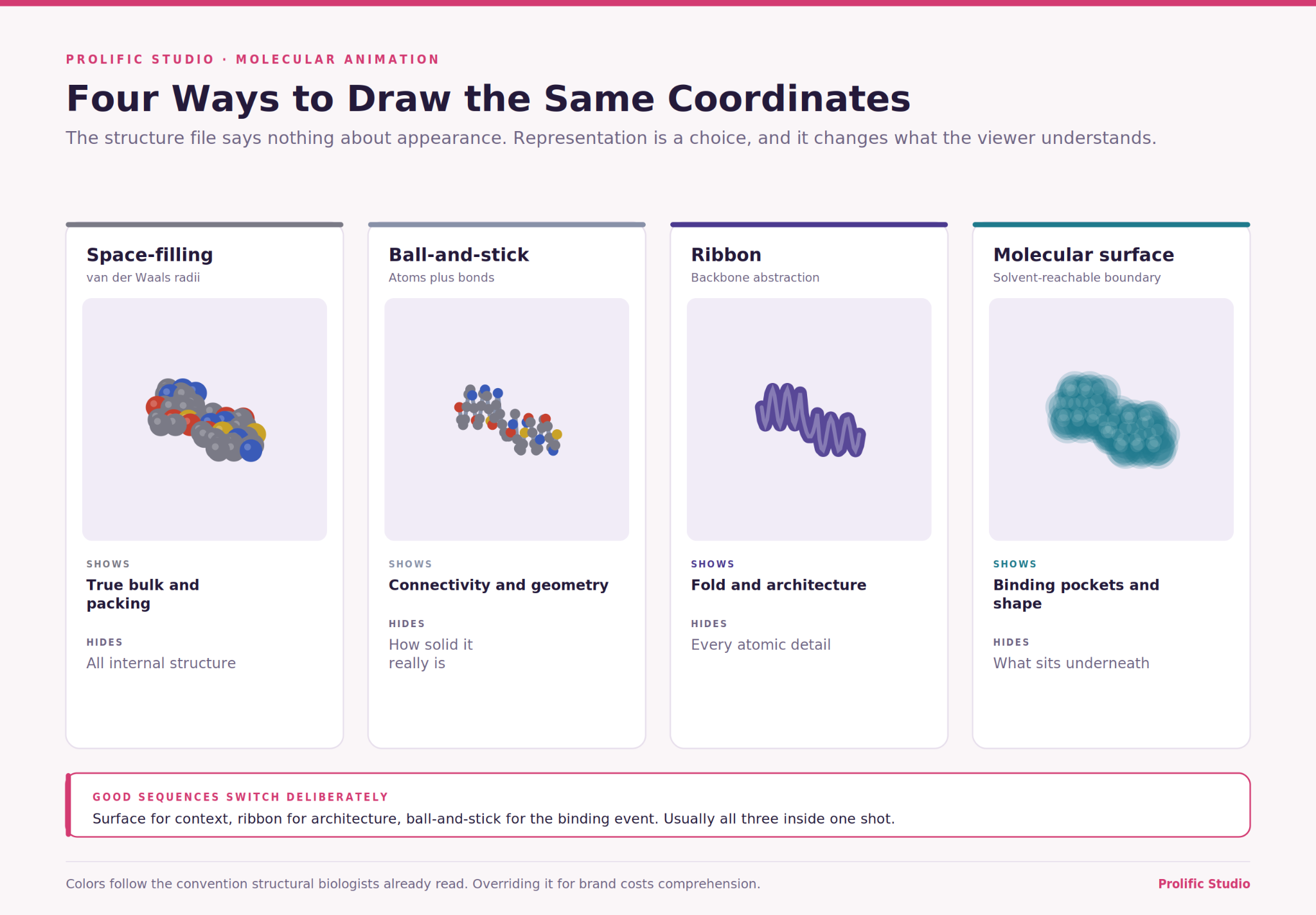
The coordinate file says nothing about appearance. Representation is a choice, and there are four main ones.
Space-filling, sometimes called van der Waals or CPK, draws each atom as a sphere at roughly its real radius. It shows true bulk and how tightly things pack. It hides internal structure completely.
Ball-and-stick shrinks the atoms and draws the bonds. It reveals connectivity and geometry, and it is what most people picture when they think of a molecule. It badly misrepresents how solid a molecule actually is.
Ribbon, or cartoon, abstracts the protein backbone into helices and sheets. It communicates fold and architecture instantly and discards all atomic detail.
Molecular surface computes the boundary a solvent molecule could reach. It is the best representation for showing binding pockets and shape complementarity.
Most good molecular animation switches between these deliberately within one sequence, usually moving from surface for context to ribbon for architecture to ball-and-stick for the binding event. Our explainer on what mechanism-of-action animation is covers how those choices serve a mechanism narrative.
How a Coordinate File Becomes Renderable Geometry
Not by importing it. Animation software cannot read a structure file, so something has to translate atoms into meshes.
The standard route runs through scientific visualization software first. Tools built for structural biology read the coordinate file, apply a representation, and export geometry that a renderer can use. Purpose-built bridges then bring that geometry into general animation software while preserving the connection back to the underlying data.
The critical technique is instancing. A space-filling model of a modest protein contains thousands of atoms, and a crowded cellular scene contains millions. Building each as unique geometry is impossible. Instead one sphere exists as real geometry and is referenced at every atom position, which means the scene stores positions rather than surfaces.
Surfaces are the expensive representation, because a molecular surface must be computed rather than instanced. This is why a surface-heavy shot costs more to produce and render than a space-filling one showing the same molecule.
Providers of scientific animation services working at this level should be able to describe their route from coordinate file to render without hand-waving.
Where Does the Motion Come From?
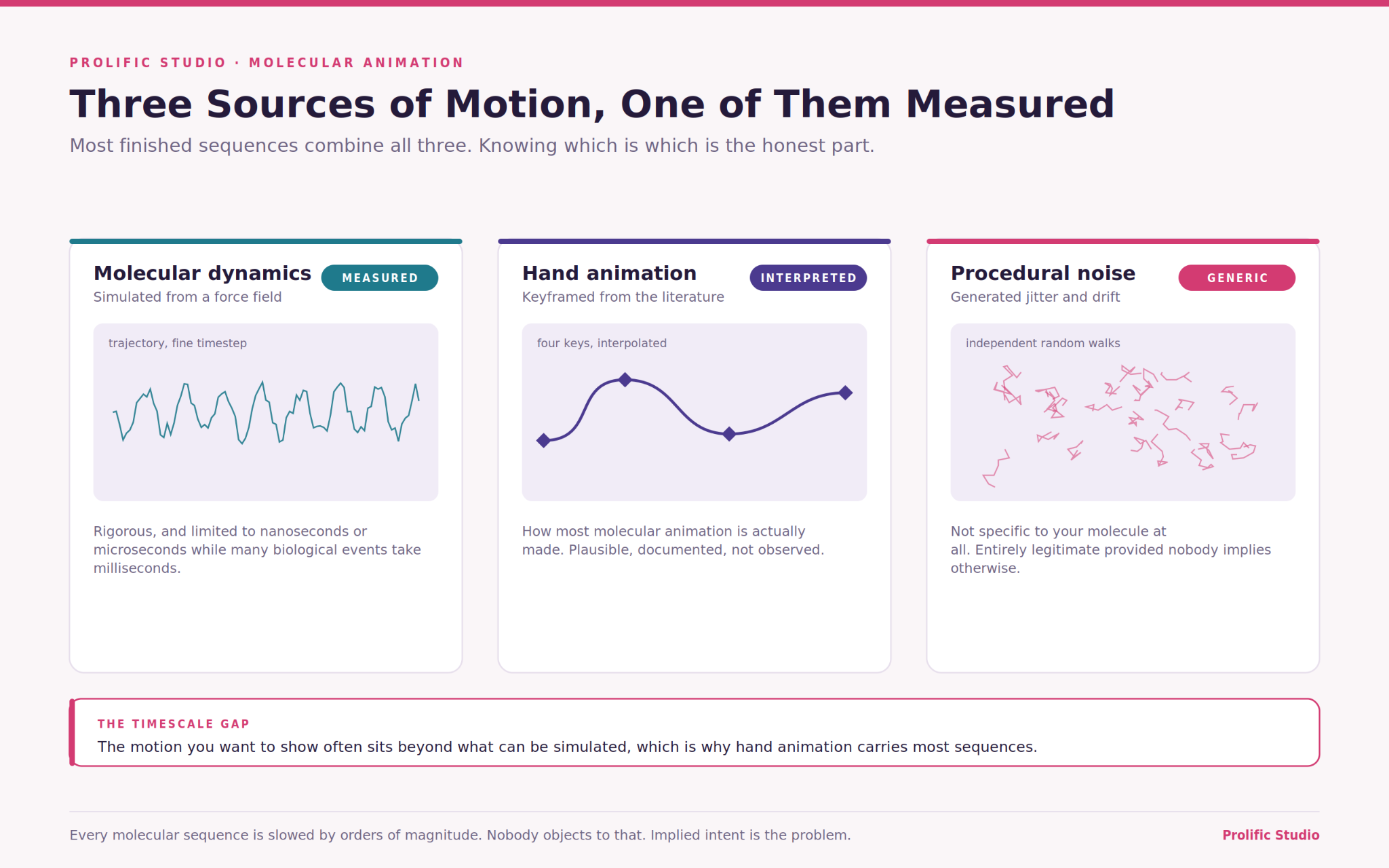
Three sources, and they differ enormously in how much they are grounded in measurement.
Molecular dynamics simulation. Physics engines compute how atoms move given a force field describing the interactions between them. Software such asGROMACS produces trajectories that can drive animation directly.
This is the most rigorous source, and it carries a significant limitation: accessible simulation timescales are typically nanoseconds to microseconds, while many biological events take milliseconds or longer. The motion you want often sits beyond what can be simulated.
Hand animation. An animator keyframes the movement based on published descriptions of the mechanism. This is how most molecular animation is actually made, and it is interpretation rather than measurement.
Procedural motion. Noise functions and simulated diffusion generate the constant jitter that makes a scene feel alive. This is not specific to your molecule at all, and it is entirely legitimate as long as nobody claims otherwise.
Most finished sequences combine all three: simulated data where it exists, hand animation for the narrative beats, and procedural motion underneath everything.
Animating a Shape Change Between Two Known States
This is the most common honest compromise in the field, and it is worth understanding because it appears in almost every mechanism film.
Structural biology frequently gives you two structures: a protein before binding and the same protein after. It rarely gives you the pathway between them. What animation software does is interpolate, moving each atom smoothly from its start position to its end position.
That interpolation is not the real transition. Real conformational change follows an energy landscape, moves through intermediate states, and may take a route nothing like a straight line. Linear interpolation produces something that looks plausible and is, strictly, invented.
This matters practically. A specialist watching a morph knows exactly what they are seeing and will accept it as shorthand. What loses them is a morph presented as though it were an observed pathway.
Two mitigations. Where intermediate structures exist, use them as waypoints. And keep the transition brief, since a long lingering morph draws attention to detail that is not real. Teams working on novel targets face this constantly, and our overview of biotech animation services covers the categories where published structures are thinnest.
Making Diffusion Look Like Diffusion
Molecules do not travel. They are knocked around by collisions, and any depiction of purposeful movement is wrong.
The technique has two parts. Random walk motion applied per molecule, so each one jitters unpredictably rather than following a path. And population-level bias, so the overall distribution drifts toward wherever the narrative needs it to go. Individually erratic, collectively directional.
The second half of the problem is crowding. Cytoplasm is densely packed with macromolecules, and a molecule shown crossing open space misrepresents the environment badly. Rendering realistic crowding is expensive, which is why so many animations quietly skip it.
There is a legitimate middle ground. Establish crowding in a wide shot so the viewer understands the environment, then thin it out for the close-up where the binding event needs to be legible. That reads as a deliberate visual choice rather than an inaccuracy.
Speed is the other half of the honesty question. Real molecular events happen far faster than any watchable frame rate, so every sequence is slowed down by orders of magnitude. Nobody objects to that, but a film that also implies a molecule searched deliberately for its target has made a second change that a specialist will notice.
Our walkthrough of the drug MOA animation process covers where in the production schedule these decisions get locked.
Why Molecular Scenes Are So Computationally Heavy
Atom counts, and the fact that molecular scenes have no empty space to optimize away.
A single protein might be tens of thousands of atoms. A ribosome is hundreds of thousands. A realistic crowded cytoplasmic volume runs into millions, and each one needs shading, shadowing, and often transparency. Ordinary 3D scenes are mostly air, so renderers optimize for that. Molecular scenes are not.
Three techniques manage it. Instancing, as described above. Level of detail, where distant molecules use simplified geometry. And rendering in passes, so different depth layers composite together rather than resolving in a single calculation.
The practical consequence for a buyer is that render time is a real line item in molecular work in a way it is not in most animation, and a surface-heavy sequence in a crowded environment can multiply it.
Lighting Conventions That Make Molecules Legible
Molecular scenes need lighting choices that ordinary 3D does not, because there is no horizon, no ground plane and no familiar object for scale.
Ambient occlusion is close to mandatory. Darkening the crevices where surfaces approach each other is what makes a molecular surface readable as a shape rather than a blob, and it is the single largest legibility gain available.
Depth cueing, meaning fading or desaturating with distance, substitutes for the atmospheric perspective the eye uses everywhere else. Without it, a crowded scene flattens into visual noise.
Convention-respecting color matters more than brand palettes. Structural biologists read carbon, oxygen, nitrogen, and sulfur through an established color scheme, and overriding it for aesthetic reasons costs comprehension with the audience most likely to care.
A medical animation studio experienced in molecular work will raise ambient occlusion and depth cueing as requirements rather than options.
What Is Measured, and What Is Inferred?
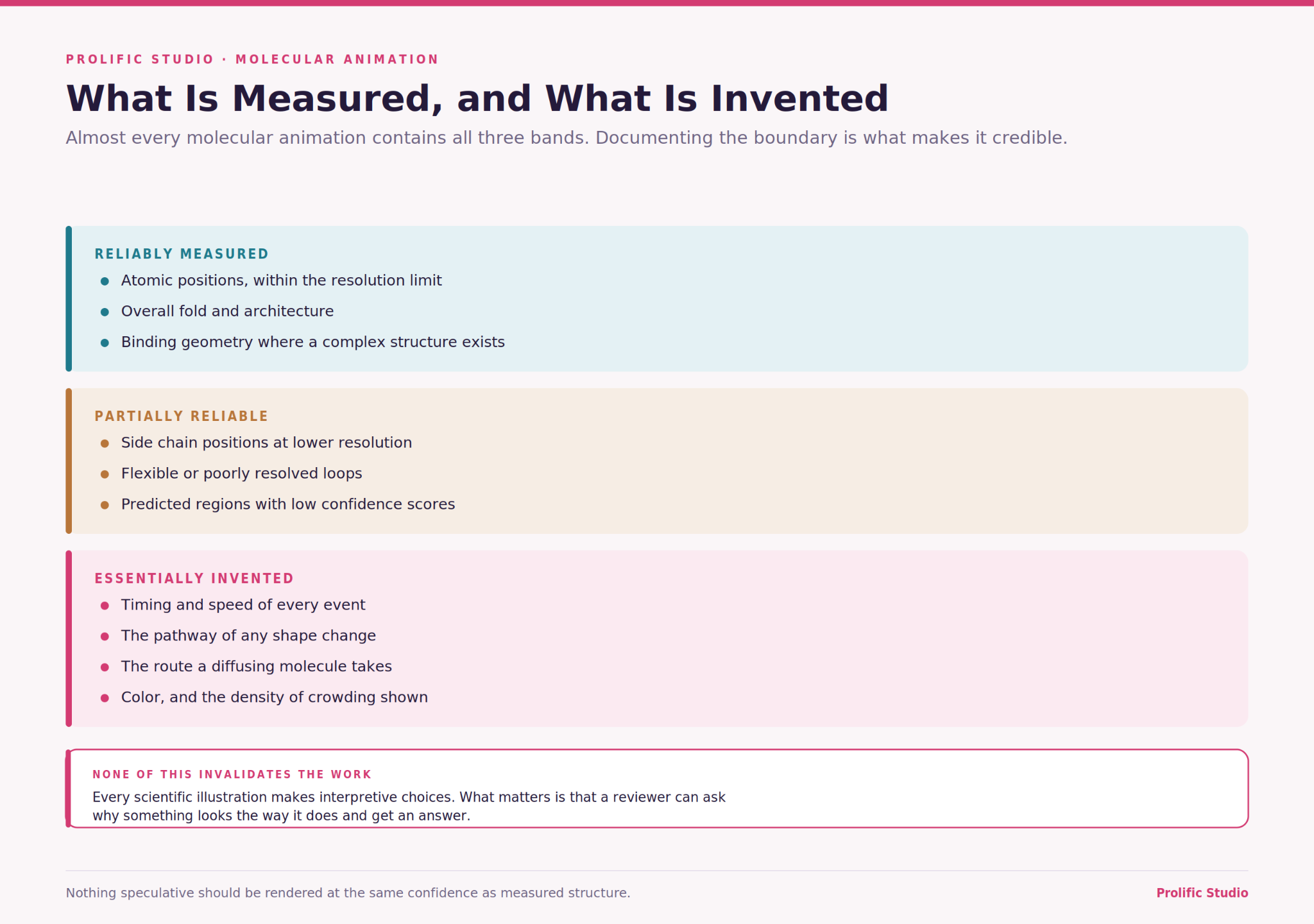
Almost every molecular animation contains both, and being explicit about the boundary is what separates credible work from decorative work.
Reliably measured: atomic positions within the resolution limits of the method, overall fold and architecture, and binding geometry where a complex structure exists.
Partially reliable: side chain positions at lower resolution, loop regions that are flexible or poorly resolved, and predicted regions carrying low confidence scores.
Essentially invented: timing and speed, the pathway of any conformational change, the specific route a diffusing molecule takes, color, and the degree of crowding shown.
None of that invalidates the work. Every scientific illustration makes interpretive choices. What matters is that the choices are documented, that a reviewer can ask why something looks the way it does and get an answer, and that nothing speculative is rendered at the same confidence as measured structure.
Scientific visualization software reads coordinate files, applies representations, computes surfaces and handles the structural biology correctly. This is where the science lives, and it is not animation software.
Bridge tools move that geometry into general animation packages while keeping the link to the underlying data, so a change in representation does not mean rebuilding from scratch.
General animation and rendering software handles camera, lighting, simulation, compositing and final output. This is where the film gets made rather than where the science gets established.
A studio doing this properly has people who can operate the first category, not just the third. That is the practical difference between molecular animation and animation that happens to feature molecules, and it shows up in the details a specialist audience notices. Our overview of what is biotech animation covers the modality categories where that depth matters most.
Final Words
The most useful question you can put to a molecular animation studio is not about style. It is which structures they intend to use and where those structures came from.
A team that answers with accession codes, resolution values, and an honest note about which regions are poorly resolved is working from data. A team that answers with mood boards is going to produce something that looks the part and cannot be defended in review.
Send us the structures you are working from and the mechanism you need shown. Prolific Studio is an animation production company working across mechanism, molecular, clinical data, and device material, and we will tell you what the data supports and where the gaps are.
Frequently Asked Questions
Where does molecular animation data come from?
Atomic coordinate files produced by X-ray crystallography, cryo-electron microscopy or nuclear magnetic resonance, plus computational structure prediction for proteins nobody has solved experimentally. Nothing is photographed.
Is molecular animation scientifically accurate?
Structure usually is, within the resolution limits of the method. Timing, conformational pathways, diffusion routes, color, and crowding density are generally interpretive. Credible work distinguishes the two rather than blurring them.
Why do different animations of the same protein look so different?
Because representation is a choice, space-filling, ball-and-stick, ribbon, and molecular surface depict identical coordinates in fundamentally different ways, and each reveals something the others hide.
Can you animate a protein that has not been solved experimentally?
Yes, using a predicted structure, provided you treat low-confidence regions accordingly and say what you have done. Predicted models carry per-residue confidence scores that should inform how much detail you show.
How is molecular movement generated?
Three ways: molecular dynamics simulation, hand keyframing based on published mechanism descriptions, and procedural noise for ambient jitter. Most finished work combines all three.
Should we use a predicted structure or wait for an experimental one?
Use the prediction if the timeline demands it, treating low-confidence regions with less detail. Waiting for an experimental structure can add years, and a carefully handled predicted model is more defensible than an invented one.
Why is molecular animation expensive to render?
Atom counts run to millions in crowded scenes, molecular surfaces must be computed rather than instanced, and there is no empty space for a renderer to optimize away.
Patrick Mitchell is an animation expert at Prolific Studio, with expertise in 2D and 3D animation, motion graphics, VFX, and visual storytelling. With knowledge across industries including healthcare, technology, education, entertainment, finance, and product development, he explores how animation turns complex ideas into engaging visual experiences. Through his insights, Patrick Mitchell shares practical perspectives on animation, creative trends, production techniques, and digital innovation.