Most accounts of the MOA animation process list seven stages and stop. That is accurate and close to useless, because it tells a buyer nothing about where the money actually goes, where the schedule breaks, or what they should be looking at when a file lands in their inbox.
This is the version with the detail left in: what happens inside each stage, who is doing it, and which decisions get expensive if you make them late.
Key Takeaways
- Nothing is drawn for the first two weeks. The reference pack and the written mechanism come first.
- A prose description of the mechanism, signed off before any script, prevents most late-stage rework.
- A medical animation storyboard carries citations per frame. If yours does not, that is a warning sign.
- The animatic is where timing gets fixed. Fixing it after animation begins costs roughly twenty times more.
- Molecular geometry usually comes from public structural data rather than being sculpted by hand.
- Two review gates, at storyboard and near-final cut, decide whether the project holds its schedule.
- At handover, you should receive scene files and models, not just an MP4. Put it in the contract.
Before Anything Is Drawn: The Scientific Reference Pack
Weeks one and two produce a document, not a picture. Somebody assembles every source the animation will be built from and puts it in one place.
A proper pack contains the approved claim set, structure identifiers for every protein involved, the pathway diagrams your medical team works from, the key publications, kinetic data where timing matters, and an explicit list of which steps are well established versus inferred. That last list is the one people skip, and the one reviewers ask about.
The scale of available annotation is worth knowing. Curated protein resources such as UniProt hold hundreds of millions of sequence entries with functional annotation attached, so the question is almost never whether reference material exists. It is whether somebody has assembled the right subset before production starts.
Who does this matters. It should be your medical or scientific team with the studio’s science lead, not an account manager. Our overview of what is pharmaceutical animation maps where this sits among the other formats.
Writing the Mechanism as Prose Before It Becomes a Script
Week two produces a plain-English description of what happens, in order, with the uncertain parts marked. No visuals, no narration, no creative language.
This step gets skipped constantly, and it is the single highest-leverage thing in the whole process. Disagreements about the mechanism are guaranteed on any project of reasonable complexity, and they surface eventually. The only question is whether they surface in a document, where resolving one costs an email, or in a storyboard review, where it costs a week.
The document should read like a methods section. This binds here: that conformational change follows, this downstream event results, this part is inferred from the following study. Circulate it to medical, regulatory, and a practicing specialist outside the project.
Get it signed. Not approved in a meeting, signed. Everything downstream inherits it, and our explainer on what is mechanism of action animation covers what the finished deliverable has to carry.
What Does a Medical Animation Storyboard Actually Contain?
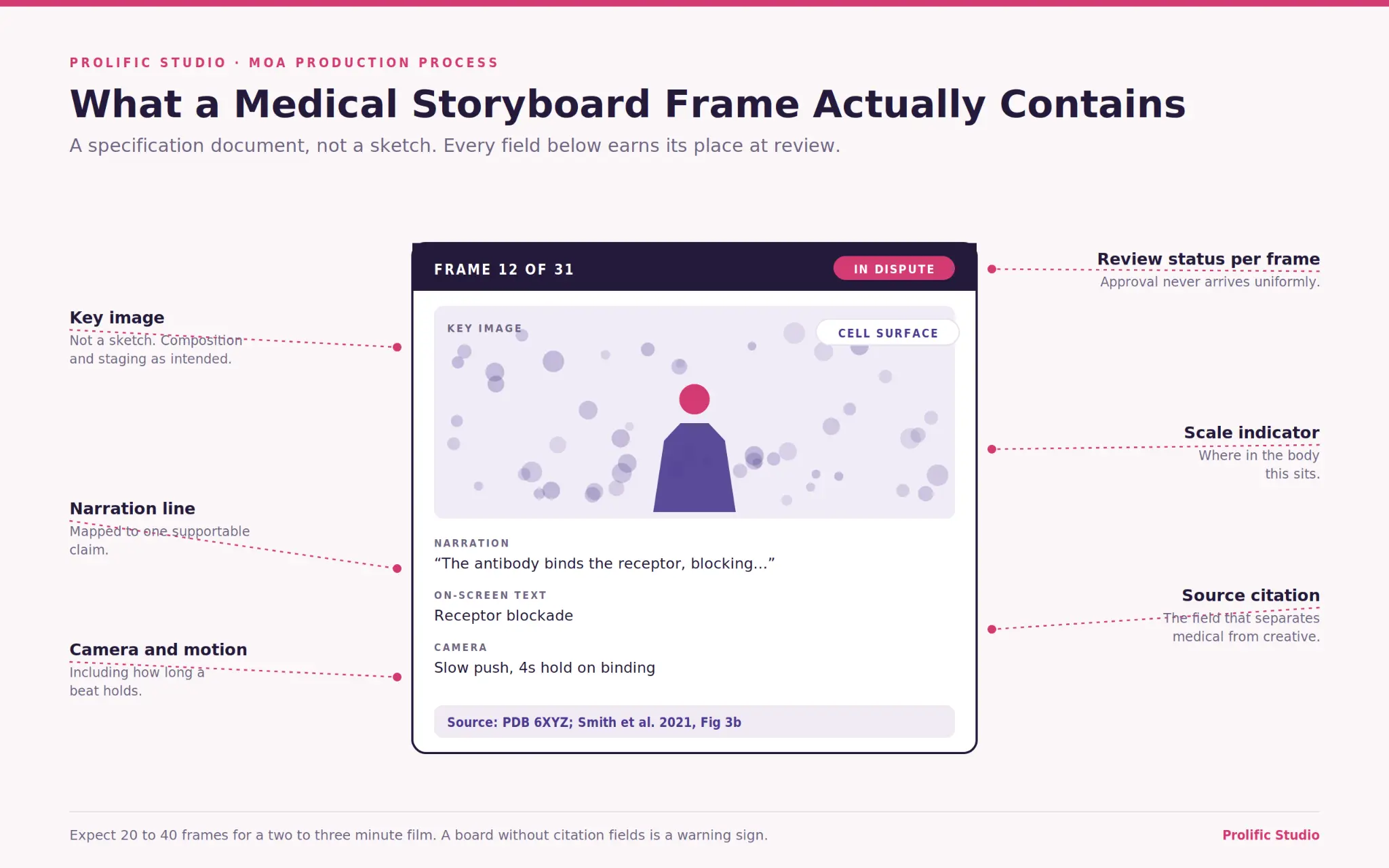
Considerably more than sketches. A medical storyboard frame is a specification document, and each frame carries fields a general animation storyboard does not.
Per frame, you should see: the key image, the narration line for that beat, on-screen text, a camera and movement note, an explicit scale indicator saying where in the body this sits, and a citation for anything factual in the frame. That last field is what separates a medical storyboard from a creative one.
You should also see review status per frame rather than for the board as a whole, because approval never arrives uniformly. Frames four through nine are clear while frame twelve is disputed, and tracking that at frame level keeps production moving on the rest.
Expect twenty to forty frames for a two to three minute film. A mechanism of action animation services provider delivering a storyboard without citation fields is telling you something about how the science will be handled later.
Why the Animatic Is the Cheapest Place to Fix Timing
Around week four or five, the approved storyboard frames get cut together at their intended durations with a scratch voiceover. The result looks crude and answers the most expensive question in the project.
That question is pacing. Does the binding event have room to land? Does the scale transition give the viewer time to reorient? Does the narration fit, or is it running twenty seconds long, which it almost always is on a first pass?
Timing problems are invisible on a storyboard. A board can look perfectly clear as a sequence of images and fall apart the moment it runs at speed, because the eye needs longer than a reviewer holding a static page assumes.
Watch it three times. Once for comprehension, once for pacing, once with the sound off. The third pass reveals whether the picture carries the meaning on its own, which it will need to do on a congress floor.
Say yes or no to the animatic within a few days. It is a rough-looking deliverable, and teams often sit on it because it does not feel finished enough to sign off. Every day it waits is a day the modeling team is either idle or building against a cut that may still change.
Turning Structural Data Into Buildable Geometry
Weeks five to seven. This is where published coordinates become something that can be lit and animated, and it is less like sculpting than most people imagine.
Molecular geometry starts as atomic coordinates. Those get imported through molecular visualization tooling, converted to surface meshes, then rebuilt with clean topology so they can deform and render efficiently. Raw scientific meshes are dense and unusable for animation without that rebuild.
Where no experimental structure exists, predicted models have changed the picture substantially. The AlphaFold Protein Structure Database now provides predicted structures for over 200 million proteins, which means an animator faced with an uncharacterized target has a starting point that did not exist a few years ago.
Predicted structures carry confidence scores, and those should be discussed with your medical team rather than quietly rendered as fact.
Anatomy runs in parallel and moves faster, because studios maintain libraries. Device or formulation geometry comes from your engineering files.
Setting Up Motion That Behaves Like Biology
Weeks six to eight overlap the build. Before anything is animated by hand, the systems that produce biological-looking movement get configured.
Three of them matter. Instancing, which populates a cytoplasm with thousands of molecules without modeling each one. Procedural jitter, which gives those molecules diffusion-like motion instead of stillness. And soft-body or cloth setups for membranes, which stop them from behaving like sheet metal.
Getting these right separates a film that reads as biology from one that reads as product visualization. It is also invisible in a quote, which is why cheap bids skip it.
Hand animation comes after, in three passes: blocking the key events, splining them into continuous motion, then polishing secondary movement. Studios offering scientific animation production services should be able to describe this setup work when asked, because a team that cannot has probably not done it.
Where Does the Render Time Actually Go?
Weeks nine and ten, and the answer surprises people. Most of it goes into volumetrics and translucency rather than geometry.
Cytoplasm rendered as a participating medium, subsurface scattering through tissue, depth-based haze that sells scale: these are the passes that consume hours per frame. A shot of a molecule against a plain background renders in minutes. The same molecule inside a crowded, light-scattering cell can take a hundred times longer.
Studios manage this with render layers, outputting the beauty pass alongside depth, ambient occlusion, and object mattes so that adjustments can be made in compositing rather than by re-rendering. This is why a good studio can turn around a color note in an afternoon and a lighting note in three days.
Test frames come first, always. Rendering a full sequence before checking single frames at final quality is how a week disappears.
This is also the stage where the schedule has the least give. Render time is largely fixed by the shot design agreed weeks earlier, so a request to compress the timeline at week nine can only be met by reducing quality settings. If the date is immovable, say so at storyboard when the shot design can still be simplified.
What Reviewers Check at Each Gate
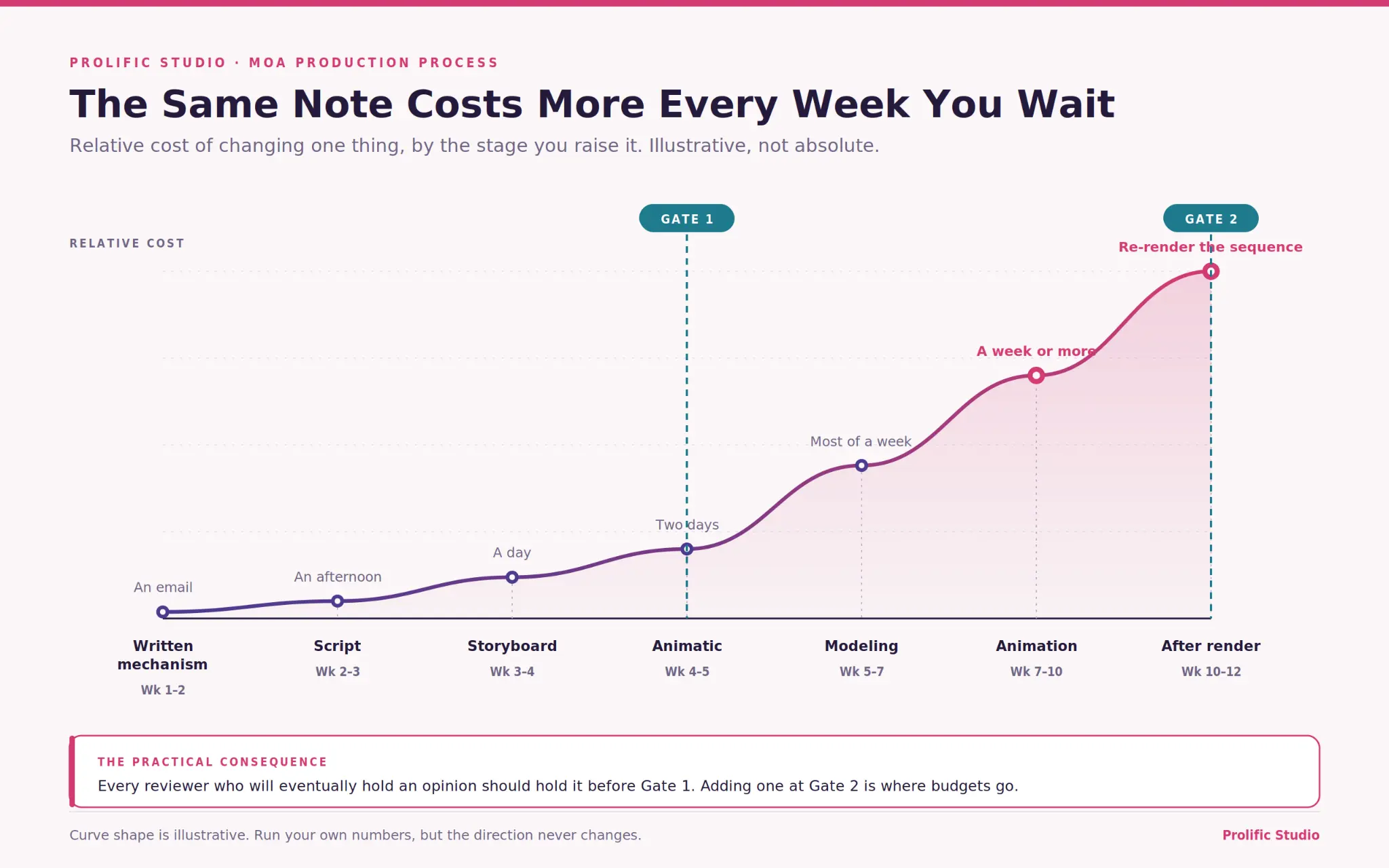
Gate one is the storyboard. Gate two is the near-final cut. What reviewers examine at each is different, and knowing that speeds both up considerably.
At gate one, they are checking the science and the claims. Is each visual claim supportable, is the sequence correct, is anything implied that the label does not support, and is the citation attached? Nothing about the film’s appearance is meaningfully reviewable yet, and reviewers who fixate on color at this stage are reviewing the wrong thing.
At gate two, they are checking execution against what was approved. Does the finished film match the signed storyboard, has anything drifted during animation, is the risk information given comparable prominence, and do the data frames hold up?
Those last ones are where projects get sent back, and our piece on how animation explains complex clinical data covers what survives that scrutiny.
Bring the same people to both gates. A reviewer who missed gate one will raise gate-one objections at gate two, when they cost weeks.
Why Sound and Voiceover Come Last
Week ten or eleven. Recording narration before the picture is locked means re-recording it, which is why experienced studios resist doing it early, however much a client wants to hear it.
The sequence is scratch voiceover in the animatic, picture lock, then final record against the locked cut. Sound design and music follow, then the mix.
The mix has a technical specification attached that most buyers never think about. Broadcast and platform delivery expect normalized loudness, and standards such as the European Broadcasting Union’s R 128 loudness recommendation define the target levels. A film mixed without reference to a loudness spec will play noticeably louder or quieter than everything around it on a congress reel.
Ask for the audio stems separately at delivery. Voiceover, music, and effects as isolated tracks make every future language version dramatically cheaper.
What Should You Receive at Handover?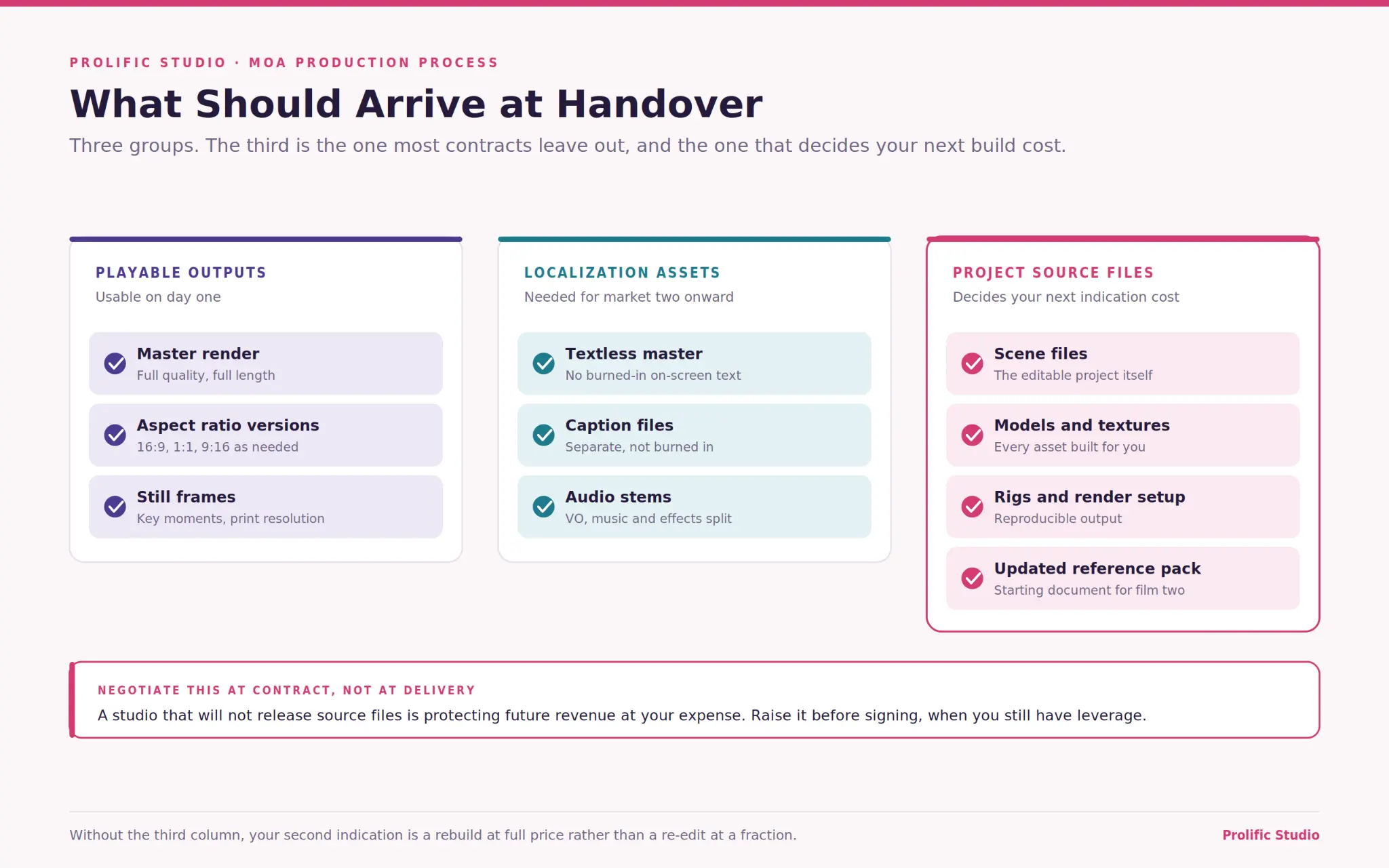
More than a video file. What you receive at week twelve determines what your next iteration costs.
The package should include the master render at full quality, delivery versions in every aspect ratio you need, a textless master for localization, caption and subtitle files, audio stems, and the still frames pulled from the animation.
Then the part people forget: the project files. Scene files, models, textures, rigs and the render setup. Without these, your second indication is a rebuild at full price rather than a re-edit at a fraction.
Also request the reference pack back, updated with anything added during production. It becomes the starting document for the next film.
Any pharmaceutical animation production studio should agree to this at the contract stage. A studio that will not release source files is protecting future revenue at your expense, and that is a negotiation to have before signing rather than at delivery.
Where Timelines Actually Slip
Four places, and only one of them is production.
Reviewer assembly. The commonest cause by a distance. A gate review scheduled before everyone is available slips, and every downstream stage slips behind it.
Late scientific disagreement. Somebody senior sees the film for the first time at gate two and disputes a mechanism step. This is what the written mechanism document exists to prevent.
Claim changes. New data arrives, or a regulatory position shifts, and the claim set moves under a film built against the previous version.
Asset dependencies. Waiting on engineering files for a device, or on a structure that has not been published yet.
Note what is absent from that list: animation running long. It happens, but it is rarely the reason a project misses its date. Our medical animation cost guide covers the budget consequences of each of these.
Final Words
The projects that finish on schedule all did the same thing at the start. They spent two weeks producing a document nobody outside the project will ever see, got it signed, and only then began.
The ones that overran began with a reference film somebody admired and an assumption that the science would resolve itself along the way. It does resolve itself, eventually, usually in week nine at considerable cost.
Send us your reference pack and your claim set. Prolific Studio is an animation video production company working across mechanism, delivery, clinical data, and clinician-facing material, and we will tell you what is buildable from the evidence you have and how long it should take.
Frequently Asked Questions
How long does the MOA animation process take?
Eight to fourteen weeks for a two to three minute film, with twelve being typical. Review cycles rather than production account for most of the variation between projects.
What happens in the first two weeks?
No visuals at all. Source assembly and a written description of the mechanism, including which steps are established and which are inferred. Skipping this is the most common cause of late overruns.
How many review rounds should we expect?
Two formal gates, at storyboard and near-final cut, plus two or three revision rounds inside the contract. Regulated projects routinely generate a fourth and fifth round, so budget for them.
Can we see something earlier than the storyboard?
Styleframes, which are single finished-quality images showing the intended look. They arrive around week four and are useful for settling visual questions without touching the science.
What is an animatic and do we need one?
The storyboard cut together at real durations with a scratch voiceover. Yes, you need one. It is where pacing problems become visible, and fixing them there costs a fraction of fixing them after animation.
What happens if the science changes mid-project?
It depends entirely on when. A change during the written mechanism stage costs an afternoon. The same change after animation begins usually means re-modeling, re-animating, and re-rendering the affected sequence, plus a fresh review cycle. Flag any pending data readouts at kickoff so the schedule can be built around them.
Who from our side needs to be involved?
Medical or scientific lead throughout, regulatory from the written mechanism onward, brand at script and gate two, and a practicing specialist at gate one. Assemble that list before kickoff rather than during.