Medical device animation is often described as medical animation with a product in it. That undersells the difference badly.
The source material is engineering computer-aided design CAD rather than published structures; the regulatory route runs through a different part of the agency; and the hardest craft problem is showing a solid object inside a body that light does not pass through.
This covers what the category is, who buys it, and what genuinely separates it from the pharmaceutical work it often sits beside.
Key Takeaways
- Device animation starts from CAD. That single fact shapes the pipeline, the timeline and what you have to supply.
- Engineering CAD is not animation-ready. Expect a conversion stage before anything moves.
- Six formats cover most commissioned work, from surgical technique through procurement material to patient training.
- The core craft problem is visibility: showing a solid device inside opaque tissue without losing anatomical orientation.
- Device regulation runs through a different route than pharma, with its own claim constraints tied to cleared indications.
- Showing the failure mode builds more trust with clinicians than any hero shot.
- Combination products sit across both worlds and need a team comfortable in each.
Understanding Medical Device Animation
Medical device animation is animated visual content showing how a medical device works, how it is used, or how it interacts with anatomy. It is built from the manufacturer’s engineering data and produced for clinical, procurement, regulatory, and patient audiences.
The category spans everything from an implant seating against bone to a catheter navigating vasculature to a capital equipment workflow in an operating room. What unites it is that the subject is a manufactured object with exact geometry, which is a different starting point from anything in pharmaceutical animation.
That difference matters commercially. A drug mechanism has to be reconstructed from literature. A device already exists as a precise digital model, which usually makes device animation faster to start and cheaper per minute, provided the files are in usable shape.
If you are scoping a first project, medical device animation services are typically quoted per finished minute like the rest of the field, with the CAD conversion stage priced separately or folded into the first invoice.
Why It Starts With CAD, Not a Blank Scene
Because the geometry already exists, and because it is the wrong kind of geometry.
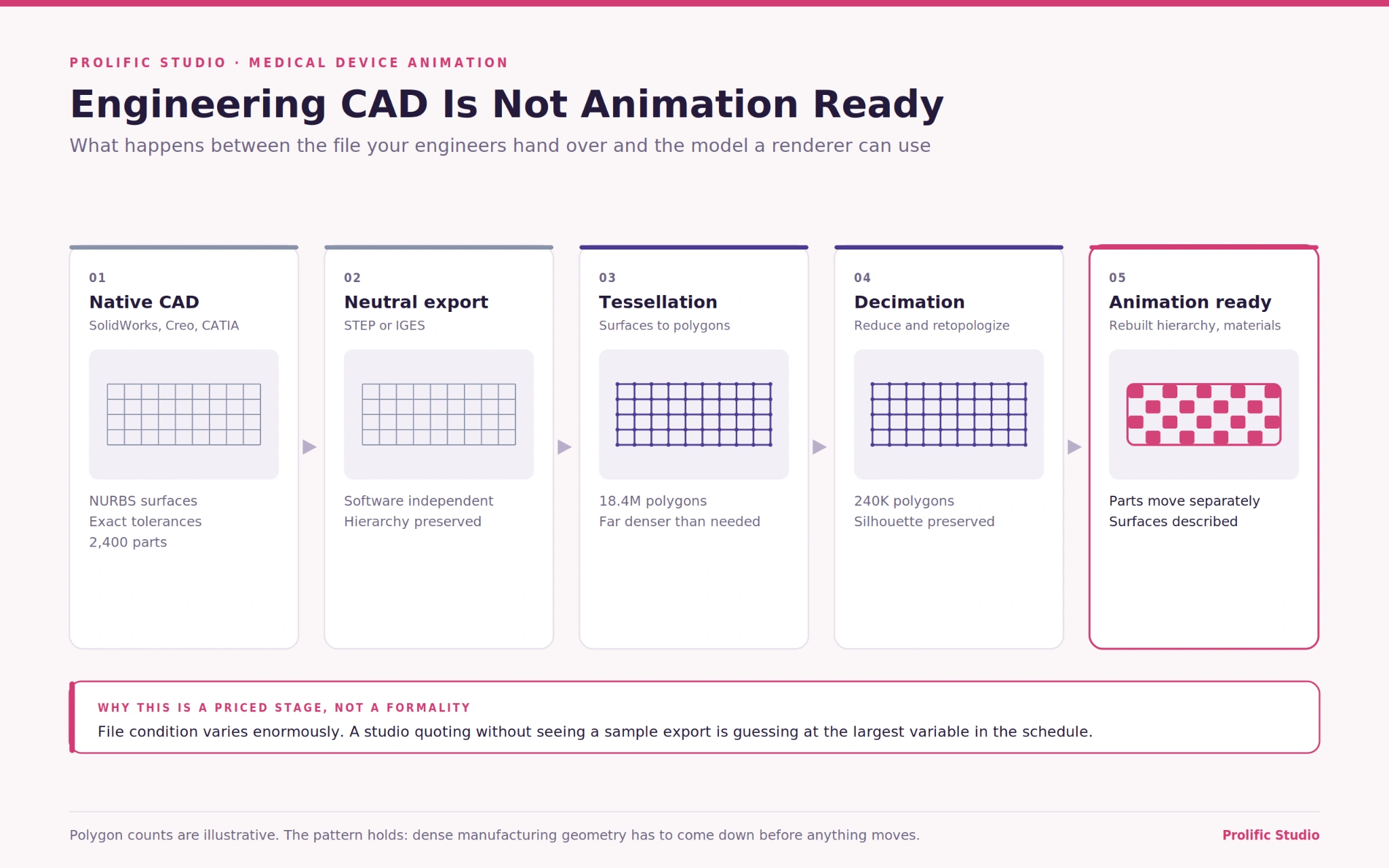
Engineering CAD is built for manufacturing. It carries exact tolerances, internal components nobody will ever see, fastener threads modeled to spec, and surfaces defined mathematically as NURBS rather than as the polygon meshes animation software works with. A single assembly can contain thousands of parts and geometry far denser than any renderer needs.
Conversion is a real stage with real cost. It involves exporting to a neutral format, tessellating curved surfaces into polygons at a sensible density, decimating or retopologizing parts that came through too heavy, rebuilding the assembly hierarchy so components can move independently, and stripping internals that will never be visible.
Teams frequently assume this is instant because the model exists. It is not, and a studio that quotes without seeing your files first is guessing. A medical animation studio that asks for a sample export during the quoting conversation is doing the responsible thing.
There is a second problem nobody warns marketing teams about: the device keeps changing. Engineering revisions continue while the animation is in production, and a geometry change at week six means redoing conversion and any shot the part appears in. Agree on a design freeze for the animated revision, or at minimum agree on who tells the studio when something moves.
The Six Formats That Cover Most Commissioned Work
Sorted by what they are for rather than by how they look.
Surgical technique animation. Step-by-step operative sequence, aimed at surgeons and proceduralists. Usually the longest and most detailed.
Deployment or actuation sequence. How the device does its job at the moment it matters, whether that is a stent expanding, a stapler firing, or an implant seating.
Device mechanism animation. How the device achieves its therapeutic effect in tissue over time, which is the device equivalent of a drug mechanism film.
Procurement and value material. Footprint, workflow fit, reprocessing, throughput. Aimed at value analysis committees rather than clinicians.
Training and instructions for use. Correct setup, handling, and technique, often with regulatory content requirements attached.
Patient-facing explanation. What the device is, what it does, what to expect. Our guide on how medical animation helps patient education covers how this differs from the clinical versions.
Most launches need two or three of these, cut from one asset library rather than commissioned separately.
Showing a Device Inside a Body That Is Not Transparent
This is the defining craft problem of the category. The device is opaque, the anatomy around it is opaque, and the interesting part happens where they meet.
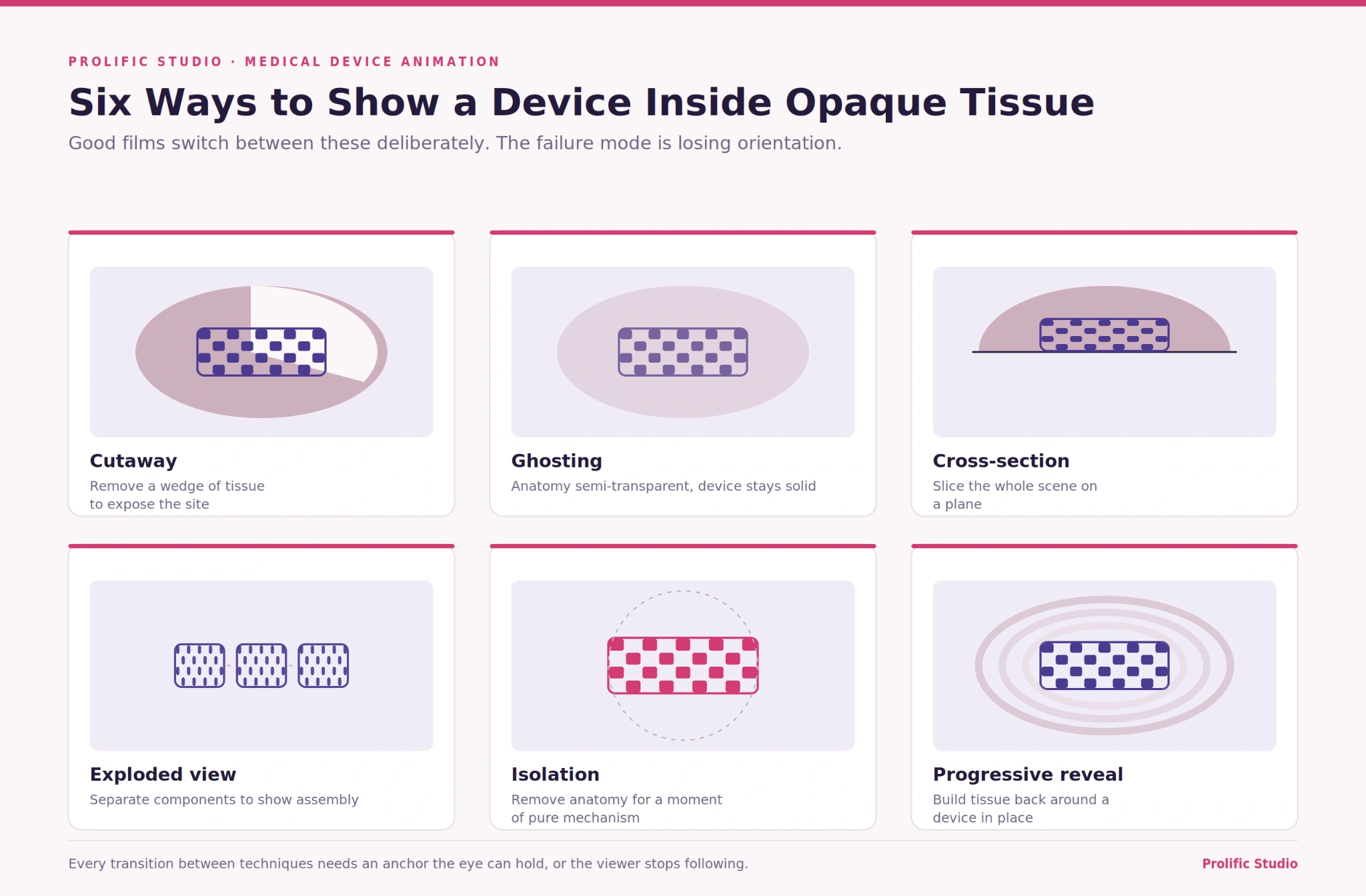
Six techniques do the work, and good films switch between them deliberately rather than defaulting to one. Cutaway removes a wedge of tissue to expose the site. Ghosting renders surrounding anatomy semi-transparent while the device stays solid.
Cross-section slices the whole scene on a plane. Exploded view separates components to show assembly, useful for implants with multiple parts. Isolation removes anatomy entirely for a moment of pure mechanism. Progressive reveal builds tissue back around a device already in place.
The failure mode is losing orientation. A viewer who cannot tell which way is proximal, or what tissue they are looking through, stops following. Every transition between techniques needs an anchor the eye can hold.
Whether a given sequence should be animated or filmed is a separate question, and our comparison of 3D medical animation vs live-action medical video works through where each wins for device content specifically.
Who Actually Watches Device Animation
Five audiences, and they want genuinely different films.
Surgeons and proceduralists want technique and handling. They are evaluating whether they can do this, and they notice immediately when a sequence skips a difficult step. Technique preferences also vary by region and training tradition, so a sequence built around one approach may need an alternate cut for another market rather than a straight translation.
Nurses and technicians want setup, handling, and reprocessing. This audience is chronically underserved and often determines whether a device gets used smoothly after purchase.
Value analysis committees and procurement want footprint, workflow, throughput, and total cost. Mechanism barely registers with them.
Patients want to know what is going inside them and what recovery looks like.
Sales teams and distributors need a version that survives being interrupted mid-conversation on a tablet.
The scale of the sector explains why this fragmentation exists. Industry figures published through MedTech Europe’s market data show a market composed largely of small and mid-sized manufacturers, which means most device marketing teams are small and buying animation without a large internal studio to lean on.
How Device Regulation Differs From Pharma
Different route, different vocabulary, and claim constraints tied to your cleared indications rather than to a drug label.
In the United States, devices are regulated by a separate center from drugs, with market entry running through premarket notification, premarket approval, or a de novo pathway depending on classification and risk. What your animation may claim follows from the indications for use in whichever of those applies.
In Europe, the framework is the Medical Devices Regulation, Regulation (EU) 2017/745, which replaced the previous directives and tightened clinical evidence and post-market surveillance requirements. Anything you publish in European markets falls under it.
Two practical consequences for animation. Instructions for use content carries regulatory requirements that marketing content does not, so decide early which category your film falls into. And comparative claims against another manufacturer’s device attract scrutiny in both regions, so treat them as a regulatory question rather than a creative one.
Your regulatory affairs colleagues own the detail. Bring them in at storyboard rather than at delivery.
What Your CAD Files Need Before Anyone Can Animate Them
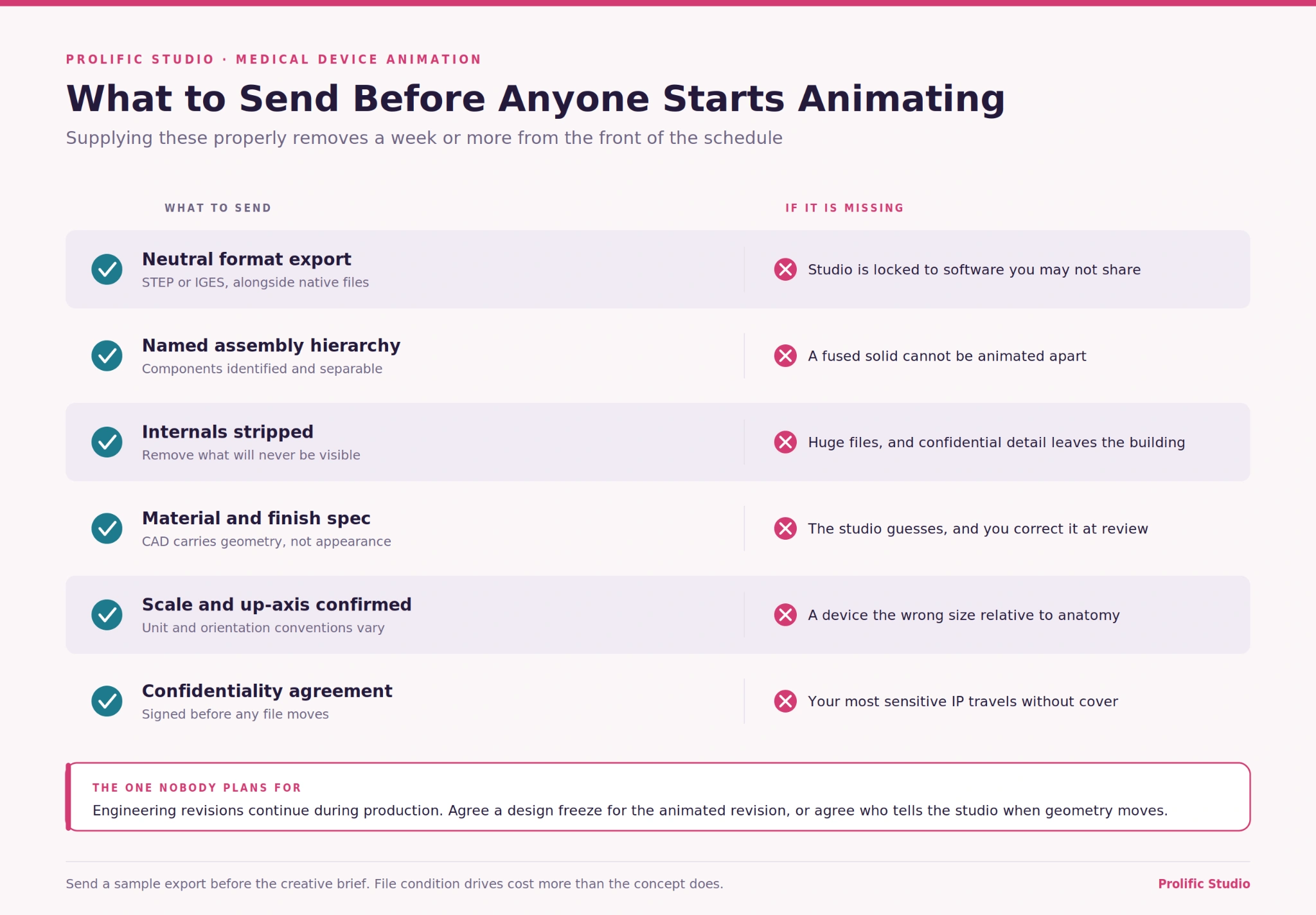
Six things, and supplying them properly removes a week or more from the schedule.
A neutral format export, typically STEP, alongside the native files. Native-only delivery ties the studio to specific software you may not both have.
A named assembly hierarchy, so components can be identified and moved independently. Files exported as one fused solid cannot be animated apart.
Internals stripped where they will never be visible, which reduces file size dramatically and removes confidential detail you may not want leaving the building.
Material and finish specification, because CAD carries geometry but rarely carries how a surface should look.
Scale and orientation confirmed, since CAD units and up-axis conventions vary between packages and a silent mismatch produces a device the wrong size relative to anatomy.
A confidentiality agreement in place first. CAD is among the most sensitive material a device company holds. Any healthcare animation production company working in this space should have a defined process for handling it before you send anything.
Should You Show the Failure Mode?
Usually yes, and it is the single most trust-building decision available in device animation.
The instinct is to show the device working perfectly, repeatedly. Clinicians watching that form a reasonable suspicion, because they know devices are misseated, misdeployed and mishandled, and a film that pretends otherwise is selling rather than teaching.
Showing what incorrect placement looks like, and how to recognize and correct it, does three things. It demonstrates confidence in the product. It answers the question the clinician is actually holding. And it makes the training genuinely useful rather than decorative.
Field safety information exists partly because devices behave unexpectedly in practice. Regulators publish device safety alerts and field safety notices openly, and the UK’s drug and device alerts service is one example of that material being made public. Content that acknowledges this reality reads as more credible, not less.
Discuss it with regulatory before scripting. Depicting misuse has claim implications and should be a deliberate decision rather than a surprise at review.
Combination Products Sit Across Both Worlds
An autoinjector, a metered-dose inhaler, a drug-eluting stent, and a prefilled pen are devices and drugs simultaneously, and animation for them needs both skill sets.
The film usually has to do two jobs. Show the device mechanically, meaning how the mechanism fires, how the dose is delivered, how the patient handles it. Then show what happens pharmacologically once the drug is released, which is molecular work with entirely different source data and different reviewers.
Teams often commission these separately and end up with two films that do not look related. Building them together from one asset library is cheaper and produces a coherent story, but it requires a studio comfortable with CAD conversion and molecular reconstruction in the same project.
Review is also doubled, since drug claims and device claims travel different paths. Our overview of what is pharmaceutical animation covers the drug side of that equation.
What Does Medical Device Animation Cost?
Between $8,000 and $18,000 per finished minute for most device work, with surgical technique and complex deployment sequences at the upper end.
That sits below molecular mechanism work, and the reason is the CAD. Geometry that would take weeks to model from scratch arrives already built, so the modeling stage is a conversion rather than a construction.
Two costs get underestimated. CAD conversion itself, which varies enormously depending on file condition and is genuinely hard to quote blind. And anatomy, since the device may exist digitally but the surrounding tissue has to be built or licensed.
Derivatives are cheap once the library exists. A surgical version, a procurement cut, a patient explainer and a trade show loop all come from the same models. Our medical animation cost guide sets out the ranges across categories.
Final Words
The most useful thing you can do at the start of a device animation project is unusual: send a sample CAD export before anyone writes a creative brief.
File condition determines schedule and cost more than the creative concept does, and a studio that has seen your geometry can quote accurately rather than defensively. It also surfaces problems, like a fused assembly or a missing hierarchy, while they are cheap to fix.
Send us an export and tell us who watches the finished film. Prolific Studio is a video animation agency working across device, mechanism, clinical data, and patient material, and we will tell you what your files need before the schedule depends on them.
Frequently Asked Questions
What is medical device animation used for?
Surgical technique training, deployment and actuation sequences, device mechanism explanation, procurement and value analysis material, instructions for use content, and patient explanation. Most manufacturers commission two or three of these from one asset library.
Can you animate directly from our CAD files?
Not directly. Engineering CAD carries manufacturing detail and mathematical surfaces that animation software does not use. A conversion stage rebuilds the geometry as animation-ready meshes with a working assembly hierarchy.
What CAD format should we send?
A neutral export such as STEP alongside your native files, with the assembly hierarchy named and internals stripped where they will never be visible. Confirm scale and up-axis, because conventions differ between packages.
How is device animation different from pharmaceutical animation?
The source data is engineering CAD rather than published structures, the regulatory route differs, and the central craft problem is showing a solid object inside opaque tissue rather than visualizing molecular scale.
Who should review a device animation before release?
Regulatory, marketing, and at least one clinician who actually uses the device. Add an engineer from the product team, because they will catch geometry and motion errors nobody else sees, such as a component moving in a direction the mechanism does not allow.
How long does a device animation take?
Typically six to ten weeks for a two minute piece, with CAD condition the largest variable. Clean files with a named hierarchy can shave a week off the front of the schedule.
Do we need to show the device failing or being misused?
For training content, usually yes. Clinicians trust films that acknowledge how devices behave in practice. Raise it with regulatory before scripting, since depicting misuse carries claim implications.