
Most science animation made for investors is built as though it will be watched the way the founder watches it: full screen, with sound, by someone paying complete attention. What actually happens is forty seconds on a projector in a room with no audio, followed by the file being forwarded to a scientific advisor you will never meet.
Those two situations demand different things. This is about the second half of the job, meaning how the asset performs once it leaves your hands.
Key Takeaways
- Investors assess two things simultaneously: whether the science is credible, and whether the team can explain it. The film is evidence of both.
- Placement matters more than production value. The right slot is early, after the problem and before the pipeline.
- You get thirty to sixty seconds in a live pitch, not three minutes. Build the short cut first.
- A live-pitch version and a sent-ahead version are two different builds, and the second one has to work with no presenter.
- The data room version gets scrutinized by scientific advisors. It has to survive an expert audience you never speak to.
- Build for a room with no sound and no connection, because that is the room you will get.
- Do not animate your pipeline, your market size or your team. Those slides are worse as video.
What Are Investors Actually Evaluating?
Two things at once, and only one of them is the science.
The first is whether the mechanism is credible. The second, which founders consistently underestimate, is whether the team can explain complex work clearly. A film that lands cleanly signals that you understand your own science well enough to compress it, and that signal travels regardless of whether the viewer can evaluate the biology.
That matters because the room is mixed. Life science funds employ people with doctorates. Generalist and crossover funds frequently do not, and both types sit on the same cap table.
The film is not the pitch. It is a single piece of evidence inside it, and treating it as the whole argument is the most common structural mistake. For the broader commercial case, our piece on how MOA videos help pharma and biotech brands covers what the asset does across a company’s life rather than in one meeting.
Where the Video Sits in the Deck
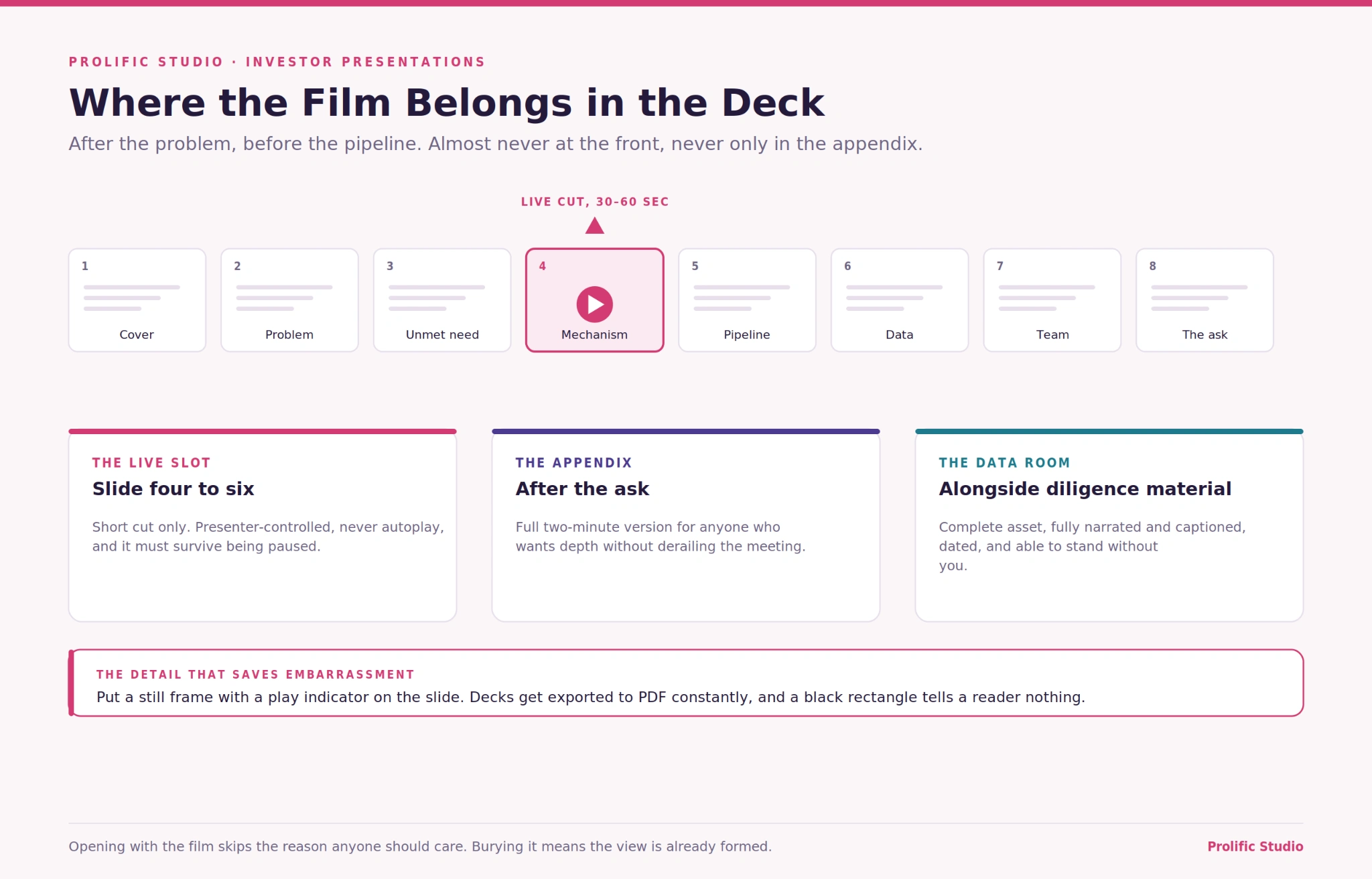
Early, after the problem and before the pipeline. Almost never at the front, and almost never in the appendix alone.
The sequence that works: establish the unmet need, then show the mechanism, then show what you have built on it. Opening with the film skips the reason anyone should care. Burying it after the pipeline means the audience has already formed a view.
Three placements to plan for, because your deck will be used in three ways. The live slot, usually slide four to six, is where the short cut plays. The appendix holds the full version for anyone who wants depth without derailing the meeting. And the data room holds the complete asset alongside supporting material.
One practical note that saves real embarrassment: put a still frame with a play indicator on the slide rather than a black rectangle. Decks get printed and exported to PDF constantly, and a black box tells a reader nothing.
A biotech animation production agency used to fundraising work will ask which of the three placements you need before it asks about visual style.
The Twelve-Minute Pitch Problem
A seed pitch runs ten to fifteen minutes. A demo day slot can be five. Inside that, your science film gets thirty to sixty seconds, not three.
This is where most investor animation fails. A beautifully built three-minute mechanism film cannot be played in a twelve-minute pitch, so the founder either skips it, scrubs through it awkwardly, or talks over it while it runs. All three outcomes waste the asset.
Build the short cut first and treat the long version as the derivative, which is the reverse of how most projects run. Thirty to sixty seconds forces the discipline of choosing one idea, and the one idea is almost always the mechanism rather than the platform breadth.
Keep the long version to two minutes, not four. It exists for the appendix and the data room, where somebody has chosen to go deeper, and even there, attention runs out sooner than founders expect.
Rehearse with the film in place rather than around it. Founders who have only practiced the spoken pitch discover in the room that the video changes their timing, and the recovery is visible. Run the deck end to end at least twice with the clip playing, and know exactly what you say over the top of it.
Live Pitch Versus Sent-Ahead Deck
Two builds from one library, and conflating them produces something that underperforms in both.
The live pitch version supports a founder who is talking. It should be visually led with minimal narration, because you are the narration, and it needs to survive being paused, resumed and talked over. Text on screen competes with the person presenting.
The sent-ahead version replaces you entirely. It needs complete narration, captions for people watching without sound, and enough context that it makes sense to someone who has not heard your introduction. It will also be forwarded, which means it will be watched by people who received no framing at all.
The practical approach is one visual build with two audio and text treatments. That costs a fraction of two productions and keeps the story consistent between the meeting and the follow-up.
A medical animation studio that asks which version you need first is scoping the project correctly, because the answer determines the script rather than the styling.
What Happens in the Data Room
Your film gets watched by people you never meet, under conditions you do not control, by scientists whose job is to find problems with it.
Diligence is where investor animation is genuinely tested. A fund with a scientific advisory board will route your mechanism film to someone with domain expertise, and that person is not evaluating whether it looks good.
They are checking whether the mechanism as depicted matches the literature, whether anything is overstated, and whether the visuals imply certainty the data does not support.
Three things protect you there. Document your sources so a question about a depiction has an answer. Signal visually where evidence ends, and interpretation begins. And keep the data room version dated, since a film showing a discontinued program as active is a diligence problem rather than a stale asset.
Assume the file circulates beyond the fund. It frequently does, and control over that is limited once a link has been shared.
Name a single person who owns the current version. Diligence problems more often come from an outdated file still circulating than from anything wrong with the newest one.
Building for a Room With No Sound and No Connection
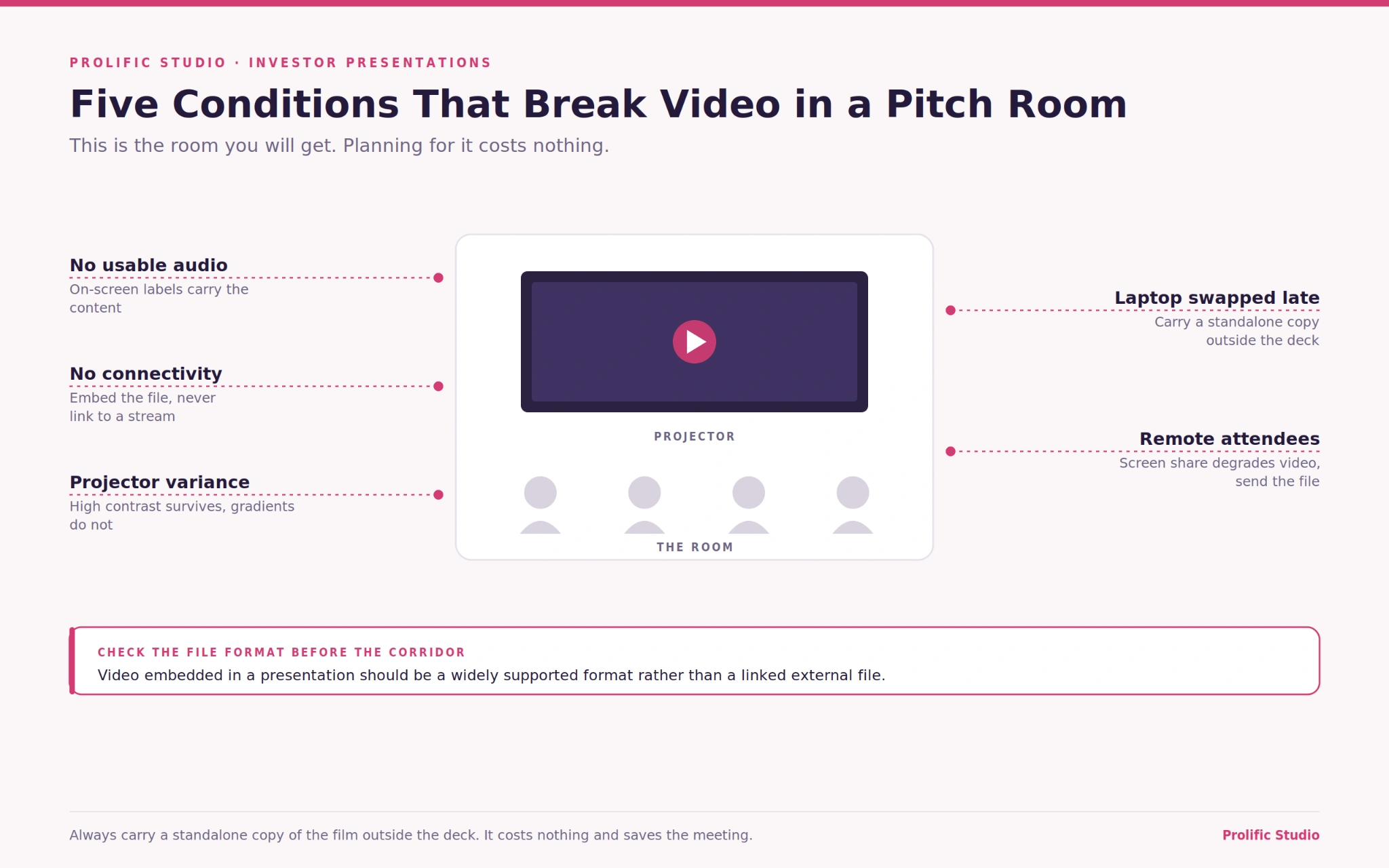
The pitch room is a hostile environment for video, and planning for that costs nothing.
Four conditions recur. Audio is often unavailable or unusable, so on-screen labels have to carry the content. Connectivity is unreliable, so streaming links fail and the file must be embedded locally.
Projector aspect ratios and color response vary wildly, so high-contrast work survives and subtle gradients do not. And laptops get swapped at the last moment, which breaks anything dependent on a specific machine.
The file itself matters more than people expect. Video embedded in a presentation should be a widely supported format rather than a linked external file, and Microsoft’s reference on video and audio formats supported in PowerPoint is worth checking before you finalize the deck rather than in the corridor beforehand.
Test on the actual hardware if you can, and always carry a standalone copy of the film outside the deck.
How Technical Should It Be?
Deep enough that a scientific advisor respects it, clear enough that a generalist follows it. Those are compatible more often than founders assume.
The trick is layering rather than averaging. Build the visual so the mechanism reads correctly at a glance, and let precision live in the labels and the narration. A generalist absorbs the shape of what is happening. A specialist reads the annotations and finds them accurate. Nobody is served by a film pitched at the midpoint, which reads as vague to one group and simplistic to the other.
Two specifics. Name the target and the mechanism class explicitly, because a specialist is listening for those words. And show scale honestly, since molecular crowding and relative size are the details expert viewers notice first.
A useful test before you finalize: show the film to one person with no life science background and one with domain expertise, and ask each what they took away. If the first cannot describe the shape of the mechanism, it is too dense. If the second finds nothing to question, it is probably too vague to be interesting.
Clinical data slides follow their own rules, and animating them badly is a fast way to lose a technical audience. Our piece on how animation explains complex clinical data covers what survives scrutiny.
What Not to Animate for Investors
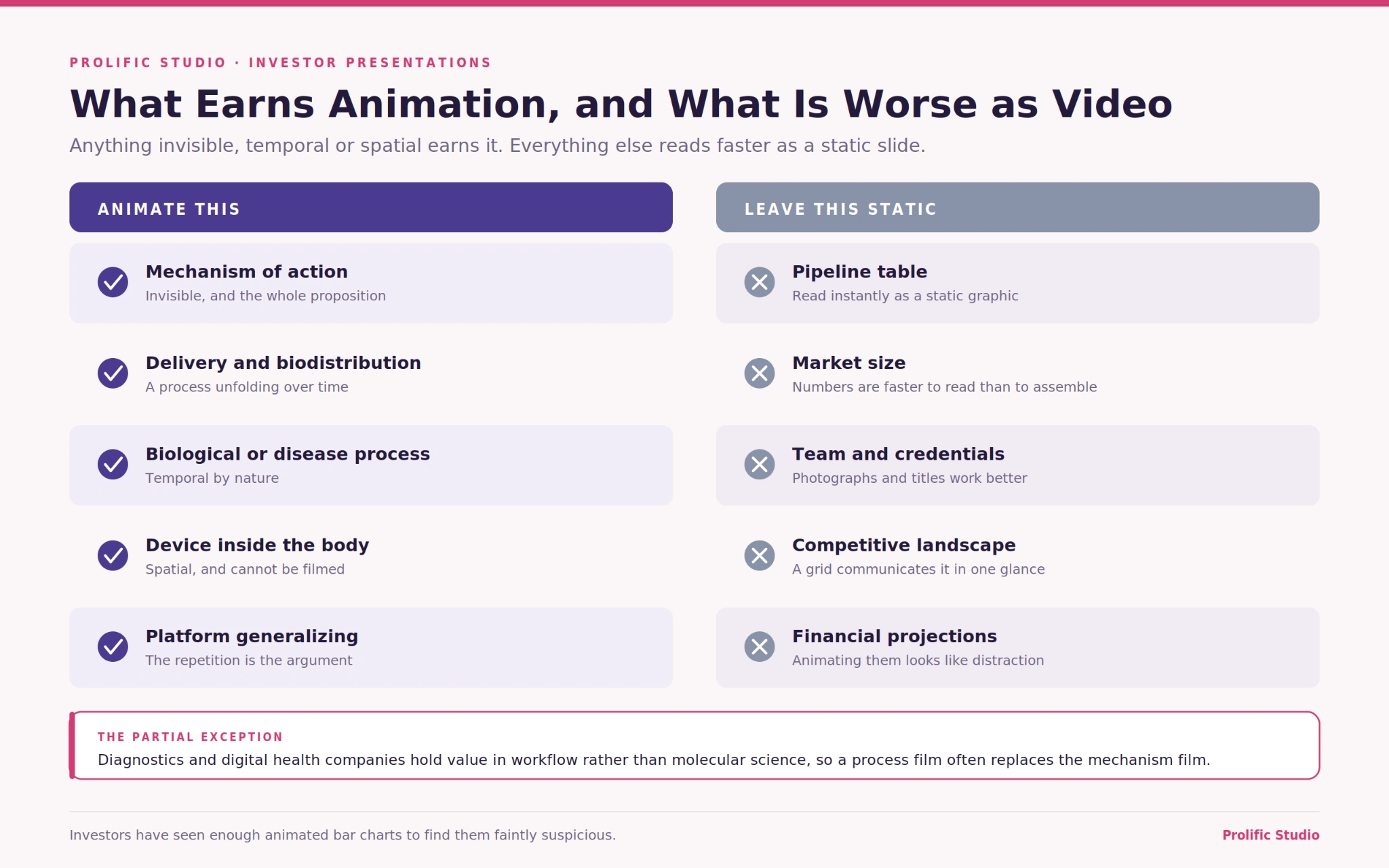
Three things, and animating them is a common waste of budget.
Your pipeline. A pipeline table communicates breadth efficiently as a static graphic. Animated, it becomes a slow reveal of information the viewer could have absorbed instantly.
Market size. Numbers on screen are faster to read than numbers that assemble themselves. Animation adds seconds and no comprehension, and investors have seen enough animated bar charts to find them faintly suspicious.
Your team. Photographs and credentials work better. A stylized team sequence reads as production budget spent in the wrong place.
What does earn animation is anything invisible, temporal, or spatial. Mechanism, delivery, biological process, device interaction inside the body.
Companies whose value sits in workflow rather than molecular science, such as diagnostics and digital health, are a partial exception, and providers of healthcare animation services will often build a process film instead of a mechanism one for exactly that reason.
Forward-Looking Content and What It Costs You Later
A film depicting a capability you have not yet demonstrated is a forward-looking statement, and it persists long after the meeting.
The risk is not usually the pitch itself. It is that the asset stays in circulation. A film built at Series A showing an aspirational application gets forwarded, posted, and eventually watched by someone diligencing a later round, at which point the gap between what was depicted and what was demonstrated becomes a question you have to answer.
Public and near-public companies face a further layer, since selective disclosure rules govern what material information can be shared and with whom.
Three practical habits. Distinguish demonstrated from intended visually rather than in a disclaimer. Date every version. And involve whoever handles investor relations at storyboard rather than at delivery, because their objections concern content that is expensive to change late.
What Should It Cost, and When Should You Build It?
A two-minute mechanism film with a short pitch cut runs $30,000 to $70,000, and the right time to commission it is before the raise rather than during it.
The short cut costs very little once the long version exists, which is the argument for scoping both at the outset. Retrofitting a thirty-second version from a finished three-minute film usually means re-timing and re-recording rather than trimming.
Budget for one revision cycle after your first three or four pitches. What confuses investors becomes obvious quickly, and a targeted re-edit is cheap compared with the cost of a film that keeps not landing.
Allow eight to twelve weeks. Founders routinely start this four weeks before a raise and end up with something rushed. Our medical animation cost guide sets out the ranges across categories.
Final Words
Before commissioning anything, write the one sentence you want an investor to say when they describe your company to a partner who was not in the room.
That sentence is the brief. If it needs three clauses and two pieces of jargon, the film has an impossible job, and the problem is the positioning rather than the animation.
Send us that sentence and your timeline. Prolific Studio is an animation production company working across mechanism, platform, clinical data, and device material, and we will tell you what a film can carry and what belongs somewhere else in the deck.
Frequently Asked Questions
Where should the animation go in a pitch deck?
After the problem and before the pipeline, usually slide four to six. Opening with it skips the reason anyone should care, and placing it after the pipeline means the audience has already formed a view.
How long should an investor animation be?
Thirty to sixty seconds for the live pitch cut and up to two minutes for the appendix and data room version. Build the short cut first and treat the long one as the derivative.
What do investors actually do with the file?
Forward it. It gets sent to colleagues, scientific advisors and sometimes beyond the fund entirely, which is why the sent-ahead version needs full narration and enough context to stand alone.
Should the film play automatically during a pitch?
No. Keep it presenter-controlled so you can introduce it, pause it and resume after a question. Autoplay removes your ability to manage the room.
Do we need different versions for different investor types?
Usually two versions rather than several. Layer the content so a generalist follows the shape and a specialist finds the labels accurate, which serves both without building separate films.
Can we reuse the investor film for other audiences?
Partly. The visual build transfers well to conference, website and recruitment use. What does not transfer is the script, since an investor version is arguing that the science is credible while a scientific audience already accepts that and wants specificity instead.
When should a startup commission investor animation?
Eight to twelve weeks before the raise begins. Commissioning during a live process means the asset arrives after the meetings where it would have mattered most.