An MOA film usually gets justified in a budget request as “we need to explain the mechanism.” That is true, and it is not a business case. What the asset actually does depends heavily on who owns it. A Series B biotech is buying credibility with people who cannot evaluate the science themselves.
A commercial-stage pharma brand is buying message consistency across several hundred people who repeat it daily. Those are different purchases. Here is what the film does in each case, and how to tell whether it worked.
Key Takeaways
- Biotech buys an MOA film for credibility with investors and partners. Pharma buys it for consistency across a field force. Same asset, different job.
- The job changes with company stage, from fundraising through partnering to field enablement and market defence.
- An MOA film displaces recurring costs: repeated verbal explanation, rebuilt slide decks, and drift in how the science gets described.
- Value compounds. The second indication and the fifth market cost a fraction of the first build.
- Measure what the audience does next, not how many people pressed play.
- An MOA film is the wrong investment when the mechanism is the least interesting thing about the product.
- Read a quote against what it replaces over three years, not against the quarter it lands in.
What an MOA Film Is Actually Bought For
Four things, and only one of them is explanation. Credibility, comprehension, consistency, and reuse.
Credibility comes first because it is the hardest to buy any other way. A film that renders a mechanism accurately signals that the company understands its own science well enough to show it, which is a proxy an audience uses whether or not anyone intends them to.
Comprehension is the obvious one. A mechanism that takes twenty minutes to explain verbally takes three minutes to show, and the version on screen does not vary with who is presenting.
Consistency is the underrated one, and for large organisations it is often the largest single benefit. Reuse is the fourth, and it is what turns a one-time cost into an asset.
The craft that delivers all four is covered in our explainer on what mechanism-of-action animation is. This article is about what the finished asset does commercially once it exists.
Why Biotech and Pharma Buy the Same Film for Different Reasons
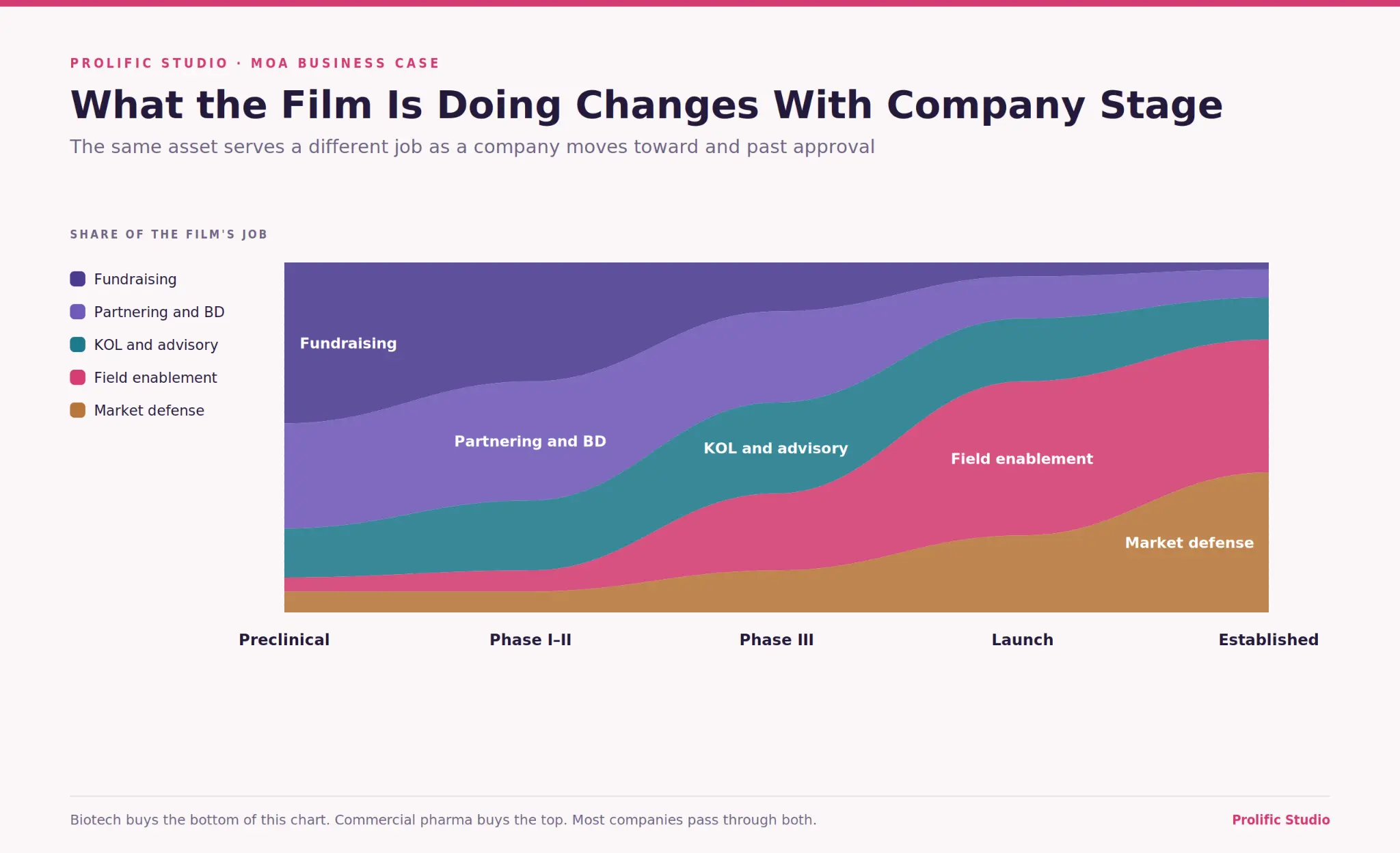
Because their audiences differ, and so does what those audiences are deciding.
A biotech showing an MOA film is usually in front of people making an investment or partnering decision. Some are scientifically trained, and many are not. The film is doing two jobs at once: transmitting the science, and demonstrating that the team can articulate it clearly. Investors read the second signal even when they think they are only evaluating the first.
A commercial-stage pharma brand is in front of prescribers who can evaluate the science perfectly well. The film is not proving competence; it is compressing time and holding a message steady across every channel and every representative.
That difference changes the build. Biotech films tend to run longer, go deeper, and end on the platform rather than a single asset. Pharma films run tighter, carry approved claims, and end on the indication.
A mechanism of action animation studio that asks which of those two situations you are in before discussing style is asking the question that determines everything else.
Why Do Investors Ask for an MOA Film?
Because a platform is difficult to evaluate from a slide, and the people writing cheques know they are being asked to fund something they cannot see.
The sums involved make the question reasonable. Industry R&D investment runs into the tens of billions annually across Europe alone, as EFPIA’s published industry figures set out, and an investor allocating against that backdrop is trying to judge whether a specific mechanistic claim is credible.
Three specific places the film earns its cost. In the data room, where a mechanism video sits alongside the deck and gets watched by analysts who will not read the supplementary science.
At an analyst day or healthcare conference, where you have minutes and a room that includes generalists. And in partnering conversations, where a business development team at a large pharma company has to take your science back to their own scientists.
That last one matters more than people expect. Your film becomes the artefact that travels internally at the counterparty, and it will be watched by people you never meet.
Build it to survive that journey. No presenter narration, no references to a live audience, and no dependency on a deck that will not travel with it. A film that only works when its creator is in the room is worth a fraction of one that does not.
Explaining a Platform to People Who Are Not Scientists
A platform story is harder to tell than a single-asset story, and animation is the format that handles it best.
The problem with platforms is abstraction. A company with a delivery technology or a targeting approach is claiming that one mechanism generalises across multiple diseases, and that claim is invisible in text. A film can show the same mechanism operating in three different contexts in ninety seconds, which is an argument no slide makes as well.
Two decisions separate the platform films that work. Show the mechanism once, properly, before showing it generalized. And resist the temptation to show all five programmes, because the audience remembers the mechanism, not the pipeline table.
Keep the claims defensible. Investors are not bound by promotional rules, but a mechanism overstated in a fundraising film has a way of resurfacing later. Providers of scientific animation video services working with pre-commercial biotech should be asking what stage of evidence each claim rests on.
Message Consistency Across a Field of Several Hundred
This is the largest and least visible benefit for commercial-stage pharma. Several hundred people explaining a mechanism in their own words produces several hundred slightly different mechanisms.
Drift is gradual, and nobody reports it. A representative simplifies one step for a busy clinician; that simplification works, it gets repeated, and within two quarters part of the field is describing something the label does not support. Nobody made a decision to do that.
A film fixes the reference point. It does not stop anyone from paraphrasing, but it gives everyone the same source to paraphrase from, and it gives training a concrete artefact to test against rather than a narrative to remember.
The same asset does the same work for medical science liaisons in scientific exchange, though it needs to be chaptered rather than linear so they can answer a specific question. Our guide on pharmaceutical animation for HCP education covers how those clinician-facing versions differ.
What Does an MOA Film Displace?
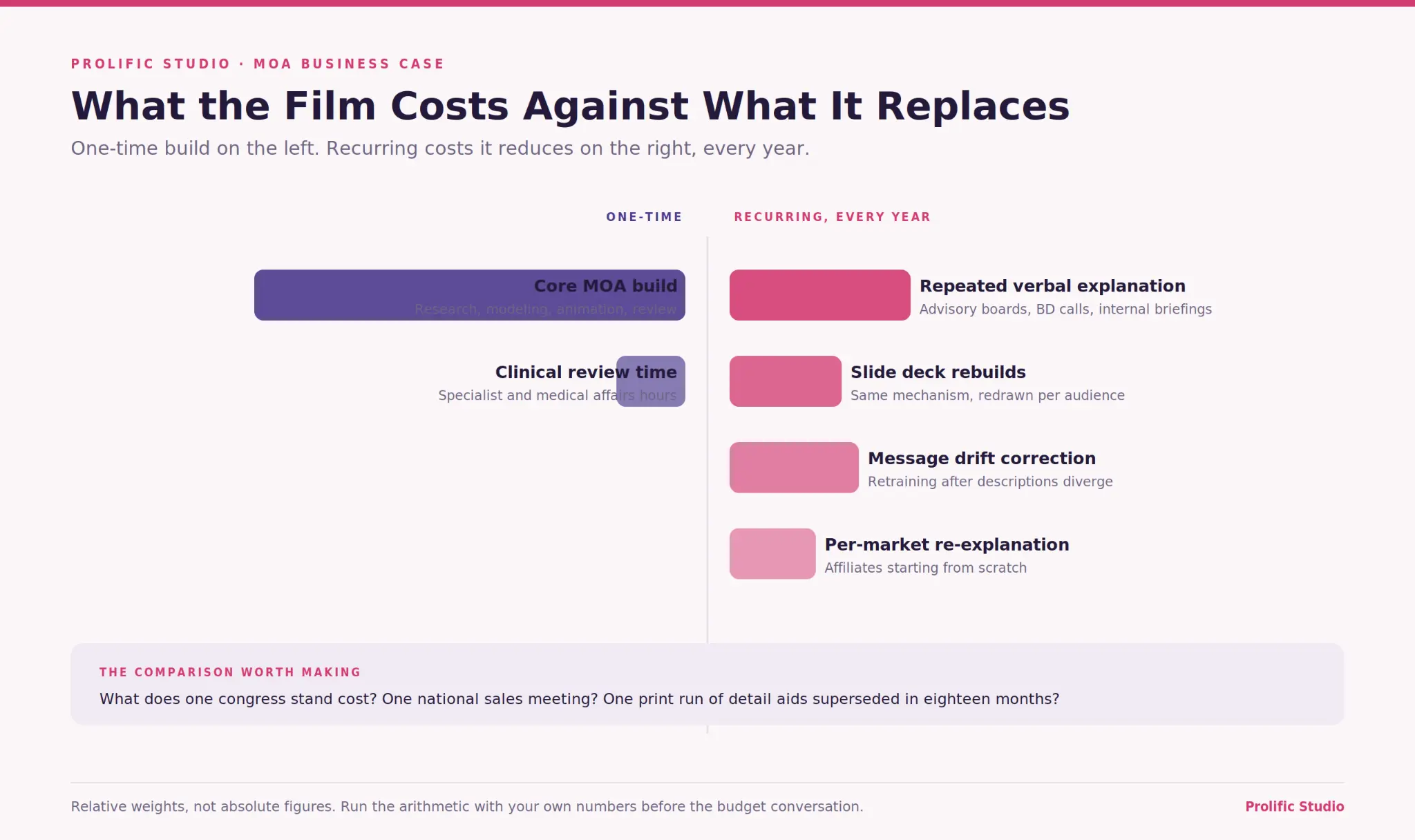
Recurring cost that nobody has ever added up. Repeated verbal explanation, rebuilt slide decks, and the internal time spent re-establishing the same science for each new audience.
Consider what is being compressed. Drug development typically spans well over a decade of work before approval, as the NIH’s National Center for Advancing Translational Sciences describes, and every new stakeholder who arrives has to be brought up to speed on the mechanism at the centre of it.
Without a film, that happens through repetition. A medical director explains it at an advisory board. A representative explains it in a call. Someone rebuilds the mechanism slides for a different audience with slightly different emphasis. Each instance is small and none appears as a line item.
The film does not eliminate that work. It changes the starting point, so the conversation begins after the mechanism rather than with it.
That shift is worth quantifying roughly before you commission. Count the meetings each quarter that open with a mechanism explanation, multiply by the seniority of the people sitting through it, and you will usually find the displaced cost is a larger number than anyone assumed.
How the Value Compounds Across Indications and Markets
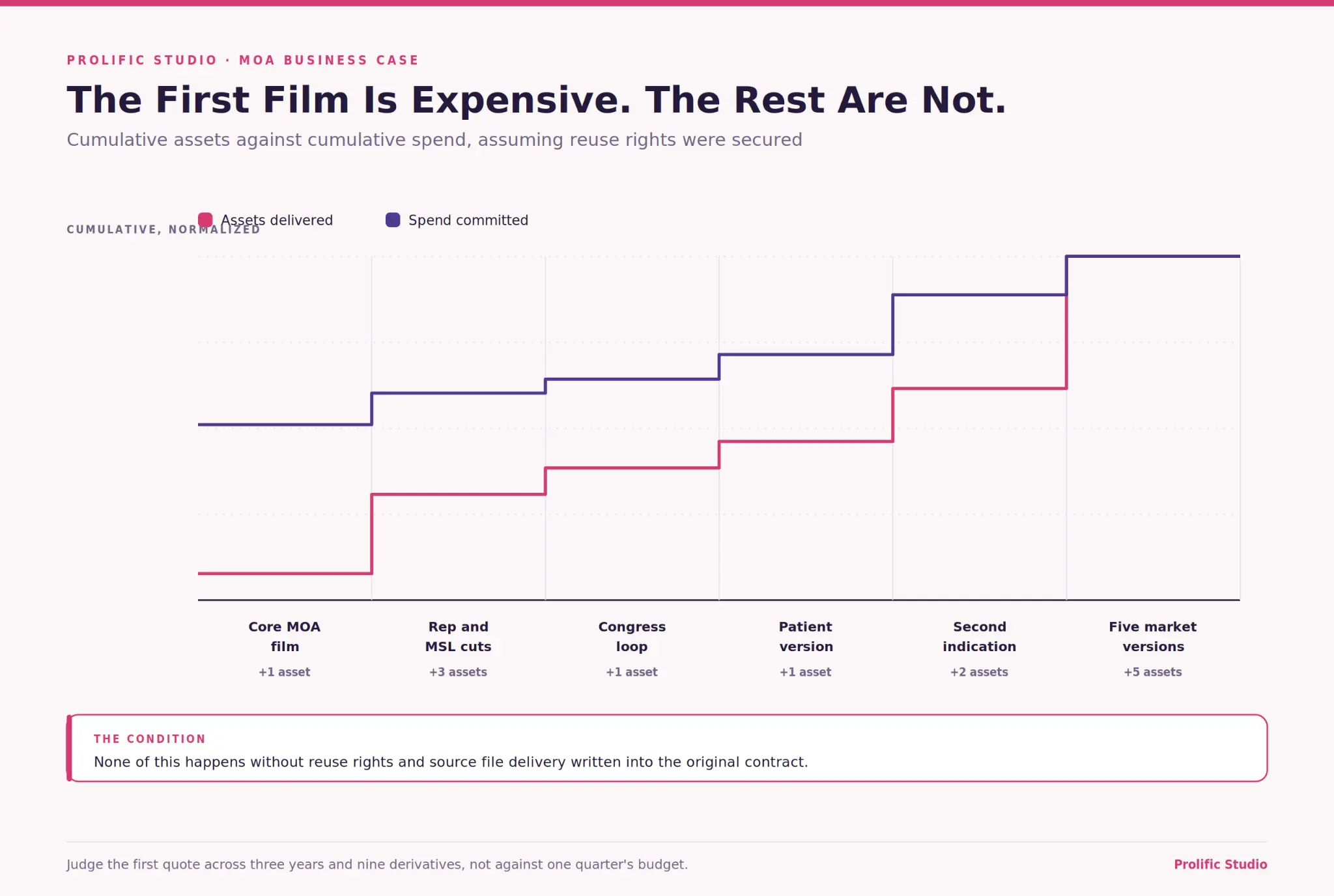
The first film is expensive. Everything after it is not, provided the contract gave you the models and scene files.
A second indication is typically a re-edit rather than a rebuild, commonly landing 30 to 40 percent below the original. A new market is a voiceover and a text layer. A rep version, a chaptered MSL cut, a congress loop, and a patient simplification are all derivatives of the same library.
Run the arithmetic over three years rather than one. A film that looks expensive against a single quarter’s budget looks different against nine derivative assets, two indications and six markets.
The condition attached to all of this is contractual. Reuse rights and source file delivery have to be in the original agreement. A pharmaceutical animation production company that hands over models and project files at delivery is offering something materially different from one that hands over an MP4.
What Can You Actually Measure?
What the audience does next, rather than how many people pressed play. Views tell you distribution worked, not that anything changed.
For biotech, the signals are behavioural and small in number. Whether the film gets forwarded internally at a counterparty. Whether the questions in a second meeting have moved past the mechanism. Whether analysts describe the platform accurately in their notes. None of these are dashboards, and all of them are observable.
For pharma, the signals are more countable. Representative confidence before and after the sales meeting. Message playback accuracy from field coaching. Chapter completion in the eDetail. Unaided mechanism recall in a post-congress survey.
Both sides should track one thing in common: the questions that keep coming back. A recurring question is a scene that failed, and it is fixable in a re-edit rather than a rebuild.
Set a baseline before release. Almost nobody does, and it is the cheapest measurement decision available. Ten minutes of asking three colleagues to describe the mechanism unprompted, recorded before the film exists, gives you something to compare against later.
When an MOA Film Is the Wrong Investment
Three situations, and recognising them protects the budget and the relationship.
When the mechanism is not the differentiator. If your product competes on formulation convenience, dosing schedule or price, the mechanism film answers a question nobody is asking. A mode of delivery film may be the right commission instead, and our comparison of MOA animation vs MOD animation covers how to tell.
When the mechanism is genuinely contested. A film that has to hedge every step communicates uncertainty rather than confidence. Wait for the evidence, or build a mechanism-of-disease film that does not depend on the disputed part.
When there is no distribution plan. An MOA film with no owner, no channel, and no date is the most expensive unused asset in this category. Name all three before commissioning.
There is a fourth, quieter case. If nobody internally can state in one sentence what the film should change, the film is not ready to be briefed.
Reading a Quote Against What It Replaces
A $50,000 MOA film is expensive against a quarterly line item and modest against the programme it supports.
Context helps here. Pharmaceutical spending accounts for a substantial share of total health expenditure across developed economies, and the OECD’s pharmaceutical spending indicator puts the scale of that market in perspective.
Against a product expected to generate revenue at that scale, the mechanism asset is a rounding error that a surprising number of programmes still underfund.
The comparison worth making is internal rather than external. What does one congress stand cost? One national sales meeting? One round of printed detail aids that gets superseded in eighteen months?
Our medical animation cost guide sets out the per-category ranges and the line items that tend to appear after the quote is signed.
Final Words
Before the budget conversation, write one sentence describing what should be different after the film exists. An investor asks better questions. A field force describes the mechanism the same way. A partner’s scientists get up to speed without a call.
That sentence determines the length, the depth, the audience and the measurement. Without it you will get a film that is technically accurate and commercially inert.
Send us that sentence and your stage. Prolific Studio’s animation services cover mechanism, delivery, clinical data, and clinician-facing work, and we will tell you what the asset needs to do and whether animation is the right way to do it.
Frequently Asked Questions
How do MOA videos help biotech companies specifically?
Mainly through credibility with investors and partners. The film transmits the science and simultaneously demonstrates that the team can articulate it, which is a signal audiences read whether or not it was intended. It also travels internally at a counterparty long after your meeting ends.
Do MOA animations have measurable ROI?
The inputs are measurable even when a single attributable revenue figure is not. Track representative confidence, message playback accuracy, recurring questions and derivative assets produced. Treat any vendor quoting a universal ROI multiple with caution.
How long does an MOA film stay useful?
Three to five years typically, and longer if reuse rights were secured. Updates are usually driven by label changes, new indications or new markets rather than by the animation dating.
Should a pre-revenue biotech spend on an MOA film?
Often yes, and earlier than expected. Fundraising and partnering are exactly the situations where explaining an invisible mechanism to a mixed-expertise audience matters most.
What is the biggest hidden benefit for large pharma?
Message consistency across the field. Drift in how several hundred people describe a mechanism is gradual, unreported and expensive to correct once it has spread.
How early should a biotech commission one?
Usually before the raise rather than after it. The film is most useful in the conversations that decide whether funding happens, and commissioning it afterwards means paying for an asset whose highest-value window has already closed.
Can one MOA film serve investors and prescribers?
Not well. Investors are assessing whether the science is credible; prescribers already accept that and want clinical specificity. Build one asset library and cut two versions from it.
Related Articles
- What is Pharmaceutical Animation? An In-Depth Guide
- How Clinical Data Animation Explains Complex Clinical Data
- Drug Launch Video Strategy for Pharma Marketing