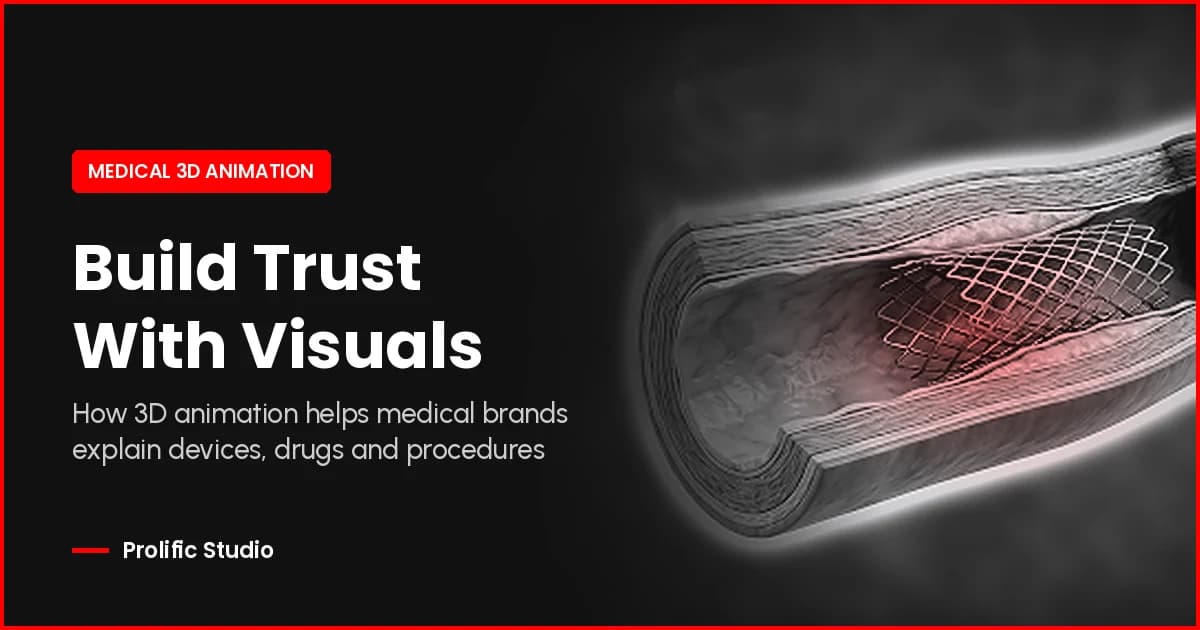
Healthcare brands build trust by showing precisely how a product works, and 3D medical animation is one of the most obvious ways to do that. If you can’t see it working in the body, it is hard to know how effective a pacemaker or a cancer drug is. Animation makes that visible to everyone who has to say yes, from a nervous patient to a skeptical investor.
This guide talks about why trust is so hard to build in healthcare and how animation helps. Then it looks at real brand examples, projects we’ve worked on, and what 3D medical animation costs.
Why Trust Is Hard to Win in Healthcare
Medical companies start with a credibility gap that most industries don’t face:
- People are cynical about what they hear. More than half of people regret at least one health decision they made based on misinformation, according to Edelman’s 2025 Trust and Health Barometer, which surveyed over 16,000 people in 16 countries.
- Most adults have difficulty with health information. Dense leaflets and clinical jargon lose most readers, since only 12 percent of Americans have proficient health literacy, the U.S. Surgeon General’s office reports.
- Regulators are closely watching claims. In September 2025, the FDA said it sent about 100 cease-and-desist letters and thousands of letters to drug companies about misleading drug ads.
- Investors and doctors have heard lots of big promises that didn’t pan out. They want to see the mechanism for themselves before they endorse a device or prescribe a drug.
Struggling to explain how your product works?
Our medical 3D animations make it clear in one watch.
- Show what happens inside the body, step by step
- Give sales teams a demo that works in any meeting
- Help patients understand their treatment before it starts
How 3D Medical Animation Earns That Trust
When people know what they are signing up for, they trust more. Animation helps them get there in a few different ways:
- More understanding. In a systematic review published in Frontiers in Digital Health in 2022 of 38 trials of animated patient information, 19 of 30 studies that measured knowledge reported better results with animation compared with standard materials. Understanding comes first, then trust.
- It provides accuracy people can verify. A good animation starts with CAD (computer-aided design) files and imaging data. Clinicians review the animation against published research before anyone outside the company sees it. Cardiologists will know if a valve leaflet moves the wrong way, and getting it right shows the company knows its science.
- Small or hidden things become visible. Modern implants are only a few millimeters in length and the drugs act on cells that no one can film. You can’t take a camera in there. Animation can do.
- It keeps the message the same. One set of 3D assets can feed both a patient video and the animated sequence in an investor deck, so all audiences hear the same story.
- It can clearly show risk. Showing where a device sits, how it’s placed, and what recovery involves is more convincing than polished claims, and it’s easier to stay within FDA rules on fair balance.
Pharma companies follow the same approach for mechanism-of-action videos, which we discuss in more detail in our article on 3D medical animations in pharmaceutical marketing.
Real Brands Using 3D Medical Animation
Medtronic: Micra Leadless Pacemaker
Medtronic says Micra is 93 percent smaller than traditional pacemakers and about the size of a large vitamin capsule. That’s a really tough idea to swallow until you see it. The Micra patient animation shows the device sitting inside the heart, with no leads and no chest incision, which answers the first question most patients ask.
Boston Scientific: WATCHMAN FLX
WATCHMAN FLX Product ANIMATION – Boston Scientific
The WATCHMAN device has been implanted in more than 600,000 patients, Boston Scientific said. The device closes off the left atrial appendage, a small pouch inside the heart where the company says more than 90% of clots form in people with non-valvular atrial fibrillation. Most patients have never heard of the pouch. The WATCHMAN FLX product animation shows how the implant opens and closes in seconds.
Abbott: MitraClip
Minimally-Invasive MitraClip™ Therapy: How Does It Work?
Abbott’s MitraClip fixes leaky mitral valves without open-heart surgery. The company said in 2023 that it has treated more than 150,000 patients with the device. An animation of the MitraClip procedure portrays the clip grabbing the valve flaps together. A patient thinking about having a procedure: animation makes the risk real, not something abstract.
If you have your own product launch coming up, our post on how 3D medical device animation helps product launches outlines where these videos fit in a launch plan.
Medical Animations We’ve Produced for Our Clients
Our own medical work is according to the same principle of accuracy first.
For Glaukos, we produced a 3D product demo of the iDose TR, a micro implant that lowers intraocular pressure for glaucoma patients. Normal product footage wouldn’t show its design, so we relied on close views and slow, controlled camera moves, carefully lit so that every surface read clearly. At Glaukos, a number of teams, including its board, reviewed every frame prior to sign-off. That’s common in the medical field, which is why we build review time into the schedule from day one.
The Bausch + Lomb project was hard in another way. We built a surgical training visualization for an ophthalmic system still in the concept and approval phase, so finishes and parts of the workflow were changing. The final video shows clinical teams how to set up the machine and connect the tubing, step-by-step, and we still got it delivered ahead of the deadline.
We animated a walkthrough of Kaiser Permanente’s pop-up eye care clinic. It follows one patient from online sign-up to glasses selection, replacing pages of written instructions with one clear story.
What 3D Medical Animation Costs
Medical animation is not cheap and costs more than most product animation as accuracy needs specialist time. The following figures are taken from published sources:
| Source | What it covers | Figure |
| Our 3D animation cost guide | Healthcare and medical animation, 1 to 2 minutes | $15,000 to $50,000 |
| Same guide | Worked example: 90-second medical visualization | About $27,000 over 12 weeks |
| Clutch | Average video production project (client reviews) | About $42,280 |
| U.S. Bureau of Labor Statistics | Median pay for U.S. animators | $49.06 an hour |
| Upwork | Freelance 3D animator rates | $20 to $60 an hour |
Built for MedTech, pharma and healthcare teams
- Mechanism of action
- Medical device demos
- Surgical procedures
- Patient education
- Regulatory presentations
Sales demos for hospital buyers, investor decks or patient content, we script, storyboard and animate it in one place.
Factors Affecting 3D Medical Animation Cost
- Your price won’t be based on one thing, but a few choices will determine most of it. A film of a cellular mechanism of action with protein structures takes longer than a device demo built from CAD files.
- Photorealistic tissue is more costly than clean, stylized looks. Then there’s the regulatory review. Pharma videos typically undergo medical, legal, and regulatory (MLR) review, and each round adds time. If you’re going to need a patient version and a physician version, plan for both from the start, because re-using the same 3D assets is much cheaper than building them twice.
- One mistake we see often is a team that signs off on the script, then shows the finished animation to its medical director for the first time. Corrections at that stage can mean re-rendering whole scenes. Bring a clinician into the storyboard review instead, when a change costs minutes rather than days.
Show the Science, and Trust Follows
People trust what they understand, and they understand what they can see. 3D medical animation lets your audience watch your product work, with an accuracy that holds up to expert review. Start with the question your audience asks most often, and build your first animation around answering it.
Prolific Studio has produced medical animation for brands such as Glaukos, Bausch + Lomb and Kaiser Permanente, with clinical accuracy checked at every stage. Explore our 3D medical animation services to plan a video your audience will believe.
Struggling to explain how your product works?
Our medical 3D animations make it clear in one watch.
- Show what happens inside the body, step by step
- Give sales teams a demo that works in any meeting
- Help patients understand their treatment before it starts
Frequently Asked Questions
How much does 3D medical animation cost?
A one- to two-minute healthcare animation typically costs $15,000 to $50,000. Complex cellular or surgical scenes and several rounds of regulatory review push projects toward the top of that range.
How long does it take to make a medical animation?
Plan for about 8 to 12 weeks for a 90-second piece. Projects that need MLR review can take longer, sometimes by several weeks.
Who uses medical animation?
Medical device makers, pharmaceutical and biotech companies, hospitals, and health insurers all use it. Common uses include patient education, investor pitches, sales training, and conference presentations.
Does medical animation need regulatory approval?
Promotional animations for prescription drugs in the U.S. must follow FDA advertising rules, including a fair balance of benefits and risks. Most pharma companies won’t release one until it’s passed internal MLR review.
Related Articles: