
Most device sales videos are built for a boardroom and used in a corridor. It runs for four minutes, needs audio, assumes a stable connection, and expects an uninterrupted audience. The rep gets ninety seconds outside a theater, on a tablet, with no signal and a surgeon already walking away.
Content built for the first situation does not survive the second, which is why so much of it sits unused. Here is what actually works in the field.
Key Takeaways
- Build for the corridor. Offline playback, silent comprehension and clean resume points are requirements, not refinements.
- The objection library is the highest-value asset. Short clips mapped to the specific objections that kill your deals.
- Present-with and leave-behind are two different builds. One supports a person talking, the other replaces them.
- Distributors need self-serve depth that direct reps do not, because nobody is there to fill the gaps.
- Device buying is a committee decision, so your reps need assets aimed at people they may never meet.
- Measure adoption before impact. Content nobody opens cannot influence anything.
- Sixty to ninety seconds per clip. The chapter is the unit, not the film.
Where a Rep Actually Plays Video
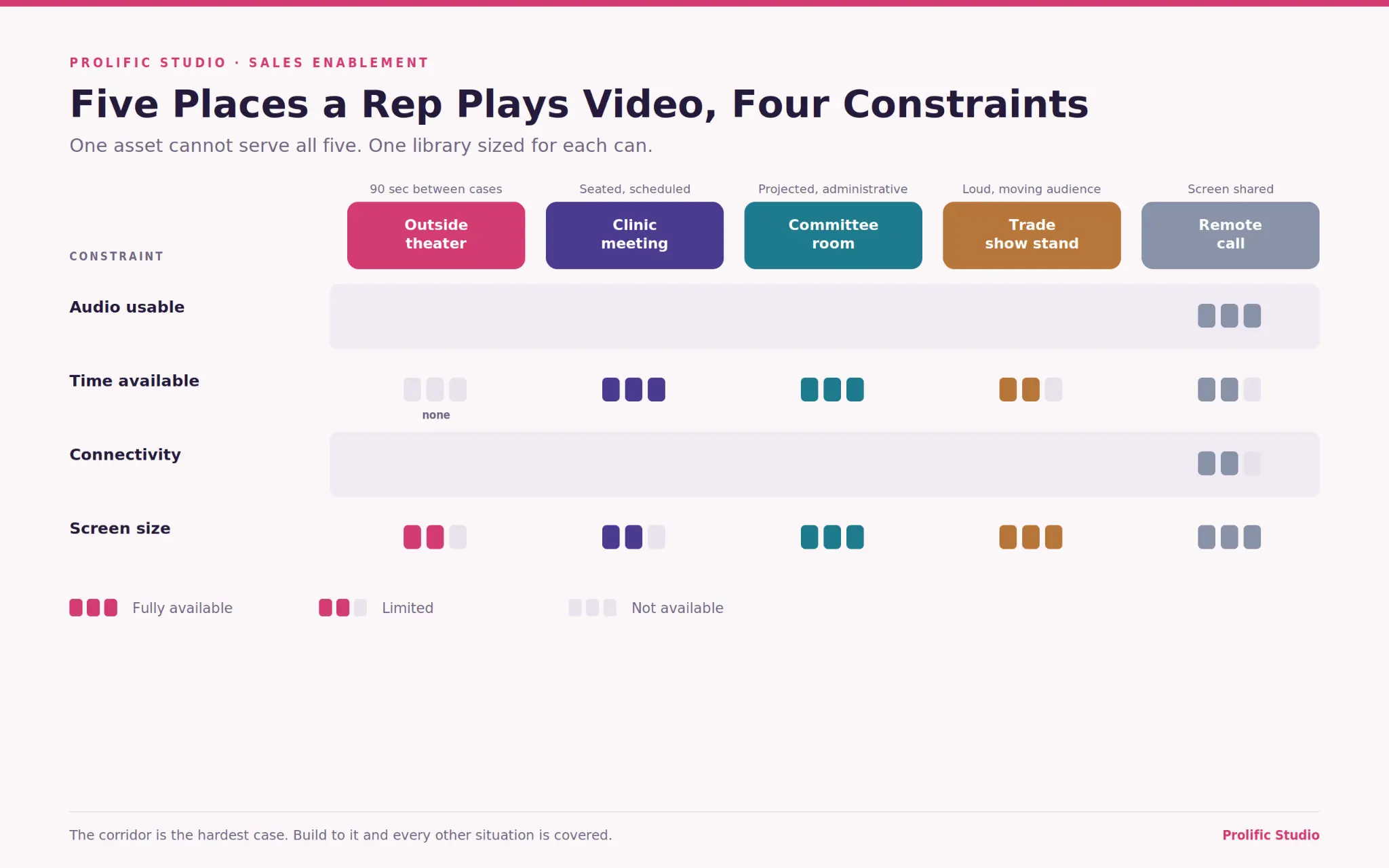
Five situations, and they impose genuinely different constraints. Content that ignores them gets skipped.
Outside the operating room. Ninety seconds or less, tablet, often no usable connection, frequently no audio because the corridor is loud and the rep is not going to hold a speaker up to a surgeon.
A scheduled clinic meeting. Five to fifteen minutes, seated, audio available, and the rep is presenting rather than handing over.
A committee or procurement meeting. Projected, audio available, but the audience is administrative rather than clinical, and the questions are economic.
A trade show stand. Silent, looping, competing with noise and movement.
A remote call. Screen shared, variable connection, and attention that drifts faster than in person.
One asset cannot serve all five. What can serve all five is one library with cuts sized for each. Our guide on how 3D animation helps medical device product launches covers how these assets get sequenced during a launch specifically.
Build for the Corridor, Not the Boardroom
Four requirements follow from the hardest case, and building to them costs almost nothing extra.
It has to play offline. Hospital connectivity is unreliable by design. Guest networks throttle streaming, theaters and basements have no signal, and a rep who has to apologize for a spinning loader has lost the moment. Assets should sync to the device and play locally.
It has to work silent. On-screen labels and captions carry the content. If your film only makes sense with narration, it fails in the environment it was made for.
It has to resume cleanly. Surgeons get called away mid-sentence. Chapters with clear entry points let a rep pick up where the conversation broke rather than restarting.
It has to open fast. A rep browsing a menu while someone waits is a rep who stops using the tool.
These are not preferences. They are the conditions of use, and any provider of medical device animation services building sales content should be asking about them before discussing style.
The Objection Library Is the Highest-Value Asset You Can Build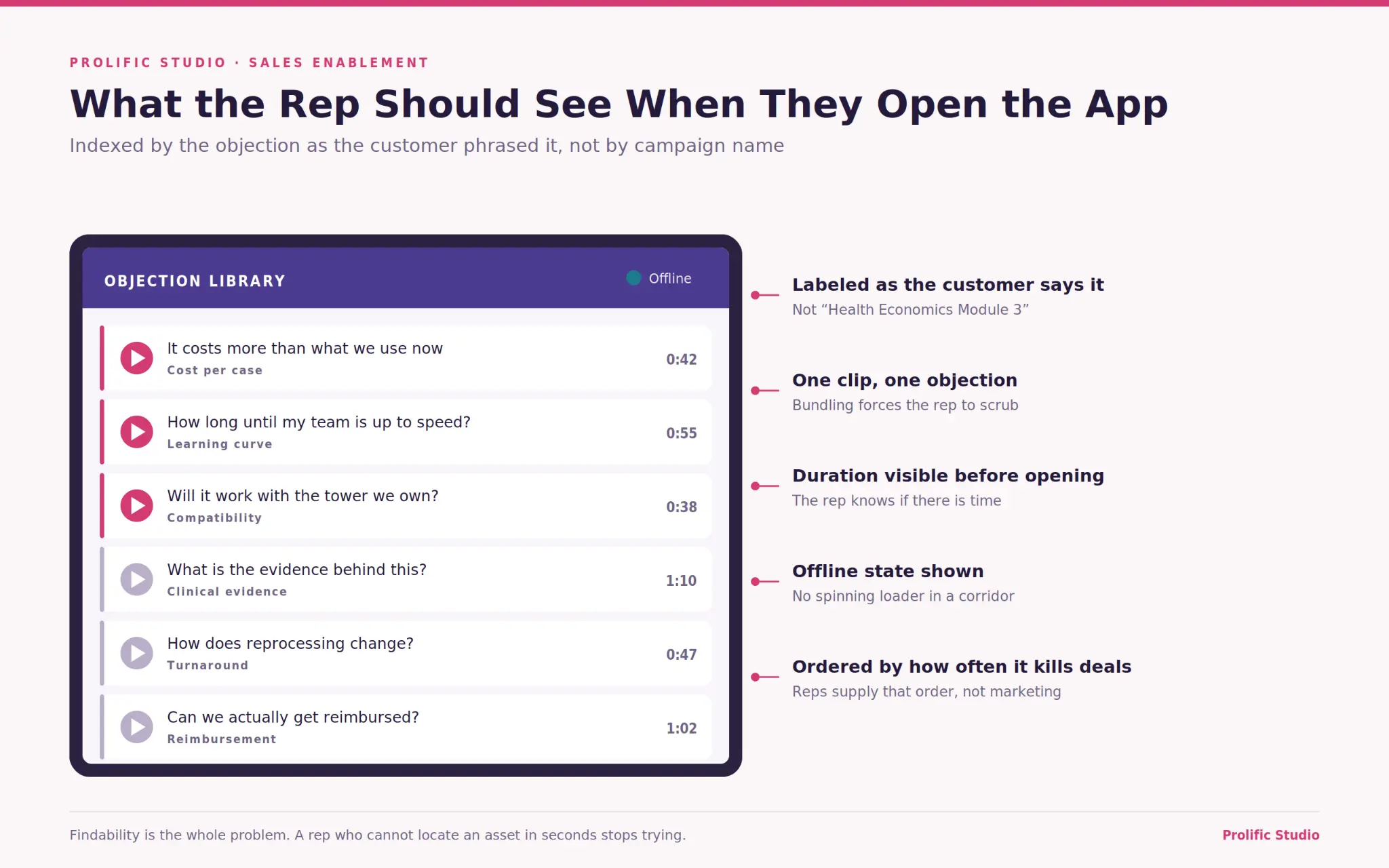
Not the hero film. A set of thirty to sixty second clips, each answering one specific objection your reps hear repeatedly.
Device objections are predictable and largely economic. Cost per case against the incumbent. The learning curve and the cases it will take to get through it. Compatibility with capital equipment already installed. Reprocessing and turnaround time. Strength of the evidence base. Whether the hospital can get reimbursed.
Each of those deserves its own clip, indexed so a rep can find it in seconds while the objection is still live. That is a fundamentally different asset from a linear product film, and it is the one reps actually open.
Build it from the same models as everything else, which keeps the cost low once the core library exists. The category overview in what is medical device animation covers where these formats sit among the rest.
Index it by the words a rep would actually think. Not “Health Economics Module 3” but “It costs more than what we use now.” The label a rep searches under is the objection as the customer phrased it, and naming assets that way removes the translation step that stops people looking.
Get the objection list from the reps, not from marketing. The two lists differ, and the reps’ version is the accurate one.
Why Most Sales Content Never Gets Used
Because it was built for the wrong moment, it cannot be found quickly, or the rep does not trust it to help.
The findability problem is the most fixable. Content buried in folders, named by campaign rather than by use, requires a rep to remember it exists and then locate it under time pressure. Indexing by situation and objection solves most of that.
The trust problem is subtler. A rep who has once played a film that ran too long, or that answered a question nobody asked, will not risk it again. One bad experience in front of a customer removes an asset from circulation permanently.
There is also a structural reason device selling is hard to support. Research from Gartner on the B2B buying journey describes buying groups routinely involving six to ten decision makers, each gathering information independently. Your rep is not in most of those conversations, which means some of your content has to work without them present.
That is the argument for leave-behind assets, which is a different build entirely.
Present-With Versus Leave-Behind
Two builds, two different scripts, and conflating them produces something that underperforms as both.
A present-with asset supports a person who is talking. It should be visually led and light on narration, because the rep is the narration. Long text blocks and a full voiceover compete with the person in the room.
A leave-behind asset replaces that person. It needs complete narration, captions, context the rep would otherwise have supplied, and a clear beginning since nobody is introducing it. It also travels, which means it will be watched by people you never met and possibly forwarded to a committee.
The practical approach is one visual build with two audio and text treatments. That is far cheaper than two productions, and it keeps the visual language consistent.
Whether the leave-behind should be animated or filmed depends on what it has to prove, and our comparison of 3D medical animation vs live action medical video works through that decision.
What Distributors Need That Direct Reps Do Not
Depth, autonomy, and language. A distributor has no clinical specialist to call and often sells several competing lines.
Direct reps get training, case coverage, and a colleague to ask. Distributors get a portal and a price list. Content that assumes the first situation fails in the second, which is why international channel performance so often lags direct territories for reasons that have nothing to do with the product.
Three things close that gap. Self-contained assets that answer questions without a human present. A competitive positioning module, since a distributor carrying four lines will default to whichever is easiest to explain. And genuine localization rather than subtitles, because a distributor presenting in their second language needs the on-screen text in their customer’s first.
Give them the reasoning too, not just the assets. A distributor who understands why the mechanism differs can handle a question you did not anticipate. One who has only been handed a film can answer exactly the questions it covers and nothing beyond.
Companies selling across categories face this doubly. A diagnostics or combination product portfolio may need device and biotech animation services drawn from one library, so the channel gets a consistent story across a mixed bag of products.
How Do You Get It Onto the Rep’s Tablet?
Through an enablement platform with offline sync, version control, and usage tracking. Email attachments and shared drives fail on all three.
The requirements are specific. Assets have to sync in advance and play without connectivity. Superseded versions have to disappear automatically, because a rep showing last quarter’s claims is a compliance problem rather than an inconvenience. And you need to see what actually gets opened.
Packaging matters technically. Content intended to work without a connection has to be delivered as local files rather than streamed, following the same principle behind offline-capable web applications that the W3C service workers specification sets out for the web.
Whatever platform you use, test it in a hospital rather than in the office. Guest network restrictions, blocked domains, and dead zones are the actual environment, and content that works on corporate wifi proves nothing.
Keeping Reps Inside Approved Content
Reps under pressure improvise, and improvisation is where compliance problems start.
The common failure is not deliberate. A rep screenshots a slide, builds a personal deck, adds a comparison from memory, and now an unapproved claim is circulating with your logo on it. This happens because approved content did not answer the question fast enough.
Two fixes work together. Make the approved version easier to reach than the improvised one, which is a findability problem again. And build clips for the questions reps are actually improvising around, which you can identify by asking them what they add.
Industry codes govern how device companies interact with healthcare professionals, and the AdvaMed Code of Ethics sets expectations in the US market that your commercial and compliance teams will interpret for your situation. Comparative claims deserve particular care, since a rep repeating a comparison verbally carries the same weight as printing it.
What Should You Measure Beyond Views?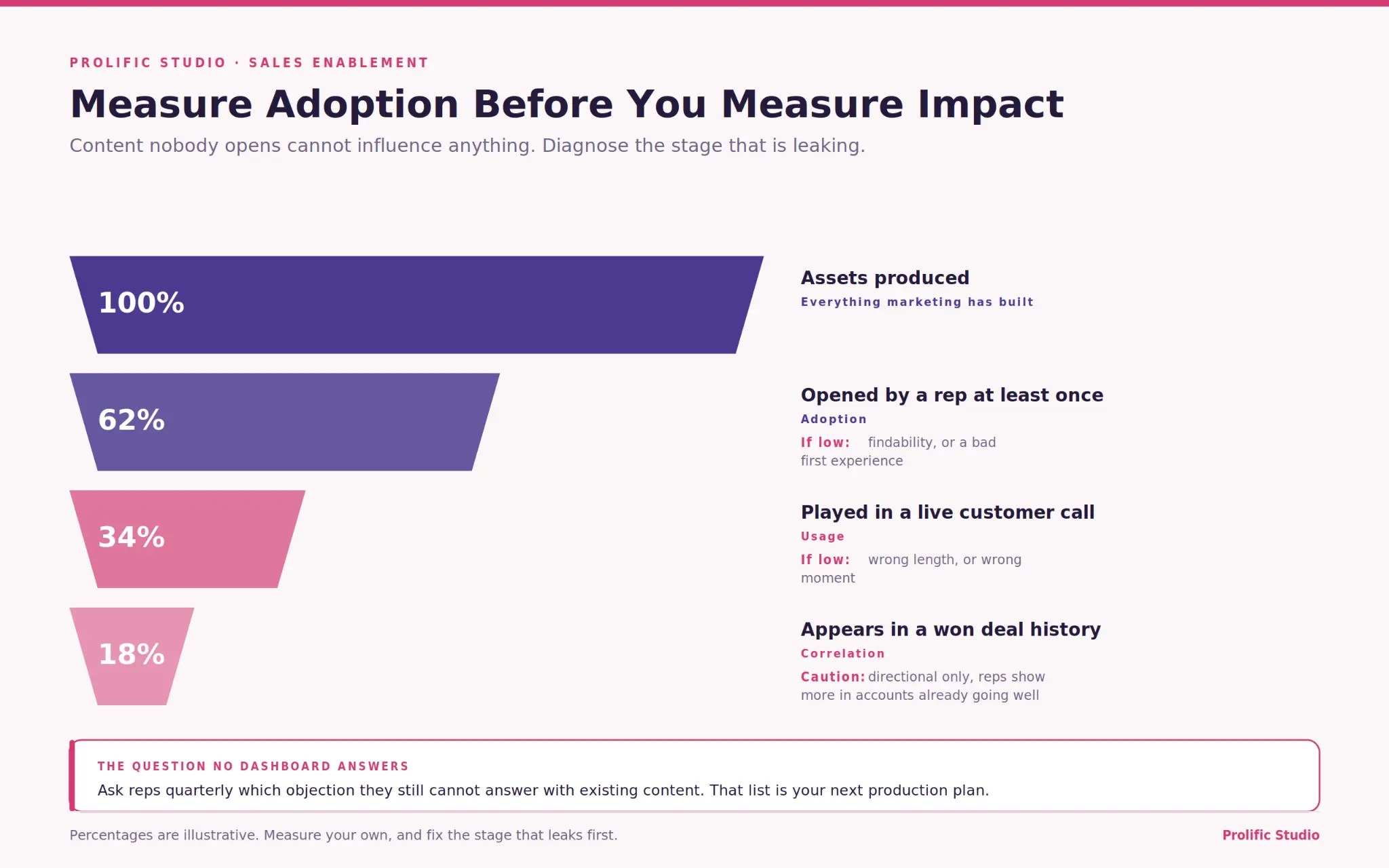
Adoption first, then usage, then correlation. In that order, because each depends on the one before it.
Adoption is the share of reps who have opened an asset at all. If that number is low, nothing downstream matters, and the cause is almost always findability or a bad first experience.
Usage is how often it gets played in a live call, which asset gets opened most, and where playback stops. A clip abandoned at twelve seconds is answering the wrong question.
Correlation is which assets appear in the account histories of won deals. It is not proof of causation and it is still the most useful signal you will get. Treat it as directional. Reps show more content in accounts that are already going well, so the arrow runs both ways and anyone presenting this as return on investment is overreaching.
Add one qualitative loop. Ask reps quarterly which objection they still cannot answer with existing content. That question generates your next production list more reliably than any dashboard. A medical animation production company working on enablement should be asking to see that list before proposing anything.
How Long Should Each Clip Run?
Sixty to ninety seconds for most, with the corridor case capped nearer forty-five and the committee case allowed to run longer.
The working rule is one clip, one question. A clip that answers the cost-per-case objection should answer only that. Bundling three objections into one three-minute film means a rep has to scrub to find the relevant part, which they will not do in front of a customer.
Trade show loops run twenty to forty seconds and restart cleanly. Present-with assets can run longer, because a person is pacing them. Leave-behind assets sit around ninety seconds, since nobody is there to sustain attention past that.
Total library size matters less than indexing. Thirty well-indexed clips beat five long films, and they cost less to update when the product revises.
Per-minute pricing sits in the usual device ranges, and our medical animation cost guide breaks down what drives the number.
Final Words
The most useful hour you can spend before commissioning sales content is sitting with four reps and asking one question: which objection do you lose to, and what do you currently say?
Their answers will not match the marketing message map. They will be more specific, more economical, and more about the incumbent than about your product. That gap is the content brief.
Send us that list. Prolific Studio is an animation studio working across device, mechanism, clinical data, and patient material, and we will tell you which of those objections a video can genuinely answer and which need a different tool.
Frequently Asked Questions
What video content do device sales reps actually use?
Short clips answering specific objections, indexed so they can be found in seconds. Long linear product films get opened far less often, because the moment a rep needs them rarely allows four uninterrupted minutes.
How long should a medical device sales video be?
Sixty to ninety seconds for most situations, closer to forty-five for anything used outside a theater, and twenty to forty for a trade show loop. One clip should answer one question.
Do sales videos need to work without audio?
Yes. Corridors are loud, reps rarely play sound in front of a customer, and captions plus on-screen labels have to carry the content on their own.
What is the difference between present-with and leave-behind content?
Present-with supports a rep who is talking, so it stays visually led and light on narration. Leave-behind replaces the rep, so it needs full narration, captions, and context the rep would otherwise supply.
Why do reps stop using sales content?
Usually because they could not find it quickly, or because it once failed in front of a customer. One bad experience removes an asset from circulation permanently, so findability and length discipline matter more than production value.
Should sales content be animated or filmed?
Animation for anything showing the device inside the body or a mechanism a camera cannot reach. Filmed material for handling, scale and anything where a real clinician on camera carries more weight than a render. Most sales libraries end up with both, cut from one project.
How do we support distributors differently from direct reps?
Give them self-contained assets that work without a clinical specialist present, a competitive positioning module, and genuine localization rather than subtitles. Distributors carrying several lines default to whichever is easiest to explain.