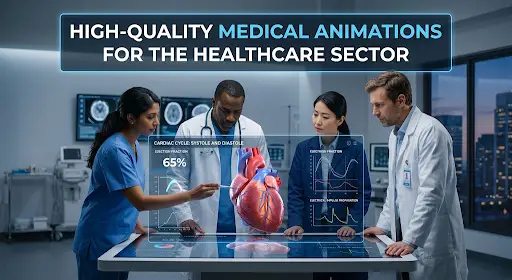
Mechanism education is justified as “clinicians want to know how it works.” That is true, and it undersells the case badly. Clinicians do not learn a mechanism because it is interesting.
They learn it because mechanism is the tool they reason with when the patient in front of them was not in the trial, when an adverse event appears that nobody warned them about, and when the drug fails and something has to come next. That is the argument for funding it.
Key Takeaways
- Mechanism is not background knowledge. It is the reasoning tool clinicians use when trial data runs out.
- Four decisions depend on it: patient selection, adverse event anticipation, interaction reasoning, and what to try after failure.
- Novel modalities create an urgent gap, because most prescribing clinicians were trained before these mechanisms existed.
- First-in-class products need far more mechanism education than best-in-class, because there is no existing mental model to attach to.
- Animation occupies a specific niche: fast comprehension of spatial and temporal processes. It does not replace the literature.
- Test whether clinicians can predict and apply, not whether they can recall. Recall questions flatter the video.
- The specialties that need this most are the ones absorbing new modalities fastest.
What Clinicians Actually Do With Mechanism Knowledge
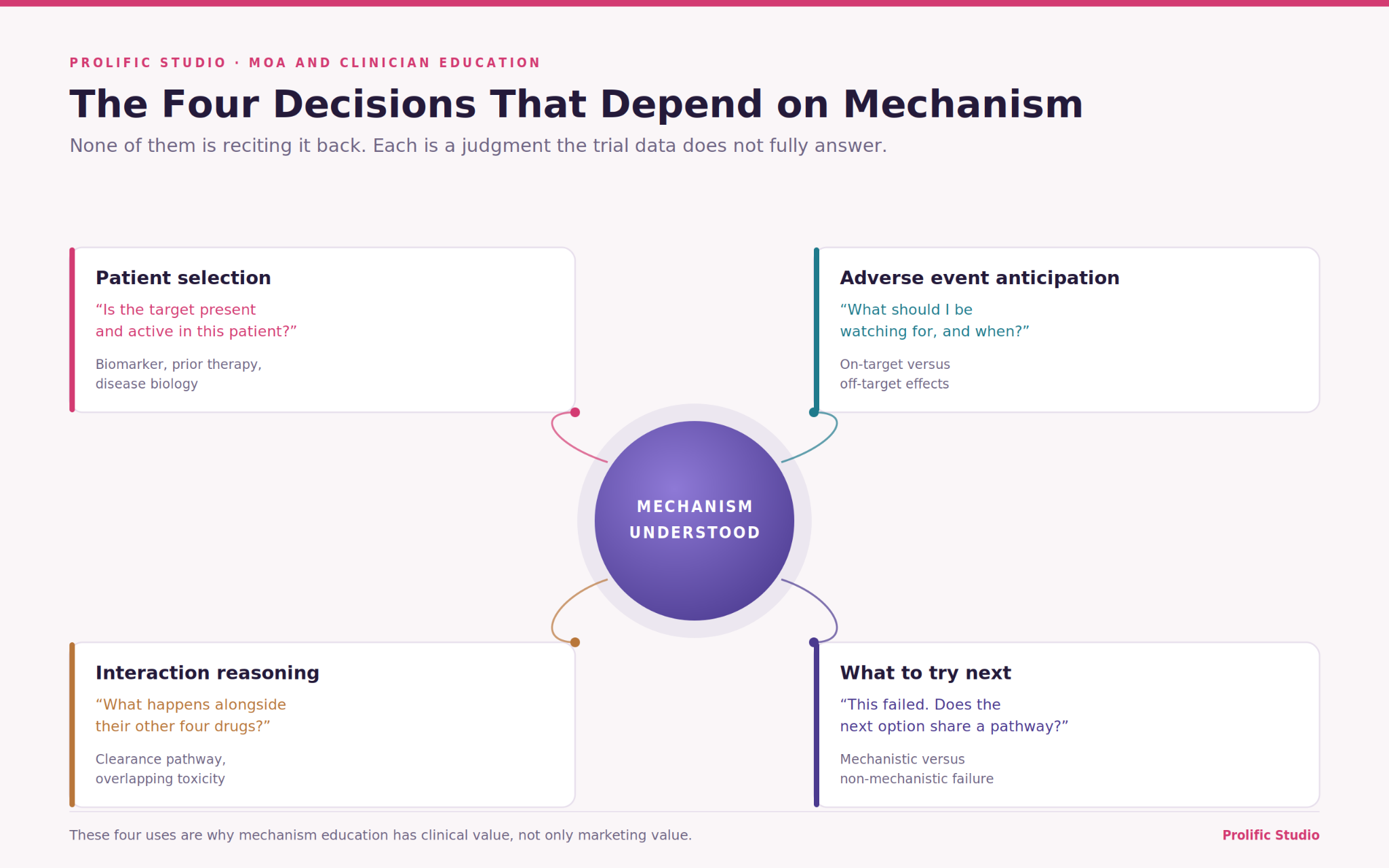
Four things, and none of them is reciting it back. Mechanism gets used as an input to decisions that trial data does not fully answer.
Patient selection. Whether a specific patient is likely to respond depends on whether the target is present and active in that patient. Biomarker thresholds, prior therapy, disease biology. Mechanism is what turns an inclusion criterion into clinical judgment.
Adverse event anticipation. Understanding what a drug engages tells a clinician what might go wrong and where to look for it first.
Interaction reasoning. Metabolic pathway, protein binding, overlapping toxicity with concomitant medication. Much of this is reasoned from mechanism rather than looked up.
What to try next. When a therapy fails, the choice of what follows depends on whether the failure was mechanistic. A patient who progressed through one pathway inhibitor may or may not be a candidate for another.
Those four uses are the reason mechanism education has clinical value rather than only marketing value. Our explainer on what a mechanism of action animation is covers the deliverable itself.
Mechanism Is How Clinicians Reason About Patients Not in the Trial
Most patients are not trial patients. They are older, they have comorbidities, they take four other medications, and their organ function sits outside the inclusion criteria.
A clinician facing that patient cannot look up the answer, because the answer was never studied. What they do instead is reason from what they understand about how the drug works, how it is cleared, and what it engages. Mechanism is the bridge between a controlled trial population and the person in the room.
This is the argument that carries weight with medical affairs, and it is rarely the argument a brand team makes. A film that explains mechanism well is not a promotional nicety. It is equipping a prescriber to make decisions in situations your trial did not cover.
It also sets a standard. If your mechanism film simplifies to the point where it cannot support that reasoning, it has failed the clinical purpose even if it tests well on recall. The same discipline applies to trial data, which our piece on how animation explains complex clinical data covers in detail.
Why Do Novel Modalities Create a Mechanism Gap?
Because most prescribing clinicians completed training before these mechanisms existed, and the gap is widening rather than closing.
Consider what has entered practice recently. Antibody-drug conjugates, bispecific T-cell engagers, chimeric antigen receptor T-cell therapy, radioligand therapy, RNA-based agents, gene therapies. A clinician who qualified twenty years ago learned pharmacology built around small molecules and monoclonal antibodies. These modalities do not behave like either.
This is where animation earns its place most clearly. A modality with no analogy in existing clinical knowledge cannot be explained by comparison. It has to be shown.
How Mechanism Understanding Changes Adverse Event Management
It converts a surprise into an expected finding, which changes how quickly a clinician acts.
The distinction clinicians work with is between on-target and off-target effects. On-target toxicity follows from the drug doing exactly what it is designed to do, in the intended tissue or in another tissue that also expresses the target. Off-target effects come from something else entirely.
A clinician who understands the mechanism can often place a new symptom in the first category immediately.
That matters for speed. Immune-related events with checkpoint inhibitors, cytokine release with T-cell engaging agents, the reason step-up dosing exists at all: each is predictable from mechanism, and recognizing it early changes management.
The scale of adverse event reporting gives some sense of why recognition matters. The World Health Organization’s global pharmacovigilance database, maintained through the Uppsala Monitoring Centre, holds tens of millions of individual case safety reports, and the value of any single report depends on a clinician recognizing what they are seeing.
A mechanism film that ends at binding has skipped the part that helps here.
Why First-in-Class Needs More Mechanism Education Than Best-in-Class
Because a best-in-class product can borrow an existing mental model, and a first-in-class product has none to borrow.
When a clinician encounters the fourth agent in a known class, mechanism education is largely differentiation. They already understand the class and want to know what is different about this one. A short, comparative treatment does the job.
A first-in-class agent is a different problem. There is no shelf in the clinician’s head to put it on. The education has to build the shelf first, then place the product on it, and that takes a genuinely deeper film.
Budget should reflect that asymmetry and often does not. Teams launching novel mechanisms frequently spend the same on mechanism education as teams launching a fourth-in-class, and then wonder why uptake is slow among clinicians who never formed a clear picture.
If you are launching something genuinely new, a mechanism of action animation services company should be proposing a longer, deeper build than the category average rather than the same two-minute template.
Where Animation Fits Among Journals, Congresses and Peers
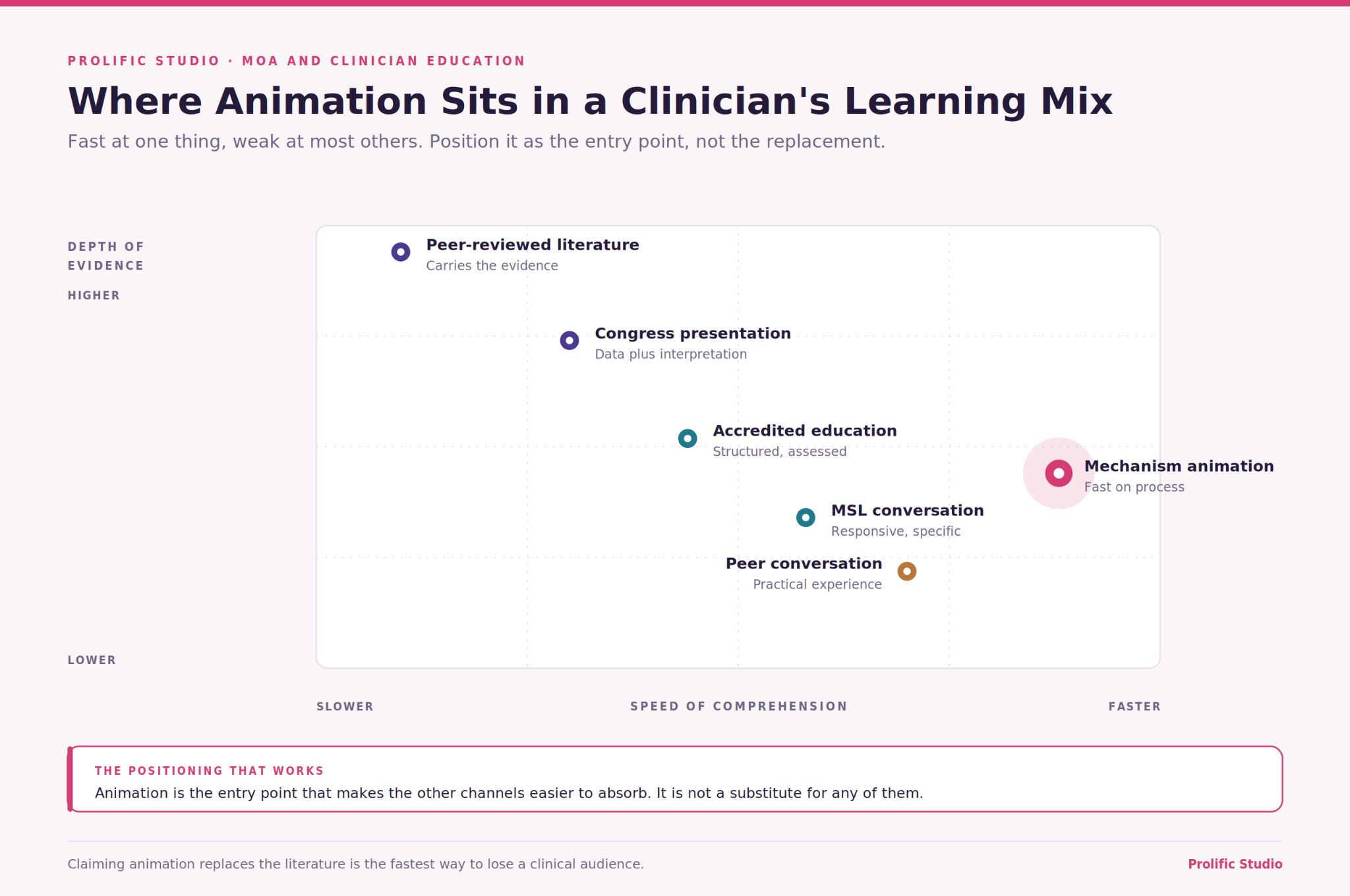
It occupies one specific niche: rapid comprehension of spatial and temporal processes. It is weak at almost everything else clinicians need, and being honest about that is what earns it a place.
Peer-reviewed literature carries the evidence and the methods. Nothing replaces it, and a clinician evaluating whether to change practice will go there. Congress presentations carry data in context with expert interpretation. Peer conversation carries practical experience, which no formal channel supplies. Accredited education carries structured learning with assessment.
Animation is faster than all of them at one thing, which is making a process visible. A mechanism that takes several paragraphs and a figure to describe becomes obvious in forty seconds of well-built animation.
The mistake is positioning animation as a replacement for any of the others. Position it as the entry point that makes the others easier to absorb. Our guide on pharmaceutical animation for HCP education covers how the clinician-facing formats work across channels.
What MOA Animation Cannot Teach
Three things, and claiming otherwise is how credibility gets lost.
It cannot establish efficacy. A beautifully rendered mechanism is a plausibility argument, not evidence of benefit. Clinicians know the difference and resent the conflation.
It cannot convey uncertainty well. Animation is a confident medium. A rendered sequence looks settled whether or not the underlying science is, which is why contested steps need explicit on-screen treatment rather than tidy visuals.
It cannot substitute for practical detail. Dosing schedules, monitoring intervals, dose modification tables. These are reference materials a clinician needs to scan and return to, and video actively prevents that.
Say this out loud in your own materials. A film that acknowledges its limits reads as more trustworthy than one that implies it has answered everything. Providers of healthcare animation services should be telling you which parts of your education plan animation is wrong for.
Teaching Versus Persuading: The Line That Protects Credibility
The same film can educate or promote, and clinicians detect the difference in about fifteen seconds. Which side of the line you land on determines whether the asset is trusted or discounted.
Teaching looks like this. The mechanism is presented completely, including the steps that do not favor your product. Uncertainty is stated. Competitor mechanisms, where relevant to understanding, are described accurately rather than caricatured. The film answers the clinician’s question rather than the brand’s.
Persuading looks like emphasis without balance. The favorable step gets forty seconds and a lighting treatment; the unfavorable one gets four seconds and a wide shot. Nothing stated is false, and the film is still doing something other than educating.
Both have a place, and the mistake is running one under the banner of the other. A promotional MOA film clearly labeled as promotional is fine. A promotional film positioned as education damages the whole program, because clinicians recalibrate their trust in everything else you send them.
The commercial value of the trusted version is higher over time, which our piece on how MOA videos help pharma and biotech brands covers from the business side.
Can Clinicians Actually Use What They Watched?
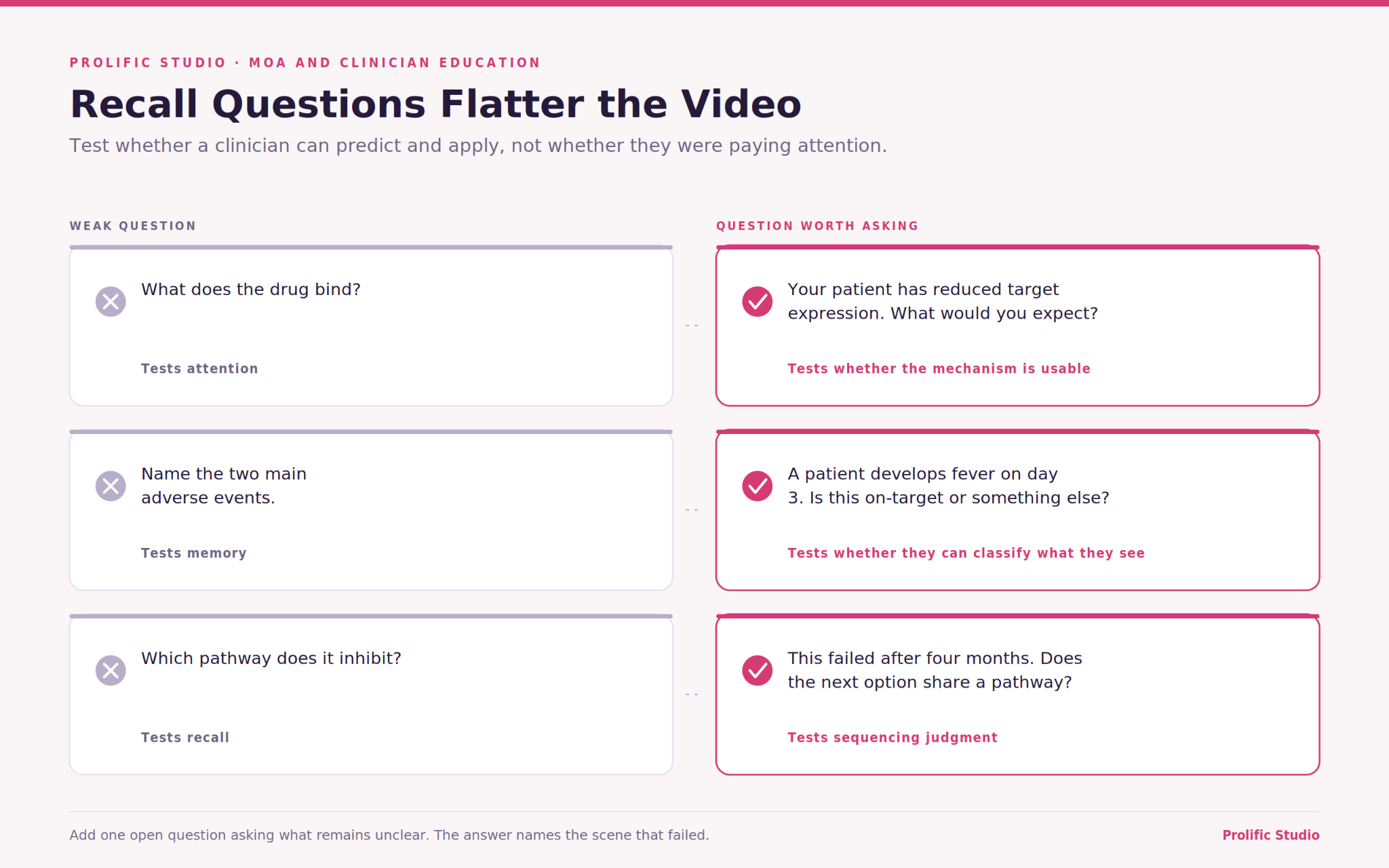
Test prediction and application, not recall. A clinician who can name the target has learned a fact. A clinician who can predict what happens in a specific patient has learned the mechanism.
The difference shows up immediately in how you write the questions. “What does the drug bind?” tests whether they were paying attention. “Your patient has reduced expression of the target and is on a strong enzyme inducer; what would you expect?” tests whether the mechanism is usable.
Three or four applied questions before and after viewing gives you a real signal. Add one open question asking what remains unclear, because the answer names the scene that failed.
Which Specialties Need This Most?
The ones absorbing new modalities fastest, and the ones where mechanism drives sequencing decisions.
Oncology and hematology sit at the top by a wide margin. New modalities arrive continuously, sequencing decisions are mechanistic, and adverse event profiles follow directly from mechanism. Immunology and rheumatology follow, for similar reasons around pathway selection after failure.
Neurology is rising fast as disease-modifying agents arrive in areas that had only symptomatic treatment. Cardiology has a large generalist prescriber base, which shifts the need toward broader, simpler mechanism education rather than deeper.
Interventional and surgical specialties are the group most often overlooked. Their equivalent question is mechanical rather than molecular, meaning how a device achieves its effect in tissue, and medical device animation answers it with the same logic applied to a different subject.
Pharmacy deserves a mention too. Hospital pharmacists reason about mechanisms constantly for interactions and handling, and they are rarely given material built for them.
A useful way to prioritize across a portfolio: rank your specialties by how often a prescriber in that field has to make a decision the trial data does not directly answer. The specialties where that happens weekly are the ones where mechanism education changes behavior.
The specialties where protocols cover almost everything need less of it than the budget usually assumes.
Final Words
The strongest mechanism briefs we receive do not open with the science. They open with a clinical reasoning problem: prescribers cannot tell which patients will respond, or they are missing an early adverse event, or they do not know what to do after failure.
Start there, and the film almost writes itself, because you know what it has to enable rather than only what it has to depict.
Send us the reasoning problem and the specialty. Prolific Studio is an animation studio working across mechanism, device, clinical data, and clinician-facing education, and we will tell you what the film needs to carry and how to test whether it worked.
Frequently Asked Questions
Why does mechanism of action matter to prescribers?
Because it is what they reason from when trial data does not cover the patient in front of them. Patient selection, adverse event anticipation, interaction reasoning, and sequencing after failure all draw on mechanism understanding.
Does MOA animation count as continuing education?
Not by itself. Accredited education requires independence from commercial influence and an accredited provider controlling the content. A company-owned mechanism film is promotional or non-promotional material, not accredited education.
How deep should mechanism education go for clinicians?
Deep enough to support clinical reasoning. If a specialist could not use the film to predict behavior in an atypical patient, it has been simplified past its purpose regardless of how well it tests on recall.
Which is more important for clinicians, mechanism or clinical data?
Data decides whether to use a drug. Mechanism decides how to use it well in patients the trial did not include. Education programs need both, built as separate assets.
Do experienced clinicians need mechanism education?
For novel modalities, often more than junior clinicians do. Someone who trained before antibody-drug conjugates or cell therapies existed has a large and specific gap that experience does not close.
Should the mechanism film name competitors?
Only where a competitor mechanism is genuinely needed to understand yours, and only described accurately. Comparative mechanism content carries claim requirements and invites scrutiny, so involve regulatory early rather than treating it as a creative decision.
How long should a clinician-facing mechanism film be?
Two to three minutes total, chaptered into thirty to forty-five second segments. The chapter is the working unit, because clinicians rarely watch straight through.
Related Articles
- MOA Animation vs MOD Animation: What Is the Difference?
- 3D Medical Animation vs Live Action Medical Video: How to Choose
- How Healthcare Video Production Helps Build Patient Trust